yahoo Press
New particle mass measurement deepens quantum mystery
Images
1 / 10
2 / 10

3 / 10

4 / 10

5 / 10

6 / 10
7 / 10

8 / 10

9 / 10

10 / 10
Physicists have measured the mass of one of the universe’s basic building blocks, the W boson particle. The new calculation, made at the Large Hadron Collider (LHC) near Geneva, could help solve a niggling mystery about this particle’s mass.

About 80 times heavier than protons, W bosons are among the heaviest of nature’s fundamental particles, which can’t be broken down into smaller bits. They carry the weak force, which allows other particles to morph from one type to another in processes such as the radioactive decay of uranium to lead and the nuclear fusion of hydrogen to helium.

A 2022 measurement of the W boson’s mass made by the Collider Detector at Fermilab (CDF) experiment at the Fermi National Accelerator Laboratory’s (Fermilab’s) Tevatron collider was the most precise to date. And it suggested that the mass differed significantly from the prediction of the Standard Model—the ruling theory of particle physics. If correct, that meant that something strange was going on with the particles governing radioactivity and with the rules of physics.

Sign up for Today in Science, a free daily newsletter from Scientific American and join a community of science-loving readers.

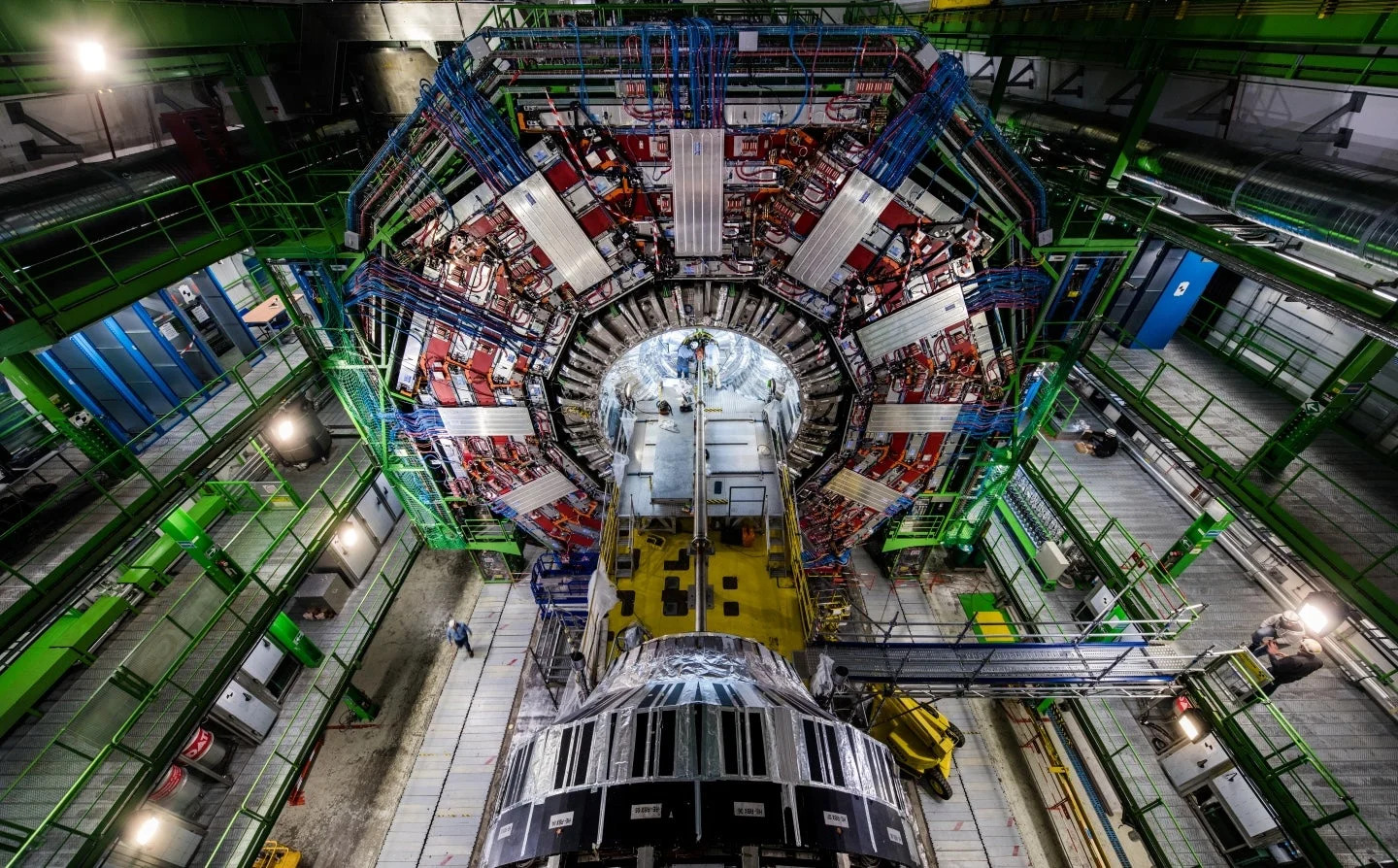
The 2022 measurement had been the most precise to date. The new measurement, however, nearly matches its precision—but agrees with the Standard Model. Leaders of the new study, which was conducted at the LHC’s Compact Muon Solenoid (CMS) experiment, say it reassures them that their basic understanding of the W boson is likely on track. “While it would have been thrilling to confirm the CDF result, what I really wanted was to publish a result that will stand the test of time,” says Massachusetts Institute of Technology physicist Kenneth Long, a co-author of the new study. “I think most physicists today will be placing their bets on the standard model, and I think our measurement is a big reason for that.”

The puzzle isn’t fully solved yet, though. “While I congratulate CMS on their valiant effort, any conclusions at this stage are certainly premature,” says Duke University physicist Ashutosh Kotwal, who co-authored the CDF analysis. “Clearly, both CDF and CMS cannot be correct.” The CDF team derived its mass measurement using six different methods and studied various ways the W boson might decay to smaller particles. “CMS, on the other hand, is just getting started, with their first publication containing only one of these six methods,” Kotwal says.

The Standard Model has been enormously successful in describing the world of fundamental particles, but scientists know it isn’t complete. It doesn’t include, for instance, the mysterious dark matter that physicists believe is ubiquitous in the cosmos or the dark energy that seems to be accelerating the universe’s expansion. If researchers can find a discrepancy between the model’s predictions and reality, it could point the way toward expanding the theory to more fully describe nature.

“I think we all expect the Standard Model to truly ‘break’ one day,” Long says. “But this measurement means that one of the more enticing (and striking) hints that the Standard Model wasn’t working now seems more like an experimental anomaly than a theoretical insufficiency. It means we have to keep looking harder and perhaps in different places to find these cracks.”

According to the LHC’s new measurement, the W boson weighs 80,360.2 ± 9.9 mega-electron-volts (MeV), roughly 160,000 times the mass of the electron, which has about 0.5 MeV. That figure is squarely within Standard Model’s predictions.

The LHC speeds up protons to nearly the speed of light and then crashes them together. The energy of the collision spawns many new particles, including—sometimes—W bosons. The experiment can’t measure W bosons directly because they disappear after only 10– 24 seconds of existence. But they often decay into a pair of particles called a neutrino and a muon (a heftier version of an electron).

The neutrino is nearly as elusive as the W boson, but CMS can study muons very precisely. By carefully measuring the energy and momentum of muons produced in about 100 million collisions thought to have created W bosons, the physicists arrived at their new mass estimate. The finding was published on April 8 in the journal Nature.