Press
Strait of Hormuz: How many ships are getting through?
Images
1 / 11

2 / 11
3 / 11
4 / 11
5 / 11

6 / 11

7 / 11
8 / 11

9 / 11
10 / 11

11 / 11
The Strait of Hormuz has become a focal point of the US-Israel war with Iran after Tehran effectively choked off one of the world's most important shipping lanes.

A two-week US-Iran ceasefire agreed on Tuesday included a condition that  "safe passage" through the narrow waterway would be guaranteed.

However, vessels in the area have received messages that they would be "targeted and destroyed" if they attempted to cross the strait without permission, and only a few ships have made the journey over the past three days.

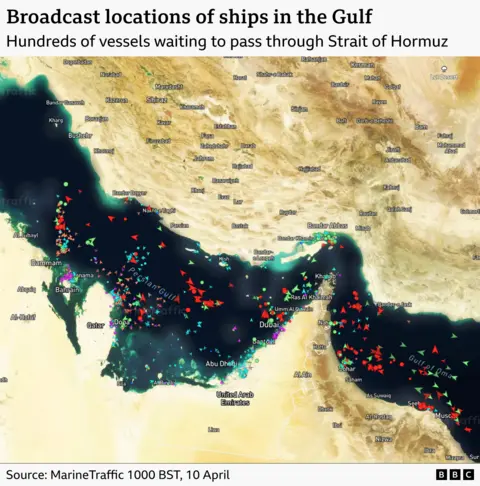
By 10:00 BST on 10 April only 15 ships had been tracked passing through the strait since the ceasefire.

Of these, four were tankers carrying either oil, gas or chemicals. The rest are listed as bulk carriers or container ships of various types.

That's based on BBC Verify analysis of ship-tracking data from MarineTraffic. Other ships have made the journey without broadcasting their location.

That compares to an average of 138 ships passing through the strait each day before the conflict started on 28 February.

The disruption to shipping since the conflict began five weeks ago has sent shock waves across the global economy, destabilising energy prices and exposing just how reliant international supply chains are on the channel that connects the Gulf with the Indian Ocean.

Shipping analysts say vessel owners will remain cautious about crossing the strait until the situation becomes clearer.

"Most shipping lines would want to get details and reassurances on what it actually takes to transit and those details are not available," Lars Jensen from Vespucci Maritime told the BBC.

Richard Meade, editor-in-chief of Lloyd's List says it has been a "very dangerous" time for ship owners who still face a huge amount of uncertainty.

"We know Iran is essentially still in control of the strait, and the assumption is that ship owners will still need to seek permission from the IRGC [Islamic Revolutionary Guard Corps]… and how that's going to work is still not clear."

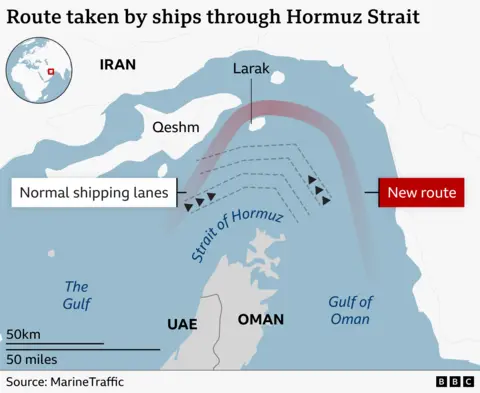
BBC Verify's analysis of the paths taken by the ships shows them taking a northern route through the strait close to Iran's coastline, within its territorial waters.

Prior to the conflict, vessels usually took a more southerly route through the middle of the waterway.

If crossings do resume at a greater pace, Meade expects stranded tankers that are fully loaded with cargo will be the priority.

"You've had nearly 800 ships stuck in there for several weeks. Most of them are now loaded with cargo so the priority is going to be to get them out."

The duration of the ceasefire - set to last two weeks - also brings uncertainty for ships, says Niels Rasmussen, a shipping analyst from BIMCO.

"I doubt there will be a large influx of ships into the Gulf… because they do not want to risk being trapped after the two-week window closes."

Another uncertainty is the possibility of sea mines, says Thomas Kazakos, secretary general of the International Chamber of Shipping.

"We need to make sure that we have clear confirmation that the safety of navigation for the ships and the seafarers are being agreed," he told BBC Verify.

On top of these concerns, ships face the uncertainty of possibly having to make payments to Iran in order to secure safe passage - following reports that tolls may be a part of the ceasefire deal.

"The Iranian negotiation position seems to be that you need to pay a toll to go through the strait and shipping lines will also be hesitant in going down the path of paying that toll," says Jensen.

Some countries - including India, Malaysia and the Philippines - have negotiated safe passage for their vessels in recent weeks.

But paying a toll could present an added complexity for other countries and shipping companies as payment "might actually be in violation of some of the US sanctions on Iran which would have other repercussions on shipping lines," adds Jensen.

Sanctions work by criminalising payments to individuals, companies and organisations, explains James Turner, a shipping lawyer from Quadrant Chambers.

He told BBC Verify that a sanction violation occurs when payment is made to anyone on the list, so paying a toll to them would be a violation unless the US makes an exception.

10 April: This piece is being updated to reflect the latest number of vessels crossing the strait since the ceasefire.

Additional reporting by Tamara Kovacevic

What claims do you want BBC Verify to investigate?

UK petrol prices have risen because of the US-Israel war with Iran but the ceasefire could see prices drop.

One of the world's most active volcanoes has been erupting on and off since December 2024.

She called rumours that Epstein introduced her to Donald Trump "mean-spirited attempts to defame my reputation".

Trump has given priority to Afrikaners, a white minority group he says is being persecuted. South Africa has objected to his characterisation.

The prime minister says "shocks" like the conflict in Iran are becoming more frequent.