Press
How small is the UK military?
Images
1 / 9

2 / 9
3 / 9

4 / 9
5 / 9
6 / 9

7 / 9

8 / 9
9 / 9
Lord Robertson, who led the government's recent Strategic Defence Review (SDR), is accusing it of putting the UK's security "in peril" and being unwilling to make the necessary investment.

The former Labour defence secretary and Nato secretary general is warning: "We cannot defend Britain with an ever-expanding welfare budget."

BBC Verify has been looking at the current size of the UK military.

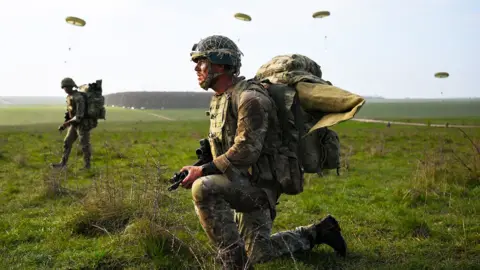
In 1990 - at the end of the Cold War - the army had 153,000 regular soldiers in its ranks, this is now down to 73,790.

The 2025 SDR recommended that the British Army's regular force should not drop below 73,000.

In its latest update, the Ministry of Defence (MoD) confirmed the number of people applying to enlist in the regular army had fallen by around 40% in 2025 compared to 2024.

Since 1990, the number of reservists has fallen from 76,000 to 25,770.

In 1990, the Royal Navy had 48 major combat ships (13 destroyers, 35 frigates).

That has dropped to 11 frigates and 6 destroyers.

There has been criticism of the Navy's readiness after it took weeks to deploy a single ship - HMS Dragon - to the Gulf to help protect an Royal Air Force (RAF) base in Cyprus.

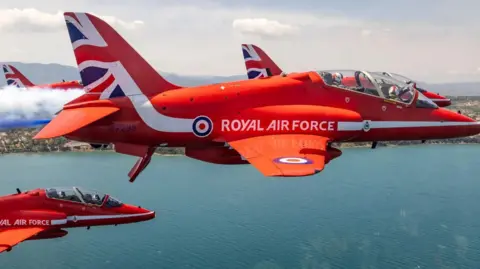
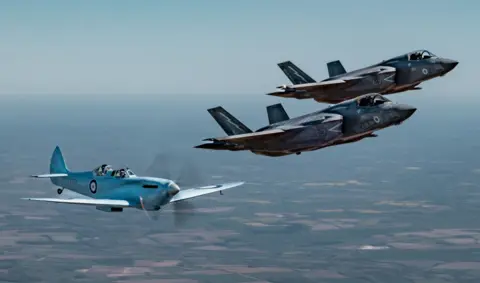
In 1990, the RAF had over 300 combat jets.

Now, with 137 Eurofighter Typhoons and at least 37 Joint Strike Fighter F-35 Lightning II in service, it has far fewer, though they are technically superior.

Uncrewed aircraft systems, also known as drones, now form an element of the UK's military air capabilities. These did not exist in 1990.

The threat from drones has been highlighted in the Ukraine conflict where they now kill more people than traditional artillery.

Analysts say the UK needs to invest considerably more in this military technology.

Responding to the criticisms from Lord Robertson, the government said it is planning "the largest sustained increase in defence spending since the Cold War".

But that is a low bar because defence spending has been on an almost constant downward path since the fall of the Berlin Wall.

The government is currently planning to commit 2.5% of GDP to Nato-qualifying defence spending by April 2027, with an "ambition" to spend 3% of GDP in the next Parliament.

One of Lord Robertson's specific criticisms is the level of spending on defence when compared with welfare spending.

Spending on working-age benefits was lower than on defence in the mid 1980s - but now it's more - and is projected to rise to around 4.3% of GDP by the end of the decade, pushed up, in part, by rising claims for things like Personal Independence Payments (PIP).

While there is some evidence that a rising number of people suffering from mental health conditions have contributed to the increase in PIP claims, independent researchers remain uncertain about the exact causes behind the upward trend.

In addition to the "ambition" to spend 3% of GDP on defence during the next Parliament, the UK has committed to a Nato target to spend 5% of GDP on "national security" by 2035.

The government has said this would be made up of 3.5% of GDP on "core defence" and another 1.5% of GDP going on things like protecting critical infrastructure and ensuring civil preparedness.

Only three countries: Poland, Lithuania and Latvia, spent more than 3.5% of their GDP on defence in 2025, although Estonia and Norway were close.

The UK's spending of 2.3% of GDP in 2025 put it just above the mid-point of spending by Nato members, according to figures from the military alliance.

The MoD has some of the largest procurement projects in government, accounting for 47 of the 213 Government Major Projects Portfolio (GMPP) in 2024-25.

In December, the National Audit Office (NAO) published an overview of its performance and said progress on 12 of those projects was rated 'Red', meaning that their successful delivery "appears to be unachievable".

And the NAO added: "Over many years, the MoD has regularly experienced difficulties delivering many of its projects to required performance, cost and time".

In addition, the NAO report was critical of the MoD's administration, noting that for projects valued above £20 million it currently takes the MoD an average of six and a half years to award a contract.

The 2025 SDR recommended a new "segmented approach" to MoD defence procurement to deliver contracts within two years.

Military analysts cite the rising threat from Russia since 2022, the current war in the Middle East and questions over the future of the US in Nato as powerful reasons for the UK to spend more on national defence.

General Sir Richard Barrons - one of the authors of the SDR in 2025 - told the BBC: "We've now entered a very new era in global affairs, with much greater risk but we're entering it with the armed forces we were left with for a much more comfortable, peaceful time."

A government spokesperson said: "We are delivering on the Strategic Defence Review to meet the threats we face."

"It is backed by the largest sustained increase in defence spending since the Cold War, with a total of over £270bn being invested across this Parliament."

Although the SDR was delivered in June last year, the 10-year defence investment plan to fund it has been repeatedly delayed.

Additional reporting by Gerry Georgieva

What claims do you want BBC Verify to investigate?

Lord George Robertson, a former Labour defence secretary, will use a speech to accuse "non-military experts in the Treasury" of "vandalism".

The Royal Air Force acrobatic team will perform over Douglas bay on 4 June during Isle of Man TT.

Duncan MacFarlane was carrying the bible in his breast pocket when he was shot during WW1.

L/Cpl Ryan Rudd was not reported missing until two weeks after he was last seen in Selby.

Aircraft from the Battle of Britain Memorial Flight take part in a commemorative flypast.