huffpost Press
Supreme Court Seems Split On Whether To Give Trump Huge Immigration Win
Images
1 / 7

2 / 7
3 / 7

4 / 7

5 / 7

6 / 7

7 / 7
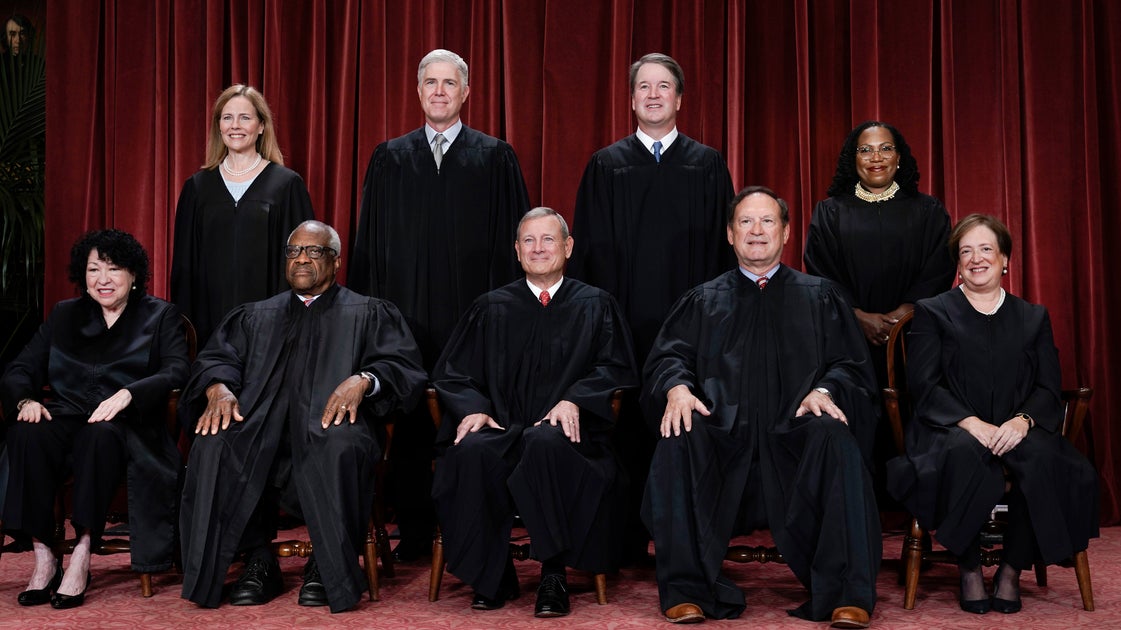
President Donald Trump’s quest to expand his deportation agenda — and the unilateral authority of his administration — was met with intense questioning Wednesday as the Supreme Court heard arguments on whether the administration should be allowed to rip away temporary protected status from hundreds of thousands of immigrants legally living in the U.S.

The combination cases, Mullin v. Dahlia Doe and Trump v. Fritz Emmanuel Lesly Miot, center on the Trump administration’s bid to end temporary protected status, or TPS, for Haitians and Syrians, including whether former Department of Homeland Security Secretary Kristi Noem adhered to laws requiring a clear consultation process to remove the protections.

During arguments, conservative and liberal justices seemed evenly split on whether Noem acted lawfully when she moved to cancel TPS status for immigrants from the two nations.

Though Solicitor General John Sauer claimed Wednesday that “there is no judicial review” of Noem’s decisions, several of the justices, including Justices Elena Kagan, Sonia Sotomayor and Ketanji Brown Jackson, seemed dubious of the claim.

“The judicial review bar is a broad one, but it means something,” Kagan said.

The conservative justices, meanwhile, seemed more interested in the technicalities of the law and legal proceedings.

Justice Samuel Alito at one point suggested that opening the door to objections over the consultation process would be a slippery slope that could end up undermining oversight.

“Once you say it’s permissible to review the adequacy of the consultation, it’s always going to be possible to raise objections to the adequacy of the consultation and the words that the State Department comes back with,” he said to Ahilan Arulanantham, who argued on behalf of TPS-holders.

“[Consultation] has to be about a subject,” Arulanantham replied. “They have to talk about country conditions.”

TPS covers individuals who cannot stay in their home country because of violence, war or other conflict that the Department of Homeland Security certifies as being both extraordinary and temporary. With TPS status, these noncitizens can stay in the U.S., work, go to school, buy or rent property, and otherwise live as ordinary citizens, but the status is not a pathway to citizenship or considered permanent residency. Just 17 countries have been granted TPS status in the U.S., but Noem removed the protections for 13 of them. (The Supreme Court already agreed last October to strip TPS from over 300,000 Venezuelans.)

Both Haiti and Syria are still very dangerous, according to the U.S. State Department. Syria is still entrenched in a humanitarian crisis, and Israel is lobbing bombs into the country. Notably, Trump agreed to extend TPS in Syria during his first term because of the ongoing war there. Today, the State Department has issued a “Level 4 - no travel” advisory for Syria because of “terrorism, civil unrest, kidnapping, hostage taking, and armed conflict.”

Haiti, meanwhile, hasn’t held a presidential election in over a decade. According to the United Nations, since an uprising in 2024, violence steadily proliferated as armed gangs took control of territories both inside and outside of the nation’s capital of Port-au-Prince. Like Syria, the State Department has also slapped Haiti with a “Level 4 - no travel” advisory.

There are some 350,000 Haitians and 6,000 Syrians in the United States who would be directly impacted by the ruling. However, a ruling for the administration could also affect the other 1.2 million people in the U.S. who have TPS by opening the door for the administration to more easily revoke protections for people of other nationalities. Trump has pledged since at least 2024 to eliminate the program altogether.

Under federal code for the TPS statute, the Department of Homeland Security can end TPS for a country, but only after consultation with various government agencies. And if DHS does not publish a notice about terminating the country’s status at least 60 days before that protection is set to expire, then TPS recipients automatically are allowed to stay in the U.S. for another six months.

District court judges have so far barred attempts to unwind TPS programs for Syria and Haiti, leaving the protections in place as the question made its way to the Supreme Court. In those instances, judges found the U.S. government likely violated the Administrative Procedure Act, which forbids officials like Noem from arbitrarily canceling programs without consultation.

Arulanantham said that TPS holders and their advocates were not claiming the secretary has zero authority to make removal decisions, but that there are built-in statutory checks and balances to consider.

“The secretary can terminate TPS, but she must turn square corners and follow the rules that Congress set,” Arulanantham said in the arguments.

In this instance, Arulanantham argues, Noem “failed to follow the steps” that require the secretary to consult with agencies as she makes a determination.

“What is reviewable is whether she actually asks anything and gets any information about these countries,” Arulanantham said.

And while it might be hard generally to discern the intent or process behind a federal official’s decision-making, this case was unique, he added.

“This was an outlier case where the secretary said live on television she was motivated by an impermissible factor,” Arulanantham.

Noem has referred to immigrants generally as “killers and leeches and entitlement junkies” when discussing travel bans. TPS-holder lawyers say that was part of the administration expressing its racial animus aloud and showing what really motivated its decision-making around TPS.

When the Miot case was before Judge Ana Reyes in Washington, D.C., in February, Reyes found that Noem’s remark was protected by the First Amendment, but noted that she was “constrained by both our Constitution and the APA to apply faithfully the facts to the law in implementing the TPS program.”

“The record to-date shows she has yet to do that,” Reyes wrote.

At arguments, Justice Brett Kavanaugh suggested that conditions in Syria had improved and this alone may be reason enough for Noem to determine TPS status could be revoked. But that, Arulanatham said, doesn’t ultimately matter because Noem was still required to make meaningful consultations with other agencies and she did not.

Sauer suggested there was a wide berth for Noem’s decision-making. She could have made a determination that “there is no appropriate agencies to consult” and that would have been perfectly permissible, and would not be subject to judicial review.

Justice Jackson asked him to consider a hypothetical: What if Noem “pulled out a Ouija board,” she said, to help her decide how to remove TPS protections for Syria or Haiti. Or what if she put a few slips of paper in a hat and drew out a country’s name that way?

“That’s not following statutory steps. She’s made a determination to do that. And your opinion would be, no judicial review?” Jackson said.

The Supreme Court’s decision could take months to surface, or they could rule as soon as the session ends in June. Since justices were only asked to focus on jurisdictional and judicial power questions around the TPS provision this time, there will still be questions yet to come in the courts about racial animus and possible violations of equal protection laws.

Meghan Haputman, staff attorney for the International Refugee Assistance Project and co-counsel in the Syria case, said it’s “hard to know” how the court will rule. But the ruling has the potential to upend lives.

“If they find there is jurisdiction, and courts have power to review TPS decision-making, that will mean all other cases in litigation are able to continue,” she said. “If they rule partially for us and partially for the government, that may impact what kinds of claims can keep on going forward in other cases. It’s hard to know how it will play out because there’s so many similarities and overlaps in these cases.”

“Syria is not the first nor is it the last to have TPS attacked,” Haputman said. “The administration won’t end their effort if the court gives them the greenlight to run roughshod over our laws.”

This is a developing story. Please check back for updates.

By entering your email and clicking Sign Up, you're agreeing to let us send you customized marketing messages about us and our advertising partners. You are also agreeing to our Terms of Service and Privacy Policy.