Press
Bank of England says rates could rise as Iran war fuels inflation
Images

1 / 11

2 / 11

3 / 11
4 / 11

5 / 11

6 / 11

7 / 11
8 / 11

9 / 11
10 / 11
11 / 11
The Bank of England has signalled that interest rates could rise this year as it attempts to curb inflation following a "significant energy price shock" from the Iran war.

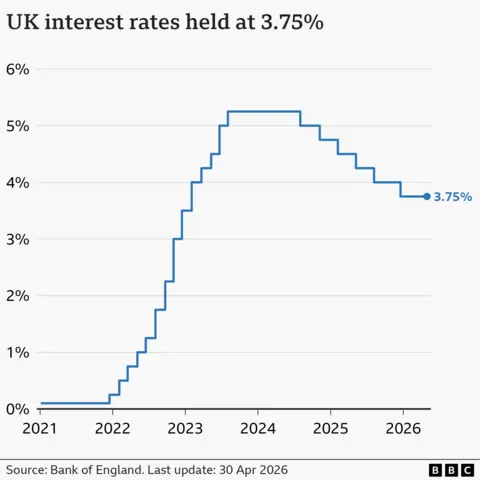
Most of the Bank's rate-setters voted to keep borrowing costs at 3.75% in April, but indicated they would act "forcefully" should oil prices hit a peak of $130 a barrel and remain high for a number of months.

The price of oil hit $126 on Thursday - the highest for four years -following reports the US may resume attacks on Iran.

The governor of the Bank of England, Andrew Bailey, told the BBC the jump in  energy prices since the conflict started had been "a very big shock" and warned of the impact on lower-income households.

"Inflation is bad for everybody, but it's particularly bad for the least well off," he said.

"Things like energy and food are a much bigger proportion of spending by those on lower incomes. So this is a difficult situation," he added.

The rate of inflation, which measures the pace of price rises, rose to 3.3% in the year to March, further away from the Bank of England's target.

As a result of the "uncertainty around the severity and duration" of the war, the Bank considered a range of scenarios to determine how it will react in the coming months.

The Bank did not give probabilities as to how likely each scenario was. However,  governor Bailey said he placed more weight on scenario B.

He acknowledged a more "benign" scenario could be possible, where interest rates would continue to be held rather than increased, should the situation in Iran resolve more quickly.

"Our job is to chart the best course we can through it," he told the BBC.

"We have flexibility to manage inflation and activity in the economy. We will use that flexibility to the best of our ability."

When inflation is above its target, the Bank typically puts interest rates up. The idea is to encourage people to spend less, reducing demand for goods and services and limiting price rises.

However, this can affect growth, and the Bank expects this to be lacklustre this year – expanding by 0.8% in the best case or by 0.7% if conditions worsen.

Huw Pill, the Bank's chief economist, was the only member of the Bank's nine-member Monetary Policy Committee to vote for a rate rise this month. Other members said the Bank should wait to see the extent of the inflationary shock.

Ruth Gregory, deputy chief UK economist for Capital Economics, said the Bank of England's comments suggested "the chances of near-term rate hikes are rising".

She said that if oil prices fall back to around $95 a barrel, "our best guess is still that rates will remain unchanged this year".

"But one or two hikes in the coming months are certainly possible, especially if [oil] prices remain around $115 per barrel, or rise even further."

The sharp jump in the price of oil since the start of the Iran war has already pushed up the price of petrol and diesel for motorists.

But the potential impact goes beyond fuel. The government has warned people could face higher energy, food and flight ticket prices as a result of the war.

Energy bills are expected to rise when the current price cap is revised at the beginning of July.

The upheaval created by the war in Iran has also increased the cost of mortgages for homeowners getting a new fixed deal.

In its report, the Bank said that over the next three years, average payments for those moving to a new mortgage deal are expected to rise by about  £80 a month.

About 53% of mortgage holders are expected to see payments rise, the Bank said.

In response to the Bank's latest rate decision, Chancellor Rachel Reeves said:  "The war in the Middle East is not our war, but it is one we have to respond to.

"Every choice I make will be about keeping costs down for families and businesses, without repeating the mistakes we've seen in the past that resulted in higher inflation and higher interest rates."

Shadow chancellor Mel Stride said Reeves had "weakened" the UK economy, and  "left us vulnerable in the run up to the latest energy crisis".

"The conflict in the Middle East is pushing up prices - but the UK already had the highest inflation in the G7 thanks to Labour's choices," he wrote on X.

Get our flagship newsletter with all the headlines you need to start the day. Sign up here.

The Bank's latest meeting reveals some interesting details on how our finances might be affected due to the Iran war.

The Bank tries to manage expectations over what outcomes are plausible if the Middle East conflict lasts several months.

The war in Iran has pushed UK Inflation further above the Bank of England's 2% target.

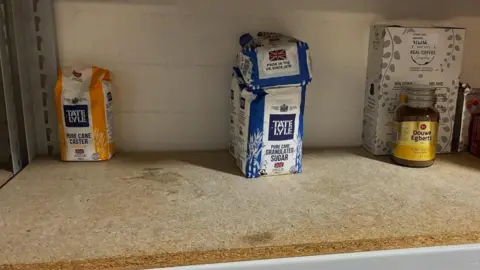
Guernsey Welfare Service says demand has grown and it could increase further.

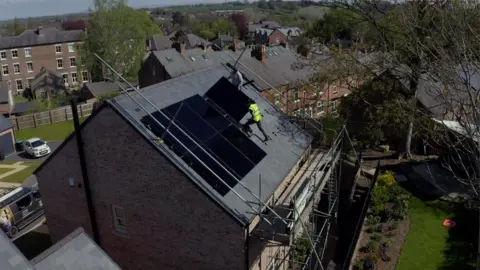
Yorkshire installers report up to a tenfold increase in interest since the start of the Iran war.