Press
West Bengal: Modi's BJP conquers one of India's toughest political frontiers
Images
1 / 13

2 / 13
3 / 13
4 / 13
5 / 13
6 / 13
7 / 13
8 / 13

9 / 13

10 / 13

11 / 13

12 / 13
13 / 13
For years, India's West Bengal state was the great exception to Narendra Modi's political advance.

His Bharatiya Janata Party (BJP) had swept through India's Hindi-speaking heartland, expanded into the west and north-east, and overwhelmed once-formidable regional rivals. Yet Bengal - argumentative and steeped in a self-image of cultural exceptionalism - remained stubbornly resistant.

That made this state election unusually consequential. With more than 100 million people, West Bengal's electorate is larger than Germany's, turning its election into something closer to a nation choosing a government than a routine Indian state poll.

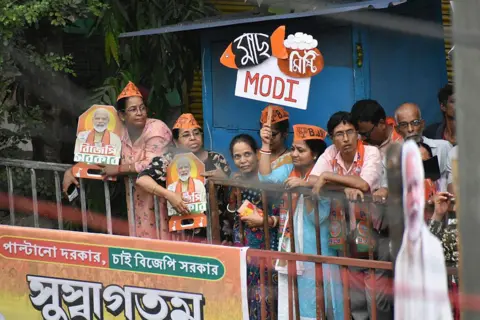
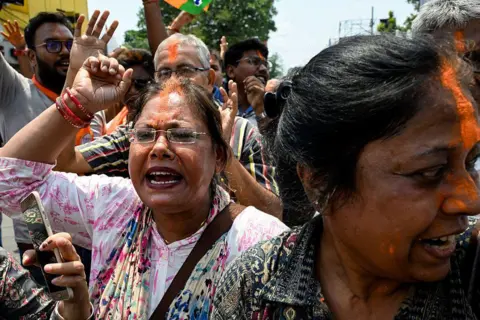
Monday's BJP victory there would rank among the most significant breakthroughs of Modi's 12-year reign. It is not merely the defeat of a three-term incumbent, but the completion of the party's long march into eastern India.

"Winning Bengal is a big victory for the BJP - a land of promise that has long eluded its grasp," says author and journalist Nilanjan Mukhopadhyay.

Monday produced an extraordinary political churn across India's south as well.

In Tamil Nadu, MK Stalin's DMK government was swept aside by actor-turned-politician Vijay and his fledgling TVK party, marking the dramatic return of film-star politics to the state.

In Kerala, the Congress-led United Democratic Front (UDF) defeated the Left Democratic Front (LDF) after two consecutive terms, ending the last remaining Communist-led state government in India. Only in Assam did the BJP buck the broader anti-incumbent tide and retain power, while the party and its allies also held on to the federal territory of Puducherry.

Yet nowhere were the results more politically significant than in Bengal.

The state has seen only one change of government in nearly half a century: the Communist Left Front ruled for 34 years before the Trinamool Congress (TMC), led by the firebrand populist Mamata Banerjee, dominated the next 15 years until now. Political scientists have long described Bengal as a system that favours "hegemonic" parties.

Analysts see the outcome not as a sudden upheaval but as the culmination of a decade-long political project. Unlike the BJP's rapid rise in Tripura or its earlier breakthrough in Assam, Bengal was never a lightning conquest.

"The BJP has been a major force in Bengal for three successive elections, consistently polling around 39% of the popular vote," says Rahul Verma, who teaches politics at Shiv Nadar Law School.

Once it established itself near the 39-40% mark, he argues, "the party really needed only another 5-6% to cross the line". Voting trends show the BJP mopping up more than 44% of the vote this time.

What makes the result particularly striking is that the BJP achieved this despite still lacking the kind of deep organisational machinery that regional parties historically required to win Bengal.

The Trinamool Congress retained a denser grassroots network and the charismatic dominance of Banerjee. Yet the BJP repeatedly sustained a commanding vote share despite allegations of rival political intimidation and the challenge of taking on one of India's most entrenched regional parties.

"That suggests," Verma says, "the party's support now extends beyond the limits of its relatively thin organisational structure."

So what shifted the election so sharply towards the BJP?

For years, Banerjee's party forged a formidable social coalition: women, Muslims and large sections of the Hindu vote across both rural and urban Bengal.

Women, in particular, formed the backbone of the party's welfare-driven politics. The Lokniti-CSDS post-poll survey in 2021 found the TMC's support among women touching 50% -  four percentage points higher than among men - reflecting the impact of years of female-focused welfare schemes and Banerjee's efforts to expand women's political representation.

This time, however, the BJP sought to directly challenge that advantage by promising larger cash transfers and expanded welfare benefits of its own.

"Banerjee's long electoral success rested on a delicate equilibrium between welfare and organisation. But the very organisation that sustained her for 15 years also became her Achilles' heel," says political scientist Bhanu Joshi.

"That balance broke down as the party machinery weakened and welfare politics appeared to reach its limits - voters began to see benefits as routine rather than transformative.

"The BJP's opening was to translate this anti-TMC fatigue into a sharper language of Hindu consolidation. So this is not simply a story of welfare failing; it is a story of welfare and organisation no longer being strong enough to contain polarisation," says Joshi.

The election also once again highlighted the centrality of Muslim voters to Bengal's political arithmetic, even if the precise contours of voting patterns remain unclear.

Muslims make up roughly 27% of the population, and nearly a third of the state's seats have substantial Muslim populations.

In 2021, the TMC swept 84 of 88 Muslim-dominated seats, reflecting a broad consolidation behind Banerjee. While early indications suggest the party retained significant Muslim support this time too, the BJP has increasingly sought to offset that advantage through wider Hindu consolidation and competing welfare promises.

"The BJP combined an aggressive welfare pitch with sharper polarisation. It promised to double cash benefits, while visible communalisation consolidated sections of the Bengali Hindu vote behind the party," says Maidul Islam, a political scientist at Kolkata's Centre for Studies in Social Sciences.

BJP leaders, however, framed the result less as ideological consolidation than as a rejection of the Trinamool Congress itself.

The TMC created a "crisis of leadership for itself," BJP leader Dharmendra Pradhan told one news network. He accused the party of "arrogance" and claimed that "voters, particularly women angered by atrocities and law-and-order failures, had decisively rejected the Trinamool Congress".

The other elephant in the room was the fiercely contested revision of Bengal's electoral rolls.

The Election Commission said the exercise, known as the special intensive revision, was intended to clean up voter lists by removing duplicate or ineligible names.

But with nearly three million voters still awaiting tribunal decisions before polling, Banerjee along with activists and civil society groups alleged that Bengal had effectively gone into the election after a "mass disenfranchisement exercise". This, they said, had disproportionately affecting poor and minority voters, especially Muslims and migrant communities in border districts.

Analysts say the exercise is now likely to come under even sharper scrutiny in closely fought seats where victory margins are much narrower than the number of deleted voters. "The revision of polls will come into play [once the results are in]," politician and activist Yogendra Yadav told NDTV news network.

But the electoral-roll controversy alone cannot explain the scale of the BJP's surge, many believe.

What also worked in the party's favour was a tightly focused campaign centred on alleged corruption and governance failures within the Trinamool Congress, hammering scandals such as a teachers' recruitment scam rather than relying primarily on personal attacks against Banerjee.

With the BJP firmly on course for victory, the implications will extend far beyond Bengal.

Unlike in neighbouring Bihar, where the party governs through alliances, or even Odisha, where its 2024 breakthrough came against a weakened regional incumbent, a victory in Bengal would represent a standalone conquest of one of India's most politically formidable states.

"It would strengthen Modi enormously," says Mukhopadhyay.

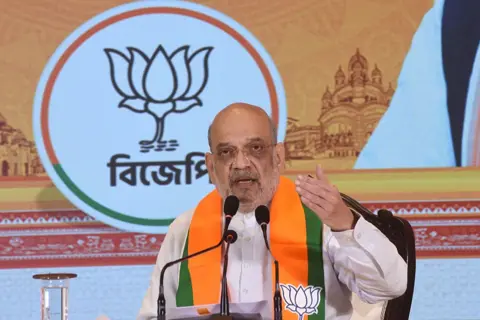
"More than Odisha, this would be seen as a personal political victory not only for Narendra Modi, but also for Home Minister Amit Shah, who effectively ran the campaign."

Within the BJP, Shah would almost certainly emerge as the informal "man of the match" - echoing the way Modi elevated him after the party's landmark victory in Uttar Pradesh in 2014.

A Bengal breakthrough could also reshape the BJP's succession politics, says Mukhopadhyay.

It would reinforce Shah's standing as Modi's most likely heir, potentially placing him ahead of rivals such as Yogi Adityanath, Nitin Gadkari and Rajnath Singh in the party's next-generation power hierarchy.

That would make Bengal's verdict consequential far beyond the state itself.

For decades, Bengal prided itself on resisting the political currents reshaping the rest of India.

Now that the BJP has finally breached one of India's most enduring regional strongholds, it may mark not just the end of an era in Bengal, but the beginning of a new phase in the Modi project itself.

A new study reveals a decline in dragonfly and damselfly species in India's Western Ghats.

Some of India's biggest producers are eyeing investments in micro-dramas, which are now hugely popular.

The astrolabe - or astronomical computer - is possibly the largest in existence and had never been exhibited before.

New York's mayor made the comments hours before meeting King Charles, but it's unclear if he brought up the diamond.

The RBI is mulling measures to tackle rising cases of digital fraud in India - but will they work?