yahoo Press
Opinion - After the Trump-Xi summit, China, not America, is on the back foot
Images
1 / 6

2 / 6

3 / 6
4 / 6

5 / 6

6 / 6
The Chinese Communist Party has been tirelessly promoting a narrative to non-Western populations: First, the U.S. is in decline; second, China’s rise and dominance are assured; and third, the eclipse of the West is inevitable.

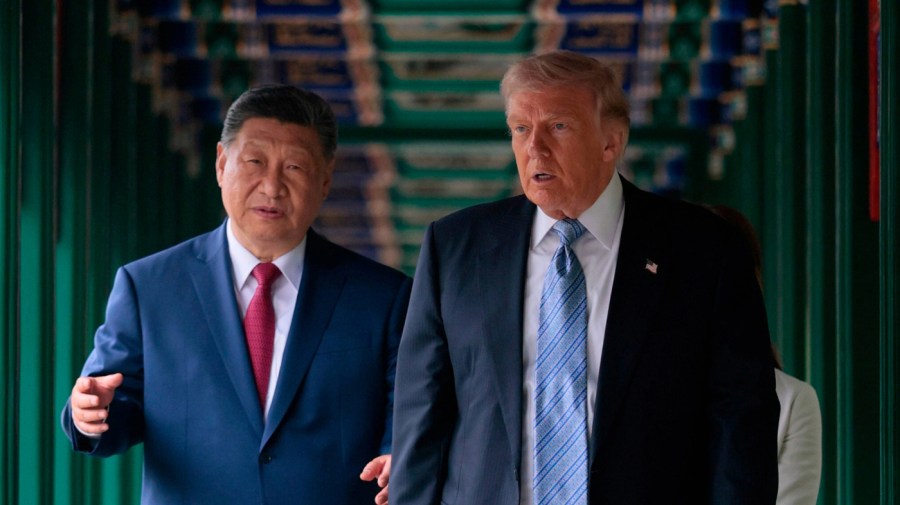
As Xi Jinping met with President Trump this week, the Chinese leader wanted the meeting to appear as though a fading and resentful U.S. is continuing to pass the torch to an ascendant and magnanimous China.

Some Americans were nervous about what Trump, preoccupied with the Iran war, might have carelessly conceded in Beijing, even if no grand bargain was on the table. But a desperate Xi was even more anxious as he confronted growing domestic criticism for his overreach and heavy-handed mishandling of his country’s politics and the economy.

This is because Trump has inadvertently but effectively disrupted China’s carefully crafted script about American impotence and irrelevance. China, rather than the U.S., is on the back foot.

To advance its narrative, Beijing weaponizes history and claims to be a victim of the West. Its historical perspective can be convincing because it mixes elements of truth with substantial falsehoods and misrepresentations. It begins with the so-called century of humiliation at the hands of Western and Japanese powers from the mid-1800s onward, followed by the Chinese Communist Party’s sacred mission to return China to greatness and preeminence.

Xi’s notion of Chinese rejuvenation feeds on this narrative. According to his framing, the end of the Second World War left the world in an unnatural state. By historical accident, America became the dominant power. From this position, the U.S. cleverly built and supported institutions that gave it an unmatched global role and relevance.

In particular, the Bretton Woods system established a new international monetary regime underpinned by the U.S. dollar, and organizations such as the International Monetary Fund and World Bank regulated finance and development. Western Europe and a select coterie of Asian allies — such as Japan, South Korea and Taiwan — were privileged beneficiaries.

For Xi, history is simply reverting to its natural state, with a push from the Chinese Communist Party. Beijing does not deny that it benefited from these Bretton Woods institutions, especially after its accession to the World Trade Organization in 2001.

But Xi claims that China is changing these institutions from within. Beijing is successfully challenging the West and making the global system fairer so that non-Western have-nots can prosper. Dealing with Washington and gradually surpassing America in power and influence are the all-important steps that will rejuvenate China so that it can supposedly help others escape and transcend the Western-built global system.

While promoting this narrative, Beijing believed it was making a compelling case for China to increase its strength and superiority — all at America’s expense. According to Beijing, we are living through great changes unseen in a century, as Xi has said several times, and the nation with the greater industrial, manufacturing and technological ability will win the economic and geopolitical contest. In this competition, Xi believes China can boast due to its superior performance.

To be sure, China has prospered by cynically gaming the global economic system. It was gaining influence in global energy markets that Western allies traditionally dominated. It was gaining ground in traditional American strongholds in Asia, the Middle East and even Latin America. China’s axis partners, such as Russia, Iran and North Korea, were preparing for war, intimidating their neighbors and creating enormous problems for America and its allies.

Meanwhile, U.S. allies were refusing to take their own security seriously and spent ever-more on bloated welfare systems. In short, the American-made world was in trouble. It was being outspent, outmaneuvered, outthought and outplayed.

This is the record according to Xi, if his pronouncements about imminent Chinese ascendancy are anything to go by. But Trump has disrupted Beijing’s strategy.

Xi did not anticipate the extent to which Trump has been willing to defy convention, take huge risks and break things to reverse all these pillars of growing Chinese advantage. Not all of Trump’s recent decisions have been about China, but China nevertheless finds itself in a worse strategic position because of them.

Xi confronted a difficult environment during his meeting with Trump. The U.S. and its allies in Europe and Asia are rearming. Washington and Israel are now calling the shots in the Middle East at China’s and Russia’s expense. Beijing’s influence in Latin America is greatly diminished. Meanwhile, America is reindustrializing and resetting a trading relationship that had benefited China illegitimately and disproportionately.

Trump, or his successors, may eventually find that the cost of disruption and breakage is far greater than anticipated. It is also too early to claim that Trump has truly reversed the structural trends and advantages China has spent decades building. But it is undeniable that Xi is experiencing an unexpected loss of control and agency.

Following the meeting with Trump, the pathway to dominance is far less assured than the Chinese leader believed not long ago.

John Lee, Ph.D. is a senior fellow at the Hudson Institute in Washington, D.C. He is a former national security adviser to the Australian government.

Copyright 2026 Nexstar Media, Inc. All rights reserved. This material may not be published, broadcast, rewritten, or redistributed.

For the latest news, weather, sports, and streaming video, head to The Hill.