huffpost Press
Trump's 1 A.M. Advice Perfectly Demonstrates How NOT To Talk To People Who Are Freaked Out
Images
1 / 9

2 / 9

3 / 9
4 / 9

5 / 9

6 / 9

7 / 9

8 / 9

9 / 9
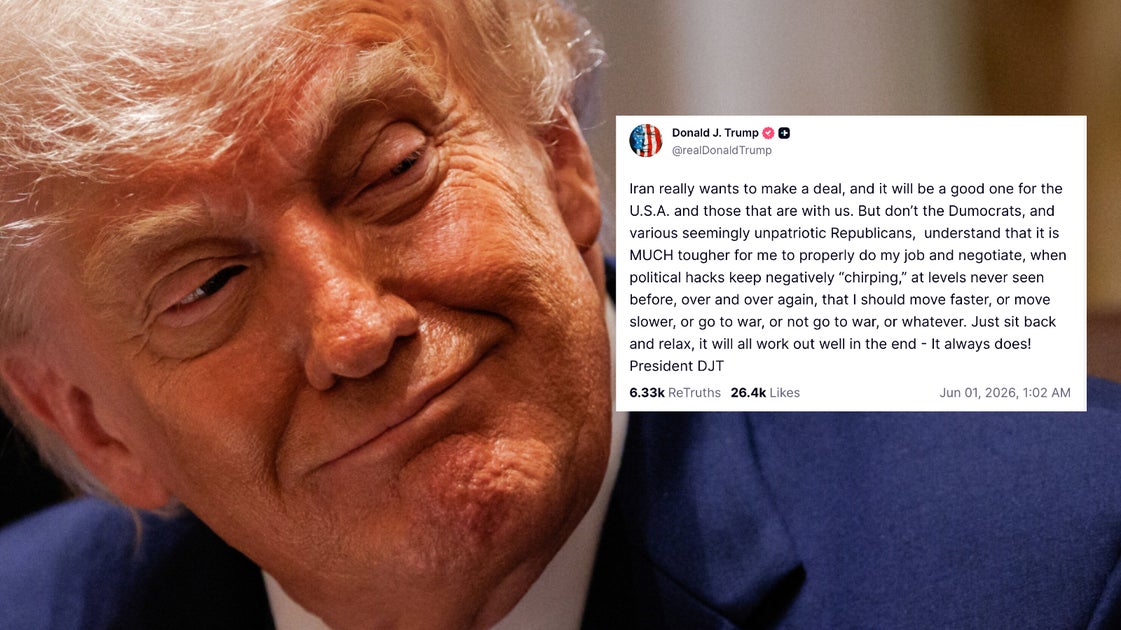
Monday morning started off with a wee-hours Truth Social pep talk from the president, where he dismissed the “chirping” of dissent and urged Americans to “just sit back and relax” amid increasingly stressful circumstances surrounding the Iran war.

“Iran really wants to make a deal, and it will be a good one for the U.S.A. and those that are with us,” per the president’s 1 a.m. post. “But don’t the Dumocrats, and various seemingly unpatriotic Republicans, understand that it is MUCH tougher for me to properly do my job and negotiate, when political hacks keep negatively ‘chirping,’ at levels never seen before, over and over again, that I should move faster, or move slower, or go to war, or not go to war, or whatever.”

“Just sit back and relax,” he continued. “It will all work out well in the end - It always does! President DJT.”

You feeling reassured yet? As any person who has ever been told to “calm down” or “relax” while feeling intense fear, stress or anxiety can tell you, it’s not all that likely.

“When people are stressed out or dysregulated, phrases like ‘just relax,’ ‘calm down,’ or ‘it’ll all work out’ are often intended to be reassuring to someone,” Kristen Gingrich (@notyouraveragethrpst), a licensed clinical social worker in Maine, told HuffPost. “However, they don’t always have that effect because they can unintentionally communicate that the person’s emotional reaction is the problem rather than the situation causing the distress in the first place.”

“No, ‘relax’ has never relaxed anyone,” Ryan Martin, a psychology professor also known as the Anger Professor, previously said on the “Am I Doing It Wrong?” podcast.

And even the most well-meaning requests for calm can land badly when emotions are high.

Martin went on to explain that when “people are elevated and they’re not necessarily thinking as rationally ... they’re a little defensive. You’re not going to make as much progress with those sort of direct statements that you want to make,” he added. “Telling people to do things like ‘just breathe’ aren’t going to have much of an impact.”

Gingrich explains that being told how to feel (to relax, to be calm) or that the thing they are worried about isn’t important, can be counter to what a stressed-out person is really looking for from the exchange.

These kind of comments will have the opposite effect: “When someone is anxious, overwhelmed, angry or scared, they are often looking first for understanding and acknowledgment,” she said. “Usually when someone feels dismissed, minimized or misunderstood, their reactions usually actually increase.”

So if the goal really is to quell the “chirping,” Trump might’ve miscalculated just a bit.

“Instead of feeling supported, they may feel pressured to justify why they’re upset in the first place,” Gingrich said. “This is one reason why using a phrase like ‘calm down’ can sometimes make someone more upset. The statement may be interpreted as, ‘you’re overreacting,’ or ‘your feelings are too much,’ even when that is not the person’s intention.”

Let’s say, hypothetically, people are upset about something you did, a series of decisions you made that are leading to very serious consequences for them. They voice those consequences.

Would you tell them to “sit back and relax” and stop chirping?

The increased stress and increased dysregulation “can become even more noticeable when the person saying ‘calm down’ is also the source of the stress for the person or that person is not going to experience the consequences from the situation at hand,” Gingrich noted.

“In those situations, the message may feel less like comfort and more like a dismissal of the underlying issue at hand. The distressed person may hear, ‘The problem isn’t what happened, it’s your reaction to it.’ That perception can understandably escalate emotions rather than deescalate them.”

If you’re in your own situation where you’re speaking to someone who is deeply distressed about something with serious consequences they’re going to experience, there are better ways of going about it.

“A more effective response might be, ‘I can see why you’re upset,’ or ‘this sounds really overwhelming,’” Gingrich said.

“Rather than saying something like, ‘Don’t worry, it’ll all work out,’ it may be more helpful and supportive to say, ‘I can understand why this feels stressful,’ or ‘tell me more about what’s worrying you.’”

Ultimately, attempting to force a solve of the issue without addressing the feelings or “reassuring away” big negative emotions can be far less helpful than you’d think.

“Most people don’t enjoy watching people become upset and want to help to calm them down or to help fix the situation,” Gringrich said. “But more often than not, people don’t need someone to immediately solve the issue, most of the time even people can still see some of the logic in the situation, but they are still having feelings. They need someone willing to sit with them in the reality of what they’re experiencing and communicate, ‘I understand why this feels hard.’”

And more often than not, the most effective things you can say are really simple like “that makes sense” or “I’d probably feel stressed too” — things that affirm the ways you recognize someone’s concerns and their rationale for having them.

And, here’s the gag: You don’t even need to agree with them about the full situation or even the core premise of what they’re upset about.

“Validation does not mean agreeing with every thought or conclusion that person has, it simply means acknowledging that the persons feelings make sense given what they are experiencing,” Gingrinch said.

“One of the biggest misconceptions about providing validation is that it will somehow make emotions worse,” she continued. “In reality, people often become calmer when they feel genuinely understood and heard by someone.”

This is all maybe a little more useful for learning some basic social skills and navigating squabbles between friends and family, but the POTUS could certainly take note, too.

By entering your email and clicking Sign Up, you're agreeing to let us send you customized marketing messages about us and our advertising partners. You are also agreeing to our Terms of Service and Privacy Policy.