The Great Flock Hunt
Photo record
14 images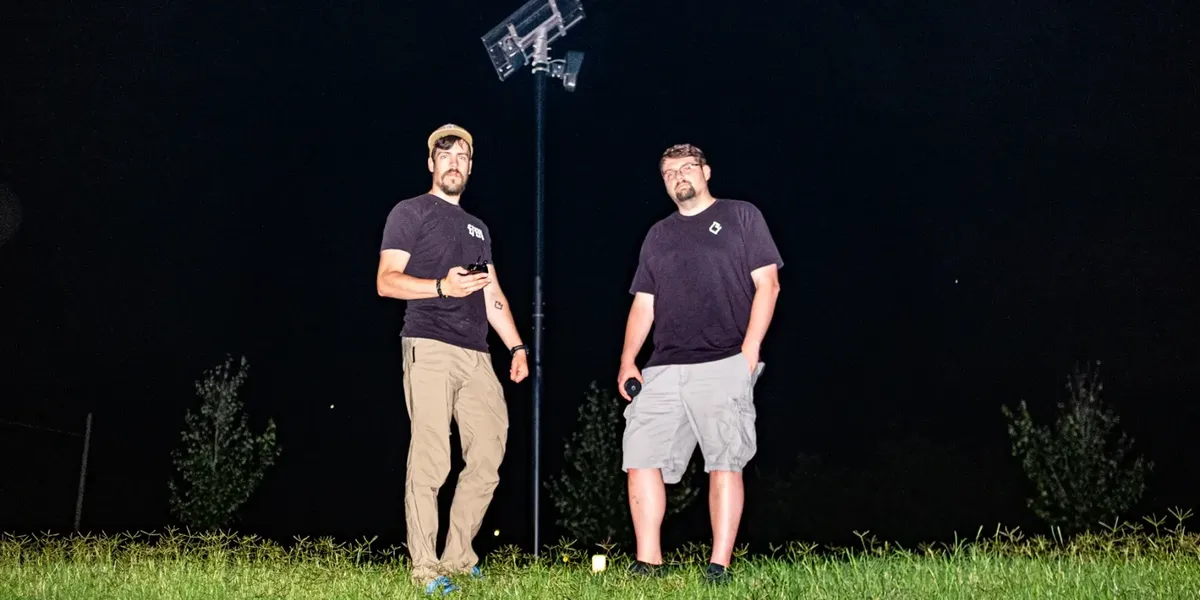


One company’s mass surveillance network made it public enemy number one. We went on the ground with the hackers hunting them down
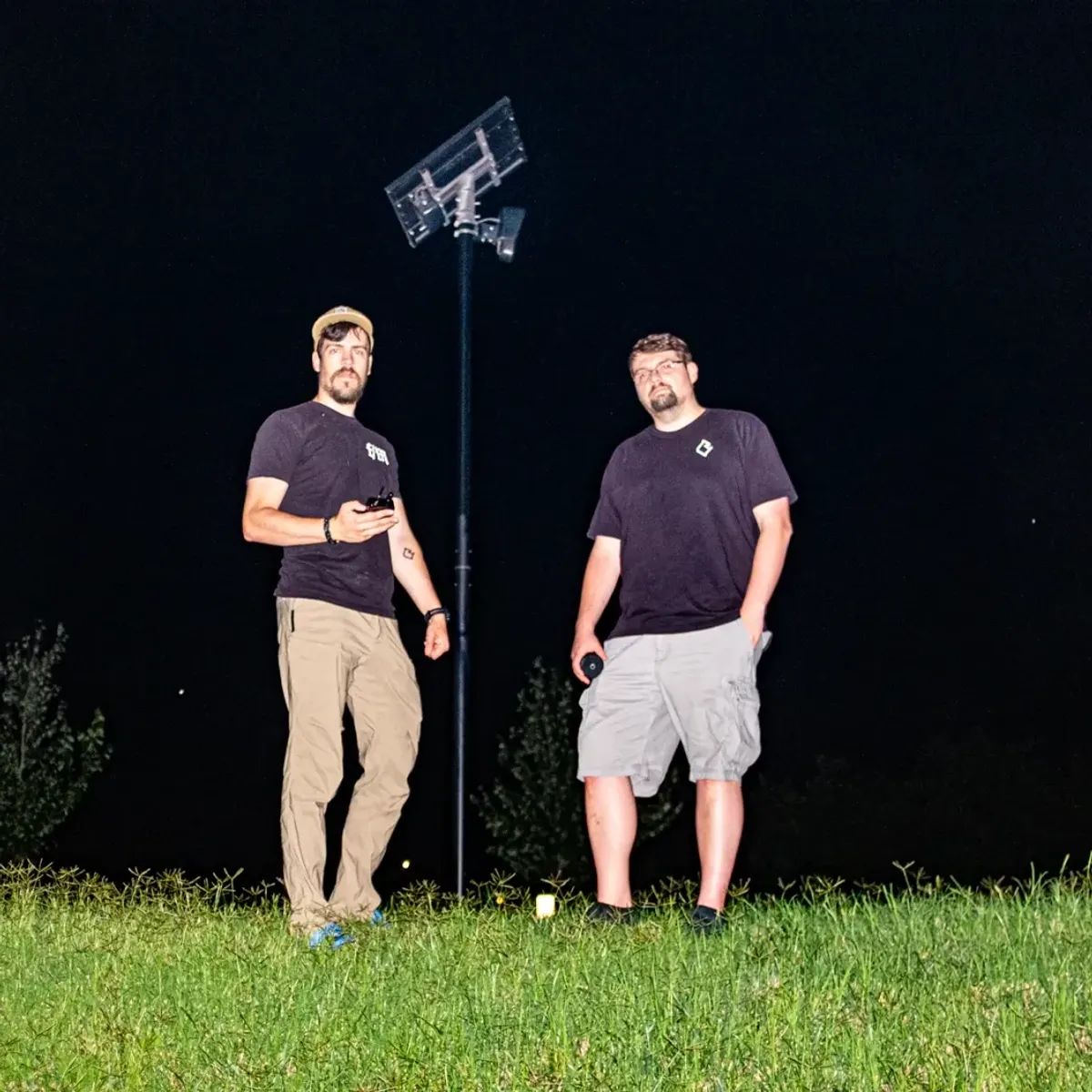
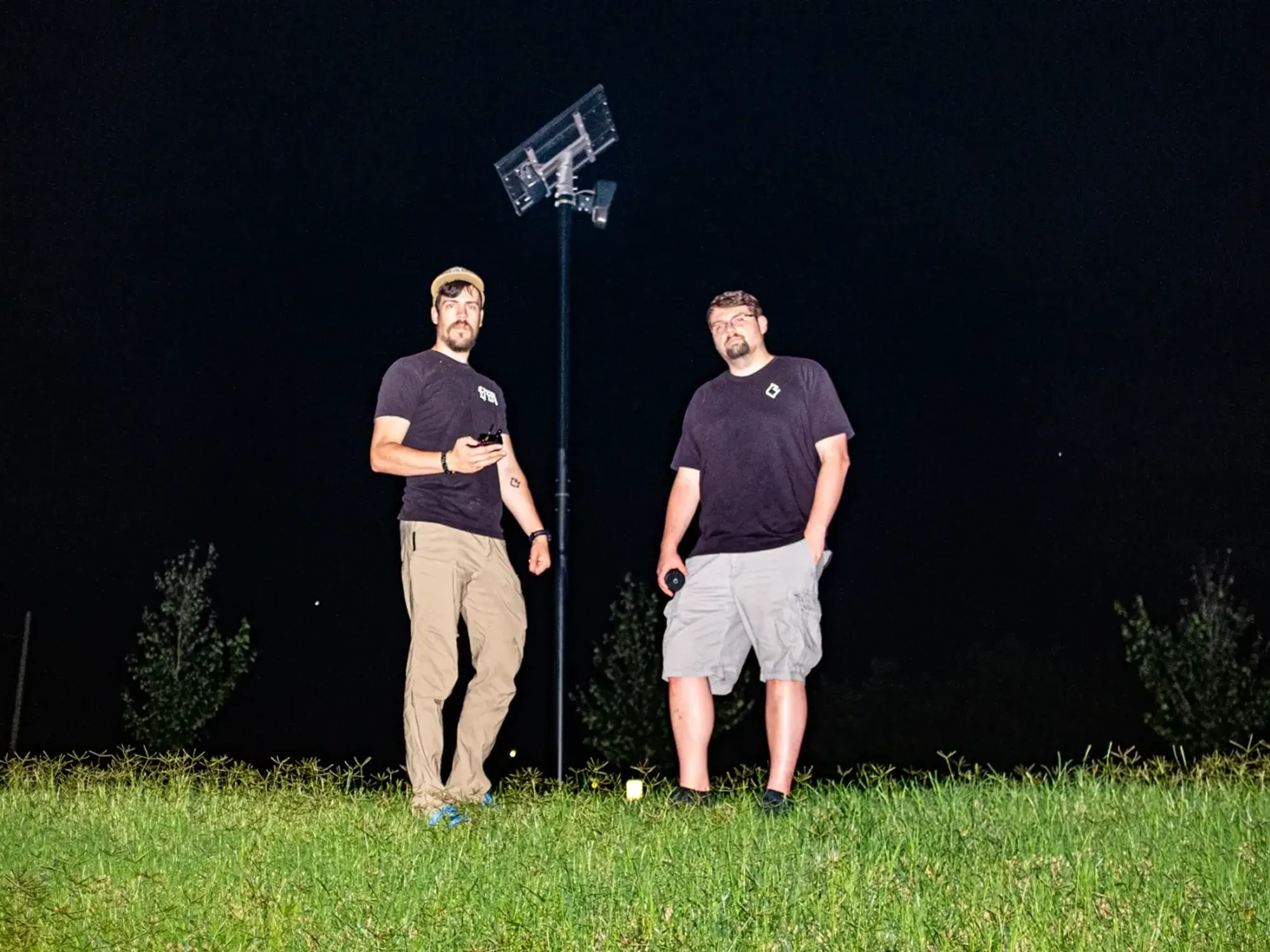
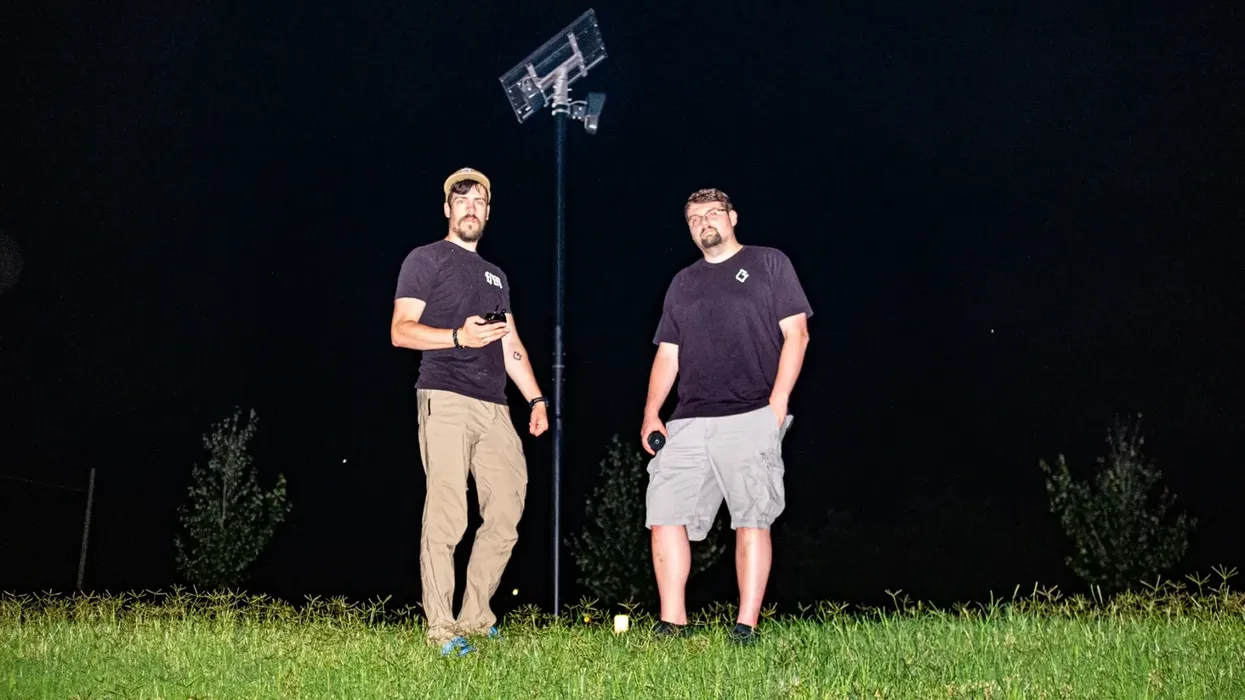
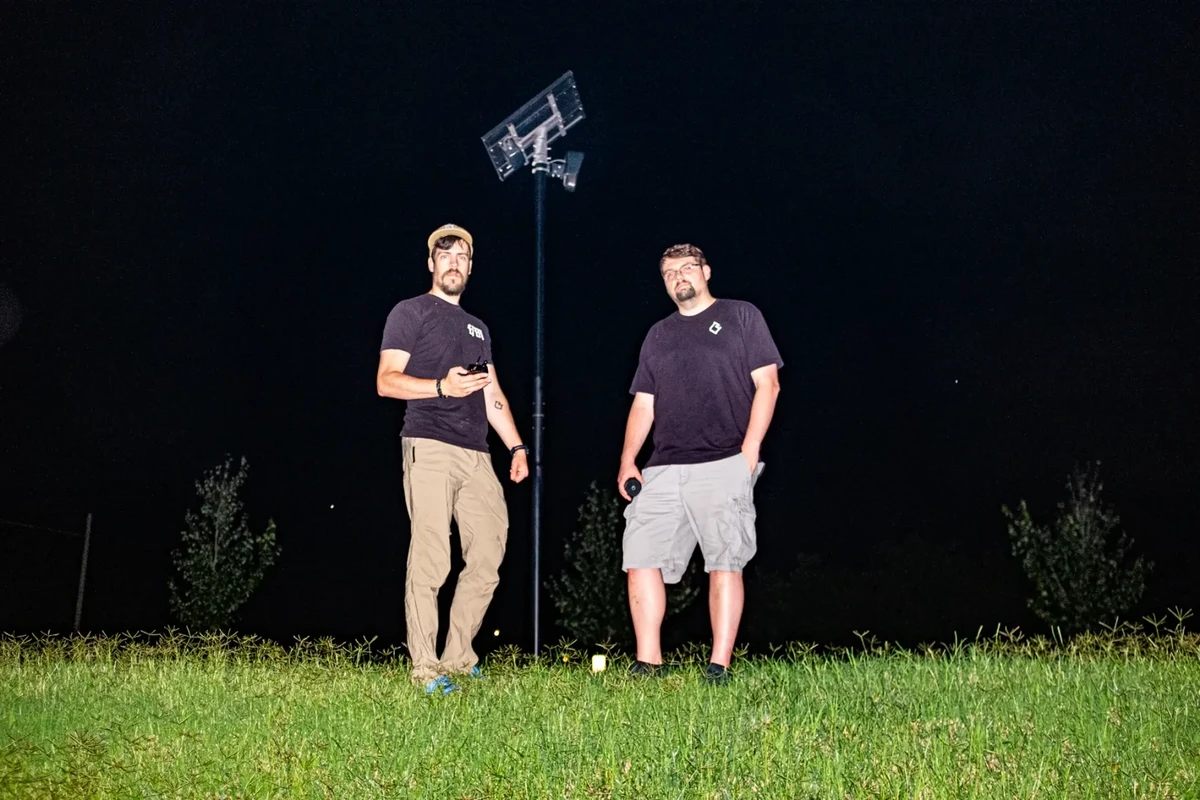
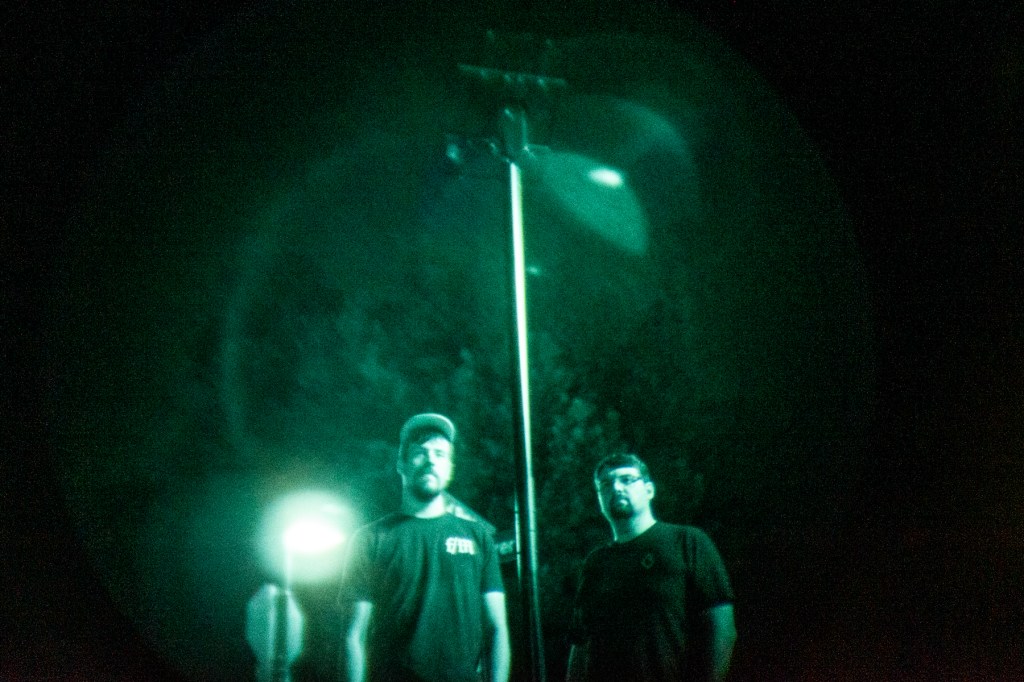
Koko and Hedge tracking Flock cameras.
Campus security is on to us. For the past 30 minutes, I’ve been doing laps around a satellite campus of a small Virginia university in the back of a conspicuously rigged-out Toyota Tacoma, a fat disc-shaped antenna magnet-clamped onto its roof and connected to a thick tube of cables that run into a black box by my side. In the front seat are two professional security researchers – call them hackers, if you want – who go by their online pseudonyms Koko and Hedge. Koko and Hedge’s work is all above board, but they still ask me to keep their legal names off the internet. In return, they agree to take me hunting for the cybersecurity world’s greatest enemy: the AI-powered mass-surveillance cameras that have popped up all over America.
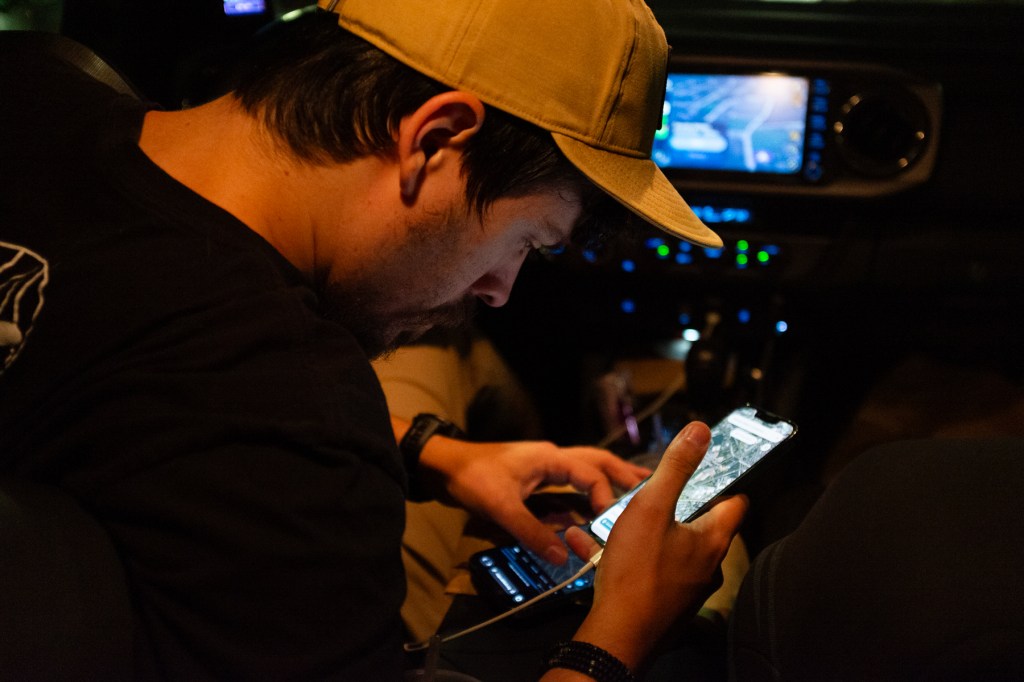
We spot our prey, but still need to get the shot — and we’ve already been passed by one city police squad car and another campus cop. Hedge is riding shotgun and navigating, neck bent over two iPhones, the glow lighting his face from below. Koko is watching for cops and keeping an eye on the numbers flashing on a small, homemade device fastened to his windshield. “OK, around this corner,†Hedge says. “We’re going to pass it on the right.†In the back seat, I twist around, trying to line up my phone camera with a night vision scope Koko brought along.
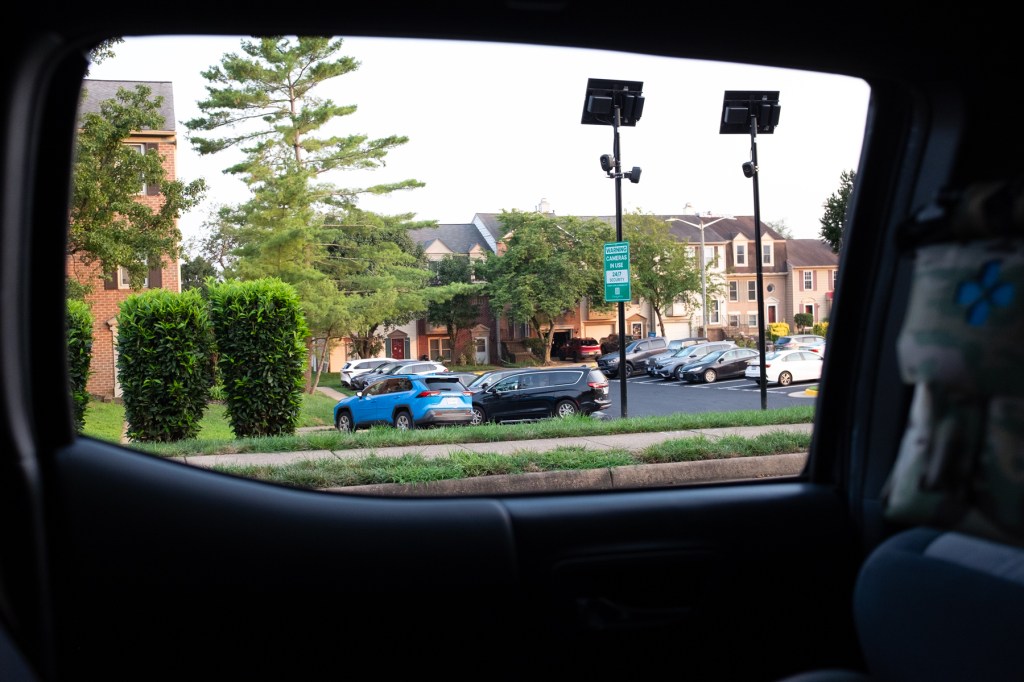
Koko crawls through the intersection. I get the target – a Flock Safety surveillance camera perched above the sidewalk on a long black pole – in frame just as its infrared flash goes off. It’s invisible to the naked eye, but on the night vision scope it’s a blinding pulse of white light. I catch it all on video — but it also catches us: the truck I’m in, the license plate, and almost certainly me, glued to the back window, phone in hand.
Over the past few months, Flock Safety has gone from a little-known, quietly-expanding security camera company into public enemy number one for a vast political coalition. Flock’s critics, which include left-wing anarchists, suburban soccer moms, libertarian computer dorks, and hardline far-right secessionists, have all claimed that the company’s nationwide network of interconnected surveillance cameras violate Americans’ right to privacy in new and frightening ways. That grassroots anger has, in turn, made Flock a defining issue in the 2026 election cycle.
“Little cameras, watching your every move, to collect information about you without you even noticing,†Michigan Senate candidate Abdul El-Sayed said in a new campaign ad on the website X. “That’s all been part of a regime that’s been pushed by, well, this guy: who happens to be the guy I’m running against – Mike Rogers.â€
Opposition to Flock has also crossed party lines. In July, Tennessee Republican Rep. Tim Burchett introduced the Protection Against Mass Surveillance Act, a single-page, simple bill that would bar the federal government from “purchasing or accessing†any “mass surveillance†technology, specifically mentioning Flock cameras and devices that use biometric or facial recognition features to profile people.
“We’ve gotta put some guardrails in,†Rep. Burchett tells me over the phone. “You want to follow my ass, get a dadgum warrant.â€
Flock, which has been around since 2017, primarily makes cameras known as Automated License Plate Readers, or ALPRs, which it then leases to cities, towns, and homeowners’ organizations, promising their clients an always-on, easily-searchable database of surveillance footage for stopping crime. There are many companies who make ALPRs, many of which offer similar services, but in the past few years, Flock has come to dominate both the market for this technology and the spotlight that it now commands. In some form or another, license-plate capture technology has been around for at least a decade — but privacy experts and security researchers have warned that the Orwellian capabilities and slap-dash vulnerabilities of Flock’s cameras represent a new, drastic security threat for everyday citizens like you and me.
Flock claims its cameras focus only on vehicles — but critics say they’re collecting so much more: giving the government tools to analyze identifying features on vehicles and pedestrians alike, creating profiles that can log everything from a bumper sticker on a car to the color of clothing a jogger wears. That data is held by a private company, which sells it to whoever is willing to pay. And once they have it, anything goes. Across America, rogue cops have used Flock data to stalk ex-wives and girlfriends, held families at gunpoint after faulty readings, and kept one woman in jail for 13 days before admitting that the cameras had led them astray. Mistakes happen in police work, of course, but security researchers also say Flock is also barely bothering to secure their cameras: they’re easy to hack and exploit by anyone with the right gear. All this adds up to a systemic invasion of privacy that is causing sane and rational experts to use words in interviews like “panopticon†and “big brother.†The future is here, and our laws have yet to catch up. Flock did not respond to a detailed list of questions sent by Rolling Stone.
“In the old days, it was just impossible to do these things,†says Andrew Crocker, a senior staff attorney at the Electronic Frontier Foundation who leads the privacy organization’s surveillance cases. “You couldn’t follow someone around 24 hours a day. That was just physically impossible. This technology makes that possible. It changes the relationship of surveillance to people in a really fundamental way.â€
Crocker says Flock and other interconnected ALPRs give the government an enormously powerful tool. There are at least 131,000 ALPR cameras in the U.S., over 80 percent of which are owned by Flock. If you have access to Flock’s system, you can plug in a license plate number or even a description of a vehicle and see footage from many of those cameras, effectively telling you almost everywhere their car has been, and sometimes even who was inside it. You can tell what time they arrived somewhere and what time they left. Flock makes all of this information available to its customers at the push of a button, with no warrant or effort required, even if the target isn’t suspected of any crime at all.
“It’s easy for everyone to understand how invasive that could be,†Crocker says. “People get, intuitively, that no one is immune from this sort of surveillance.â€
And people, broadly, are pissed: hating Flock is one of the hottest trends on social media. Content creators from across the political spectrum are making guides on the best tools to cut down Flock cameras, blasting them off poles with shotguns, and dissecting every misstep the company makes.
America’s Great Flock Hunt began almost exactly one year ago, when Benn Jordan, a musician and technology YouTuber released a video titled “Breaking the Creepy AI in Police Cameras.†In Jordan’s first video about Flock, he spent much of its runtime figuring out unique ways to fool the cameras’ license plate readers using his own AI programs. But his plain English introduction to what Flock Safety was actually doing is what connected with his audience. Today the video has 3.6 million views.
“It just opened up a rabbit hole that kept going and going,†Jordan tells me. “And it’s still going – now it’s reached critical mass.â€
A few months later, he was back with a far more provocative take. Working with a security researcher going by the name GainSec, Jordan showed how Flock’s specific protocols and tech were immensely vulnerable to cyber attacks — some of which would let them tap right into the cameras’ live feeds — in a video called “We Hacked Flock Safety Cameras in 30 Seconds.†Jordan and GainSec found unsecured video feeds they could patch right into and watch, vulnerabilities that let them into back doors in Flock’s database and the camera’s code, and even unsecured databases of Flock’s users, down to the names and addresses of police officers using the system.
Online, the security and hacking world lit up. Here was a company, the consensus went, that was doing almost everything wrong — at the people’s expense.
I started seeing other Flock videos around this time. They came across my feed, at first, through the fringes: 3D-printed gunsmiths, hard-line anti-fascists, weird black-pilled internet denizens, and even some crunchy far-right secessionists in the Pacific Northwest were suddenly all posting about these little black cameras on aluminum poles. Many of them were posting a map on a site called DeFlock.org, which showed the United States as an enormous constellation of lights — thousands upon thousands, with every dot on the map representing an ALPR camera. They were everywhere. To date, DeFlock has mapped more than 131,000 ALPR cameras in the United States, around 80 percent of which are owned and run by Flock Safety. The map, along with a searchable database called HaveIBeenFlocked.com, are the product of a massive public undertaking by a community of hackers who adapted an old A/V-club hobby into a service for the public good. They call themselves “wardrivers,†and for the past year or more, they’ve been fighting to track down every single Flock device active in the United States.
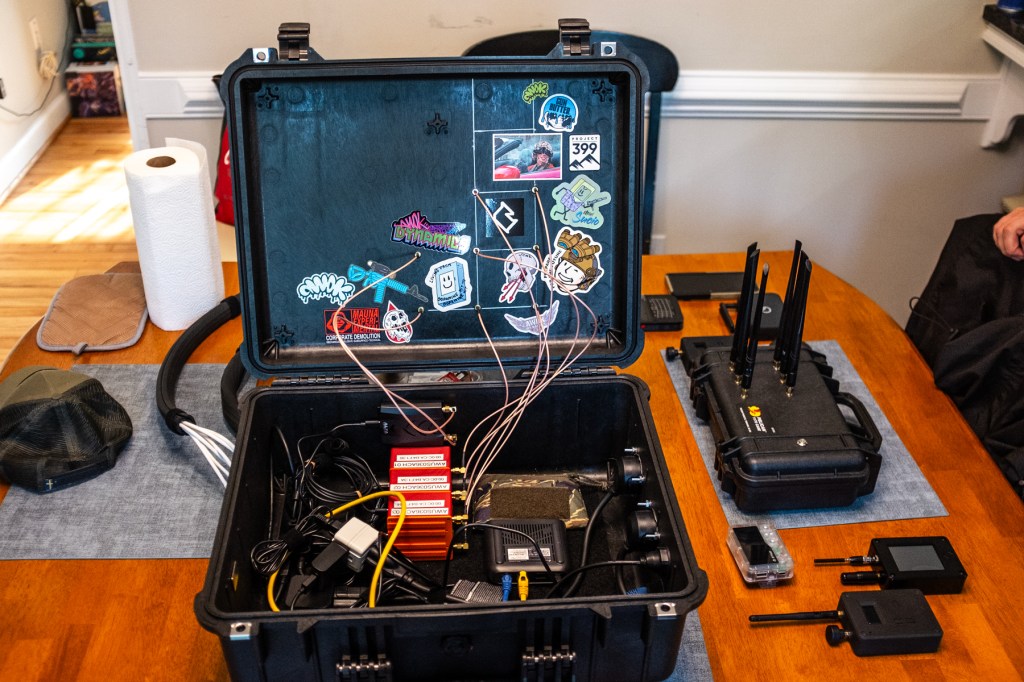
IN MID-AUGUST, I HOPPED IN A rental car and drove from New York to a suburb of DC in Northern Virginia, to meet Koko, a security consultant, entrepreneur, and dedicated wardriver who agreed to take me Flock hunting for a few days. Koko shows me into his house, where his two friendly cats climb all over a dining room table covered in hard-shell Pelican cases — think a boxy briefcase made of industrial plastic — crammed with electrical gear. One of Koko’s friends, another security researcher named Hedge, is along for the ride as well, tinkering with his own gear when we walk in.
Wardriving, they explain, is a relatively simple concept: you pack your car with all the signal-receiving gear you can get and drive around seeing what you catch. Basically every device with a battery or power cable these days is emitting some kind of signal, mostly WiFi or Bluetooth. An extremely simple “wardriving†session, then, would be just traveling along a route and logging the raw number of WiFi and Bluetooth signals you pick up: phones, cameras, computers, cars, et cetera. For some people, that’s the whole hobby — there are online leaderboards of wardrivers competing to put up the most numbers, games that they can play by “capturing†digital territory on real-world maps. Both Koko and Hedge have designed their own specific devices that are tuned to detect Flock cameras as well as other ALPRs and surveillance devices. Doing that is more complex: it requires reading the MAC address — a sort of digital serial number — for a device their gear detects and cross-referencing it with a known list of MAC addresses used by Flock cameras’ manufacturers. (This is in imperfect science. There is one brand of Bluetooth-enabled CPAP machine and certain electric toothbrushes known to have similar MAC addresses to Flock cameras, so sometimes you get false positives if you drive too close to the house of a heavy snorer.)
When you get this deep into the hobby, things get a bit more serious. The gear Koko and Hedge are packing – pocket-sized, 3D-printed boxes with tech inside that they call the Marauder and the Biscuit, respectively — can go beyond passive monitoring. They can spoof WiFi networks, clog up bandwidth, mimic AirTag signals, and all kinds of other mischief. At one point, to demonstrate, Hedge taps in a short command to the Biscuit – which is a 3D-printed mini-computer about the size of a hockey puck that pairs with your smartphone. There’s a brief pause, and then my phone goes haywire, inundated with Bluetooth signal spam — new Airpods connections, contact requests, an avalanche of popups that make my phone basically unusable until Hedge shuts it off.
“We mess with each other all the time,†Hedge laughs. “Usually when someone’s on the toilet, and we know they’ll be on their phone.â€
Koko loves the pranks too, but is serious about what this tech can do. On the way back from DEFCON, a hacking conference he attended in early August, several attendees were pulled off a plane by armed air marshals after they set up a malicious WiFi network while on board their flight home.
“This stuff should be seen no differently than owning a firearm,†Koko says. “It all depends on the person wielding it.â€
I take his word for it, seeing as he also has a Glock 19 holstered in the front of his waistband.
“So, anyway,†he says. “Want to go do some wardriving?â€
Koko quickly dashes my dreams of watching black-clad hacker gangs scrambling sensors and hacking at Flock poles with skill-saws. That’s definitely going on, somewhere, but most wardrivers, like Koko, keep all their activities strictly above board (at one point, for instance, Koko refused to park in a handicapped spot even though the parking lot we were in was entirely deserted at 11 p.m.). We load up Koko’s truck, a four-door 2023 Toyota Tacoma: Koko gets in the drivers’ seat, clipping the Marauder to the windshield. A bigger version of the same tech sits in the back seat, hooked up to a clunky round antenna on the roof. Koko’s truck only has one bumper sticker, an image of a guillotine that says “MAKE CONSEQUENCES GREAT AGAIN.â€
Our first stop is the “most controversial,†Koko says: the Lowes parking lot. There are three Flock cameras there and several other non-Flock police cameras. Activists suspect that Flock’s data has been used to plan immigration raids, which frequently target hardware store parking lots where migrant day-laborers often wait for work. We drive around the lot slowly, parking next to one of the cameras to take some photos and video. It’s late in the day, and our gear isn’t picking up the camera’s signature, even though we can see it right there. This is interesting to Koko — he has a theory that some of Flock’s solar-powered cameras shut down their WiFi and Bluetooth signaling after dark to save power, uploading data only through the cell networks, which are much harder to detect.
Stuff like this is all part of the puzzle. It’s what makes it fun for Koko and Hedge, who are in their early 30s. They both make their living primarily through selling the Marauder and Biscuit devices, which are currently selling out as fast as they can make them due to the new influx of privacy-conscious wardrivers. But the mysteries of Flock are also what piss them off: they know better than anyone the kind of data everyday people are giving up to the now-omnipresent cameras in their midst.
“Before, you had more control over the data you put out,†Hedge says. People enjoyed a reasonable amount of privacy in public; they could use cash for purchases and paper tickets for transit. The CCTV footage that did exist was, at best, lazily reviewed by a manager somewhere if and only if there was an incident. Now, he says, the cameras are always on, always taking data. “It’s hard to avoid going to the grocery store.â€
Koko and Hedge take me through a couple parking lots and a small condo development that has three new Flock cameras posted right at its entrance. Then we swing back by the house to grab some more gear. As night falls, Koko busts out a military ballistic helmet with a night vision scope attached — crucial for picking up Flock cameras’ infrared flash. We then head to a satellite campus of George Mason University, which the DeFlock map shows us is infested with Flock cameras. Koko wants to test another theory: Flock claims that their cameras are built to collect data from cars, not people, but he is pretty sure they’ll go off even if a person walks past. We do laps around the campus, recording the cameras going off as the truck drives by. Eventually, we find one pointed right at the sidewalk, and hop out. We wait for there to be no cars in sight, and then Koko and Hedge walk past. They make it about five yards past the camera, next to a row of electric scooters, before the IR flash goes off. We repeat the process with one person, then two. The camera snapped us all. Eventually, a campus security cruiser rolls past. We take that as our cue to leave.
IT’S ODD, STANDING IN FRONT of these cameras. I’ve been on TV plenty of times; as a journalist, I’m vaguely used to being treated as a quasi-public figure, albeit an extremely non-famous one. But it’s another thing entirely to stand in front of a lens that you know is recording you on behalf of a private company — not just to make sure you don’t swipe a candy bar at the self-checkout, but to keep a detailed record, if it can, of who you are and how you move about the world. Because we’ve already seen how much power that data conveys. Just last week, Wired reported that Flock had developed a new AI tool for tracking not just vehicles but their specific drivers, matching them with known “associates.†Flock did not dispute any of the capabilities Wired described. In July, 404 Media reported that police departments around the country were running Flock searches for physical descriptions of people, such as “person on skateboard,†or “woman wearing grey shirt, blond hair, black shorts.†Police have used Flock data to search a man’s car on suspicion of possessing marijuana after tracking him traveling between Michigan, where weed is legal, and Wisconsin, where it is not. Local, state, and federal law enforcement are all reportedly tracking social media users who have posted anti-Flock content. Flock’s CEO, Garret Langley, once called DeFlock, the camera-mapping website, a “terroristic organization whose primary motivation is chaos.â€
“The fact that they don’t have to get a warrant for [running a search of Flock’s data] is really shocking to me,†Crocker, the EFF lawyer, says. “The law has a hard time keeping up.â€
Flock, for its part, claims that its product is solving crimes and saving lives. That’s hard to refute. The technology is clearly powerful — in the right hands, in the right situation, there’s no doubt that an ever-vigilant surveillance net would stop horrific things from happening. Like a gun, it depends on who wields it. The argument against Flock, right now, is that a loophole in the American legal system has allowed a group of tech guys to invent a really, really big gun, which they have then loaned to the government with few restrictions and oversight. That’s not how this country is supposed to work, Koko thinks. He joined the Navy straight out of high school because he wanted to serve his country. He’s proud of that. The Navy taught him cryptography and signals intelligence and crammed years of computer science education into a few focused training units, skills he used on behalf of his country and still wants to use to help the people who live in it.
“I feel like the presence of these cameras kind of undermines the idea that people are entitled to that freedom and their privacy,†Koko says.
The day after the university hunt, we’re talking all this over back in Koko’s office. I notice a post on my phone: Flock Safety, announcing a new slate of privacy and accountability measures. Everyone crowds around Koko’s PC to pore over the statement, trying to puzzle out what the new “default retention period†for camera data means. Koko and Hedge aren’t impressed.
“I mean, this is too little too late,†Koko says.
We pile back in the truck. There’s another subdivision nearby with several cameras Koko and Hedge haven’t been able to pick up. They’re on the DeFlock map, and you can see them with your eyes, but they’re not showing up on the Marauder or Biscuit — perhaps some evidence that Flock is changing some of their tech, or has systems that the two researchers aren’t familiar with.
“I like the idea of understanding something that we’re not fully meant to understand,†Koko says.
On the way back, we drive through a quiet intersection with one camera, facing south, already on the map. As we pull up at the stop sign, I spot something else. “Wait,†I say. “Isn’t that another one?†There’s a second camera, pointing north, affixed to the side of a telephone pole. “Is that on DeFlock?†Hedge asks. We pull out our phones to check. It’s not. Hedge taps away, dropping a pin in the map, putting the new camera in the system, rotating the icon so it shows the exact angle the lens is facing. He zooms out, and the new camera becomes another dot, one of two at that intersection, of a dozen in that town, of hundreds in that part of the state. If you go outside right now and drive around, chances are, you might find one, too. It’s a small comfort, I think, to at least know where these cameras are, to be able to see them for yourself. After all, they’ve already seen you.
Norm Macdonald performing at Del Mar Fairgrounds in 2017
Norm Macdonald’s story is coming to Netflix this fall, with a new documentary from Judd Apatow set to revisit the life and career of the Canadian comedy legend.
Norm: The Tale of Norm Macdonald will premiere October 16, Variety reports, and will be the first major documentary devoted to Macdonald since his passing in 2021. Apatow is directing the film, which promises an intimate portrait of the comedian through archival footage, personal photographs and rare home videos. The project has been in the works since at least early 2025, when Apatow publicly asked fans to submit photographs, videos and other material that could help tell Macdonald’s story.
See on Instagram
Macdonald was born in Québec City in 1959 and spent his early childhood in the Quebec City area before his family relocated to Ottawa. He eventually began performing stand-up at Ottawa’s Yuk Yuk’s, before making an early breakthrough at Montreal’s Just for Laughs festival.
The documentary’s official description focuses on the career that followed, from Saturday Night Live’s Weekend Update to Macdonald’s enduring reputation among fellow comedians. also offers a chance to see the roots of that career before Macdonald became a household name south of the border. Apatow has previously directed documentaries about comedy figures including George Carlin and Garry Shandling.
Dylan Cease is already a Toronto legend, having established himself as Blue Jays’ most important players. This week, he found himself in a very different kind of spotlight: inside the Art Gallery of Ontario.
The AGO unveiled one of Cease’s paintings, “Eve of Torontoâ€, in Walker Court as part of a new collaboration between the Milton, GA-born pitcher and the museum. The work, an abstract, colourful tribute to his new city, was also turned into a limited-edition collection featuring prints, postcards, T-shirts, sweatshirts and tote bags. Proceeds from the collection will support the AGO’s charitable mission.
See on Instagram
Cease began painting in 2022 as a way to step away from the demands of baseball. “Painting gives me joy,†he said in a statement released by the AGO. “It relaxes me.â€
“Eve of Toronto†was created shortly after Cease arrived in Toronto and initially hung in Jays' manager John Schneider’s office. The painting is difficult to miss, built around bursts of colour and the word “Toronto†repeated throughout the composition. Schneider has joked about the attention it has received, but has also embraced the unlikely crossover between his ace pitcher and the local art scene.
Earlier this month, another original painting by the pitcher sold for $16,000 through a Blue Jays and Jays Care auction.
Olivia Tiedemann gets flipped off everywhere she goes. It happens at parties, in grocery stores, even when she’s walking down the street. But it’s no sign of disrespect. The one-finger salute is her biggest calling card — a profane habit that’s built her a social media fandom 5 million followers deep.
“One time, I was walking late at night and somebody honked at me and gave me the finger. I was like ‘Yep!’ and kept walking,†Tiedemann, 29, says. “It’s how we say hello to each other at this point.â€
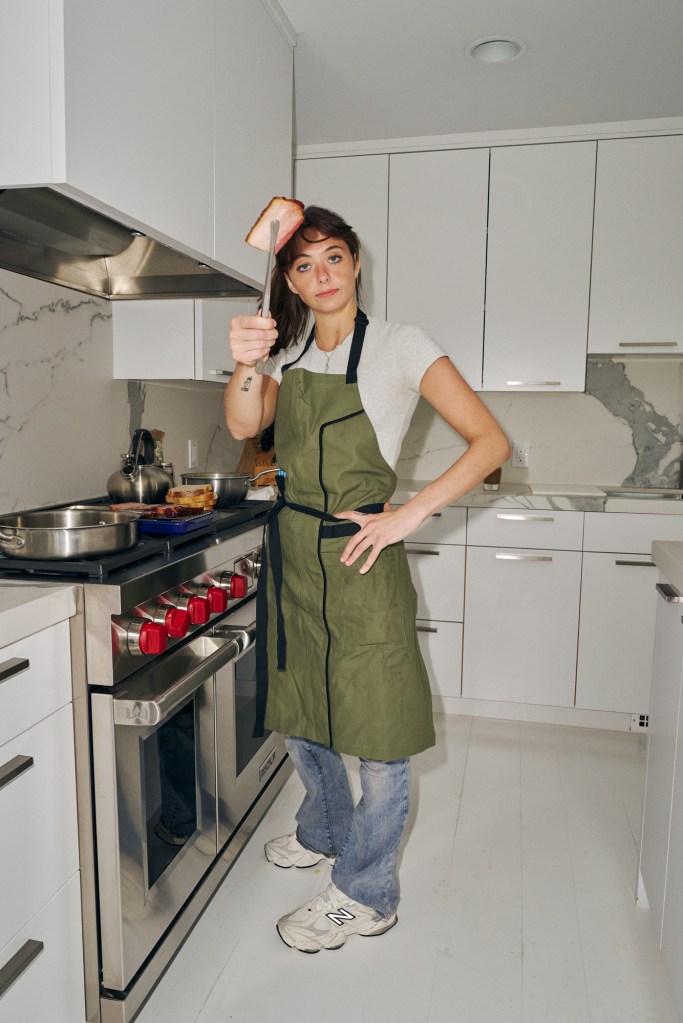
It’s been three years since Tiedemann first posted a chaotic vlog of herself cooking dinner at her job as a private chef in the Hamptons, East Coast playground for the rich and famous. The video traded the genre’s typical easy-breezy style for a mashup of clips where flames rose, expletives flew, and Tiedemann flipped the bird toward the camera at every opportunity. This fuck-you energy turned Tiedemann into an overnight star, netting her first million followers one month to the day after she posted that viral video. Since then, she’s worked with some of her biggest idols in the culinary world, cooking alongside everyone from Jean-Georges Vongerichten to Masaharu Morimoto, Giada De Laurentiis, and Gordon Ramsay. Now, the Sept. 15 release of her debut cookbook, Eat (Like) the Rich, marks a milestone moment in Tiedemann’s career, the first time she’s tried to translate her viral success into a tangible offering of her expertise — and a demonstration of her personal growth.
“When I first started making videos, I was upset at the time,†ÂTiedemann says. “I was going through this whole new world that was my job. I’ve matured a little bit, but I try to keep the fire. You can’t just be an angsty little shit all the time.â€
TIEDEMANN AND I ARE on a food crawl through Bay Ridge, Brooklyn, the neighborhood where she grew up. Though she hasn’t been back in years, at our first stop, the Palestinian restaurant Tanoreen, we’re greeted immediately by the owner, who kisses ÂTiedemann on the cheek before announcing, “I ordered ahead for you.â€
The second-eldest of four siblings, ÂTiedeÂmann grew up a block away from the restaurant, raised by her construction-Âworker father and chef mother. The brash attitude that’s attracted fans on social media didn’t win her points at home. She had an often contentious relationship with her mom that nearly got in the way of her dream career. “I started to become interested in cooking and I was really resistant to it,†she admits. “It felt embarrassing, almost, to tell my mother ‘I want to be a chef, too.’â€
Tiedemann went through several phases before her private-chef days, most of which came with an abrupt ending. When she was 15, she helped sell (illegal) weed lollipops from roving trucks in Union Square, a job made possible by a fake ID she procured on St. Marks. There was a stint at the fast-fashion store Brandy Melville, where she learned about business and drugs that “start with C†before she walked out the door one day and never returned. In high school, she skipped so many classes her senior year that she never got a diploma. Instead of going to college, she backpacked abroad for months.
It was her first restaurant job that convinced her to enroll in culinary school. And by 24, Tiedemann was head chef of an Italian restaurant on Staten Island. But when the menu shifted from upscale to more standard fare, Tiedemann started to lose interest. “I don’t want to fucking make penne vodka. I don’t,†she says. “There’s no amount of money that would have me sitting in a place doing that.†On her worst day, she blew up at a line cook after she asked for chicken stock and he returned with a bucket of Dijon mustard. Days later, she quit cooking entirely, or so she thought.
Tiedemann was working as a production assistant on films in upstate New York when she got a call from a staffing agency looking for a private chef for a Hamptons household. The job “was everything I ever wanted as a chef,†she says. That it led to social media stardom was an unexpected bonus. “Who would have thought that there could be a whole world right on the other side of it?â€
HAMPTONS FOOD CONTENT IS an entire genre online, one that typically relies on a razor-thin balance of excess and relatability. Private chefs in the vacation enclave have to fit the One Percenter aesthetic while also reminding their followers that they’re staff in this equation — which usually results in videos where they act as ever-smiling experts who can grill and sous vide and plate surprise dinners for 20 without breaking a sweat. Tiedemann’s first videos flew in the face of these rules. She mixed curses and clashing pans with unserious captions, like saying a platter of perfectly medium-rare steak had “big dick energy,†or starting videos with “Good morning, motherfuckers.â€
When Tiedemann first filmed herself cooking, it was to keep busy while the family she was working for was out of town. She never actually intended to share the videos anywhere. But after her first edit made her laugh (“I was like, ‘This fucks!’â€), she posted it on TikTok. She gained followers so quickly that when the family returned two weeks later, she couldn’t hide what she’d been up to. “I was like, ‘Hey, guys, just wanted to let you know I’ve been giving everybody the finger through my phone from your kitchen. A lot of people are watching them now. Are we cool with this?’†Luckily, the family found them funny. But then, making funny videos became a job, too. “It’s so weird how instantly the pressure turned on,†Tiedemann says. “And it’s never turned off.â€
Tiedemann is an enthusiastic gourmand, and her instinct for service is on full display as we talk. She spoons sliced beets and hummus onto my plate, pushing tabouleh to the side to make room for a mound of za’atar and sumac crisps. Every time a waiter comes by, she gushes over the food, waiting until they leave to eat more in an effort to clear her plate. “Fuck,†she whispers, adjusting the silver chef’s knife necklace dangling from her neck. “It’s hard to eat and chat.†Just when we’ve finished a plate of dip, a waiter sets down a massive bowl of shredded chicken, rice, and almonds covered in yogurt sauce and a tower of fried eggplant rounds on top of basil salad. Tiedemann and I lock eyes in a solemn understanding. There will be no food crawl.
‘EAT (LIKE) THE RICH’ IS a user-friendly guide that blends some of Tiedemann’s best-known recipes (challah French toast) with cooking advice (no! plastic! ever!). Like her, it’s full of personality, including recipes for “fuck desserts†and “salads that don’t suck.†She calls the book a “private chef’s list of commandments.â€
Meanwhile, she’s continuing to grow her online accounts and working through a contentious contract with a content-production company. She recently moved her life from New York to Austin in a peak of rage (“I was so fed up with New York at that point, like the hell of it allâ€) but still commutes to the Hamptons in the summer to work as a private chef. While there’s been a lot of change in a short time, ultimately, she says the cookbook feels like proof her path to the food world, however twisty, was the right one to follow.
“This is the work of my life,†she says. “Everything that led up to this, all the years that I spent in a kitchen somewhere, having a terrible time. It’s cool to be able to put that together into this perfect little package that I [can] give to somebody else.â€
There’s one anecdote in the cookbook’s foreword that Tiedemann wrestled with sharing. There, she reveals that she didn’t quit her head chef job because she thought she could find something better. She quit because she thought she was going to kill herself. “I wanted to not exist. It’s such a common story that you don’t see, because it’s back there,†she says, emphatically pointing toward the kitchen next to us. “[Your] whole life exists in this box. Those months [after I quit] were just reopening the world. It primed me to grow.â€
Much of Tiedemann’s style as a chef relies on the idea that sometimes, dropping everything and starting again can lead to the best outcomes. But as she moves past her initial virality and toward a culinary career with legs, she seems to be realizing that the most badass thing she can do now is focus on following through. Social media fame has opened doors that could let Tiedemann abandon the day-to-day work of a chef — the burned fingers and picky eaters and endless plates of penne alla vodka — for a life of content creation. Still, cooking is the first and only thing that’s given Tiedemann purpose, so the better option seems to be throwing up a middle finger and getting back to work.
“I want to be a chef forever. Losing touch with that would be like losing touch with myself. So I never want to stop doing that,†Tiedemann says. “And if I ever do, I’m probably morphing into some little shit and somebody better stop me. Because cooking is what I like most in the world.â€
What happens when Peter Pan’s shadow has a shadow?
Over the past two weeks, TikToker Toni Kulusich, better known as @babytoni99, has gone viral for videos of herself with Peter Pan at Disneyland. What might otherwise look like a routine character meet-and-greet has sparked a very different reaction online, with social media users questioning whether her decade-long fandom of a fictional character crosses a boundary.
According to an interview with Wired, Kulusich, 27, didn’t see her content really take off until a clip of her gifting Peter Pan a tiny crocheted duck started trending.
Suddenly, she’d gone from 10,000 views to a million, and the angry comments were flooding in. Critics took issue with some of the recordings, particularly those in which Kulusich appears to kiss Peter Pan on the cheek or get down on one knee to propose to him. Other videos, however, show Kulusich and Pan skipping arm in arm through Fantasyland, with the actor seemingly leaning into the friendly exchange.
But Kulusich insists there’s a distinction between her Disney obsession and her life outside the park. “It’s not like I’m going to the store or to my job and thinking about Peter Pan,†she said, referring to her job as a manager at a big-box retailer. “It’s just that when I’m inside Disney, I’m able to release my inner child and the kid who doesn’t want to grow up.â€
Kulusich defended herself to Wired, saying that even her husband of four years, a Marine, is “really supportive†of her hobby. But her account has sparked a conversation about Disney adults, what’s appropriate when visiting a park, and what’s pushing things too far. Though Kulusich says that criticism of her is unfair, there are plenty of other instances of fans crossing the line. (Kulusich, who is using her middle name to protect her privacy, declined to be interviewed by Rolling Stone. Disney did not respond to a request for comment.)
Today, there are 12 Disney parks across the globe. Guests come for the attractions, shows, and, of course, the characters. Those range from princesses, known within the company as “face characters,†whose performers wear costumes and company-approved makeup while showing their own exterior, to Mickey Mouse and other “fur characters,†the Disney term for performers who portray animated stars in full-body suits.
It’s not an easy job. I worked at Disney World in 2016 as a character attendant, assisting princesses in their duties. I remember one shift when I interacted with guests alongside Rapunzel and Cinderella. There was a frequent visitor, a man in his 30s, who repeatedly came to the park and would go from princess to princess, presenting them with drawings, making requests for videos, and going in for long hugs. We put his photo backstage to warn other women.
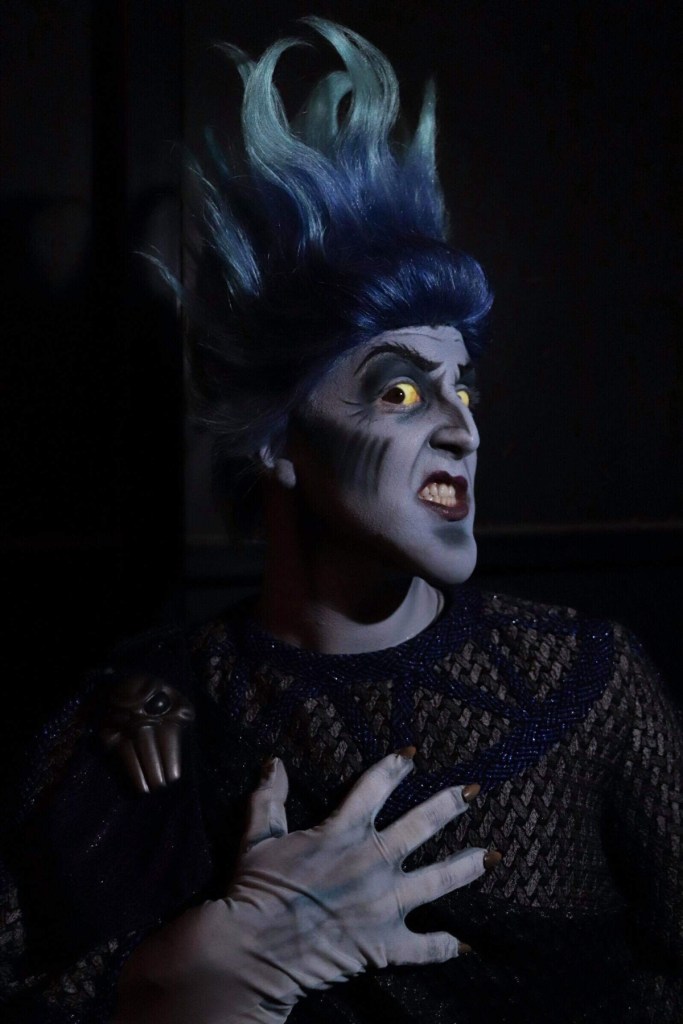
According to former Disney cast members, the divide between fantasy and reality can get surprisingly blurry for some adults who do become deeply attached to park performers. “Adult stalkers are much more common than you would think,†Justin Sanger, a 34-year-old former cast member who portrayed everyone from Hercules’ Hades to Toy Story’s Woody for more than nine years at Disney World in Orlando, Florida, tells Rolling Stone. “Honestly, the female characters are on the receiving end of this far more frequently than I ever was, but there was always someone who took their love for a character very personally.â€
He says the role has changed significantly in the past decade, thanks to the internet. “Our job was to bring these characters to life for the guests, and for the most part, people understood that and took it at face value,†he says. “But the addition of social media created a whole new level of access and made people feel more ‘connected’ to a character — or to the person portraying them.â€
He recalls seeing situations in which solo guests at the park would spend a significant amount of their free time interacting with the same character, sometimes even seeking out the actor playing them. He said that while most interactions are harmless, some fans go overboard with their devotion.
“There was also something about The Incredibles that seemed to attract a particularly extreme level of attention, including a lot of sexualization. We wore spandex and had fake muscles, but that was the role where I personally experienced some of the most extreme behavior from guests,†Sanger says. “This included people finding us on social media and asking for special meet-and-greets for family and friends. But it also included very bold, face-to-face comments about how our bodies looked in the spandex and even comments about how ‘stretchy’ Mrs. Incredible really was.â€
Sanger says the behavior became so frequent that the performers had to take action. “We actually had to ban certain guests — and even fellow cast members who were harassing us — from coming to interact with us at the themed dance party because it became an every-day, all-day type of occurrence.â€
However, Sanger notes that he has a soft spot for people who see Disney as an escape from the real world. “I genuinely don’t think there is anything wrong with being a Disney adult,†he said. “But being a Disney adult is not an issue. Stalking and possessiveness are.â€
Rob Millerick worked as a character performer at Walt Disney World in Orlando from 2014 to 2018. During his time playing Nick Wilde from Zootopia, he encountered obsessive young parkgoers, who would ultimately play a role in his decision to leave the park.
At the beginning, Millerick says, there was nothing particularly unusual about the attention. “It was very light-hearted. They were just excited to see us,†he tells Rolling Stone. The group, made up of older teenagers and people in their early 20s, began showing up regularly for the parade’s three daily performances, led by one attendee in particular.
But the appearances became increasingly common. “As time went on, it got more and more aggressive and more and more frequent until [he] was showing up every day I was there,†Millerick says, adding that his fellow performers would warn him when they saw the attendee around. “The dancers that were with me started telling each other, ‘Hey, if you see this person, Nick Wilde has to be up on the float because he’s going to try and attack him.’â€
The situation continued for months, and Disney eventually became involved. But Millerick says there was a frustrating pattern: “Every single time a manager was there to observe, he did not come,†Millerick says. “And any time the manager wasn’t there, he was there.†A few months later, Millerick quit.
Disney didn’t respond to Rolling Stone’s request for comment on how it trains employees to navigate difficult guest interactions, but from my own experience in the Disney College Program, I know that Disney’s foundational training course, “Traditions,†teaches employees to prioritize four key principles: safety, courtesy, show, and efficiency.
Every role comes with its own additional instructions; what a princess learns is different from what someone working an attraction learns, but the overarching goal is the same: Keep people safe while keeping the magic alive as long as you can do it with a smile.
As for Kulusich, she told Wired that after taking a break, she decided to come back to the park. She wasn’t going to go looking for Peter, but when she saw him, she said he waved. So while there may be problematic Disney adults who let their obsessions spiral, Kulusich insists that what she’s doing is simply an innocent hobby that “makes her happy.â€
“It’s that old trope, that musicians want to be comedians, and comedians want to be rock stars,†Robby Hoffman says.
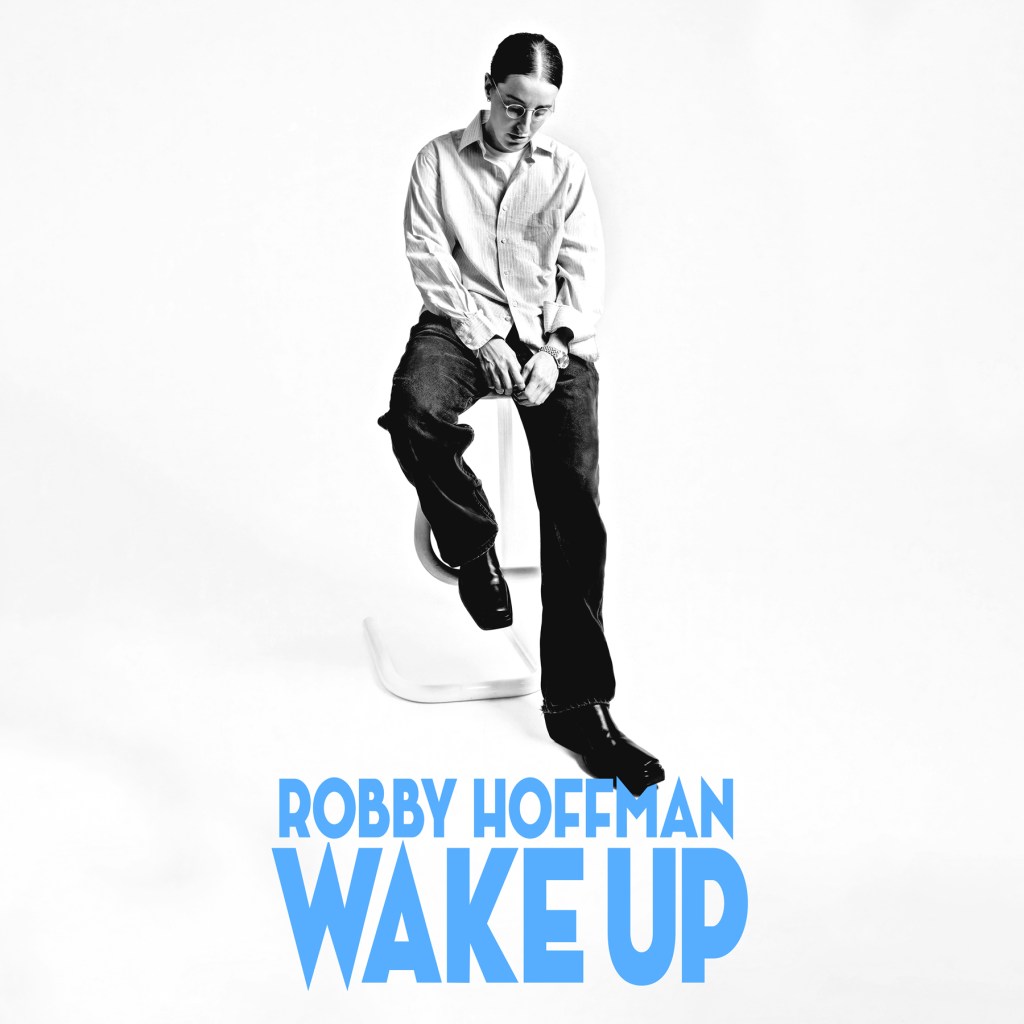
We’re talking about her comedy special, Robby Hoffman: Wake Up, which was produced by John Mulaney and was a breakout hit on Netflix when it aired in December 2025. Today, it also drops as an album from the legendary indie label Secretly Canadian, available in digital format as well as a limited run of signed vinyl. (Find out where to order here.)
For a diminutive Jewish dyke (her word) from Montreal, Hoffman has an ineffable swagger — it’s something in the incongruity of how she looks, paired with her jokes dressing down children, pedophiles, and the Brooklyn straights who use they/them pronouns. “I come out very rock star-like. It’s almost like this old Andrew Dice Clay way of doing comedy. [On tour,] I’m in a lot of historic music venues, and we’re bringing the house down with comedy instead of music. Our fandoms have really collided.â€
So it makes sense, then, that Hoffman is releasing her first album. “You always see those pictures of artists signing shit,†she says. “They want me to do that now, so I’m gonna do that. I’ll take a picture.â€
Hoffman’s rise to fame has been “slow and steady,†says the comedian, 36. “I know everybody wants to pop off right away. For me, I was always doing this for love or money. This is how I toil.†She started with four-minute stints on Toronto comedy club stages, working her way up to short specials on Netflix. Then came scene-stealing roles in Hacks (which earned her an Outstanding Guest Actress Emmy nomination earlier this year), Dying for Sex, and Rooster, and now she’s selling out venues across the globe. “I’ve been moving from smaller venues to bigger venues,†she says. “I was, for a very long time, ‘If you knew, you knew.’ Now I’m like, ‘You have to know.â€
In the press release for the album, Hoffman jokes that putting out a physical album is the only way her mother will finally hear the special. In reality, Hoffman’s interest in comedy records came almost entirely from her. “My mother, who’s a musician and avid record [collector], she probably has 10,000 records,†Hoffman says. When she got started in comedy about a decade ago, her mother started sending her comedy records. Now, the comedian makes sure to hit record stores in the towns where she tours. So far, she’s got about 50, which she shows off via Zoom. “She’s been sending me [George] Carlin and Joan Rivers,†she says, flipping through. “These are a lot of Carlin.†She pauses and makes a little grimace, pulling out another album. “But I have Bill Cosby.â€
She launches into a bit about how her mother doesn’t have a conception of “art vs. artist†— “What’s the problem with Cosby?†she says in a perfect Borscht Belt lilt, imitating her mother. “Suddenly, there’s a problem with Cosby?†Her mother, she says, doesn’t pay attention to pop culture enough to know anything about the people who make the art. “She just knows the work,†she says. “It’s actually a great way to live.†It’s classic Hoffman — a little aggressive, a little nervous, a little anachronistic, a throwback to a comedy era where someone with her personal bio very likely would not have been welcomed into the fold. (“I’m somewhere between seven years old and 73,†Hoffman says.)
Hoffman was born in Brooklyn, one of 10 children in an ultraorthodox Jewish community, and raised in Montreal after her Canadian mother extracted the family. “We grew up poor with a lot of records and a lot of books, and that was really it,†she says. “When I got into comedy, she would be like, ‘Oh, you should listen to Lenny Bruce, Jackie Mason,’†Hoffman remembers. “And I used to think those people were hacks. But then I went back. I’m like, ‘These guys are fucking awesome. She’s totally right.’†Now, when Hoffman goes home to visit, the two listen to them together. “She goes, ‘Let me just put it on,’ and we are laughing. We are laughing.â€
Though Wake Up has been streaming on Netflix for over six months, it’s this kind of intimate experience she hopes people will get by listening in an audio-only medium. “There’s a tactileness to sound, the cracking of it. It makes it more tangible,†Hoffman says. “You’re looking at the other person you’re listening to it [with]. If you’re listening to a record communally, or in my case with my mother, you’re laughing. You’re looking at her, laughing, watching me, we hear the crackling of the record. It fills the room in a way that contemporary media just hasn’t nailed.â€
It didn’t hurt that Secretly Canadian was eager to put out the album, and made the process extremely easy. “We’ve been big fans of Robby’s for a long time and couldn’t pass up the opportunity to work with her,†John Coombs, vice president of A&R at Secretly Group tells Rolling Stone. “She’s a legend in the making.â€
Though Hoffman won’t discuss the project she has in the works with HBO, she has plenty going on between spending time with her wife, former Bachelorette Gabby Windey, and an increasingly rigorous tour schedule. At the moment, she’s preparing herself emotionally for an upcoming Australian tour. “This is in February 2027,†she says. “I’m already nervous about it. The flight — it’s too long.†But too-long flight or not, she’s excited that people care enough to want her to come. “You think I want to go to Australia?†she jokes. “No, I’m coming for you.â€