The First Hours After the Planes Crashed
Photo record
12 images
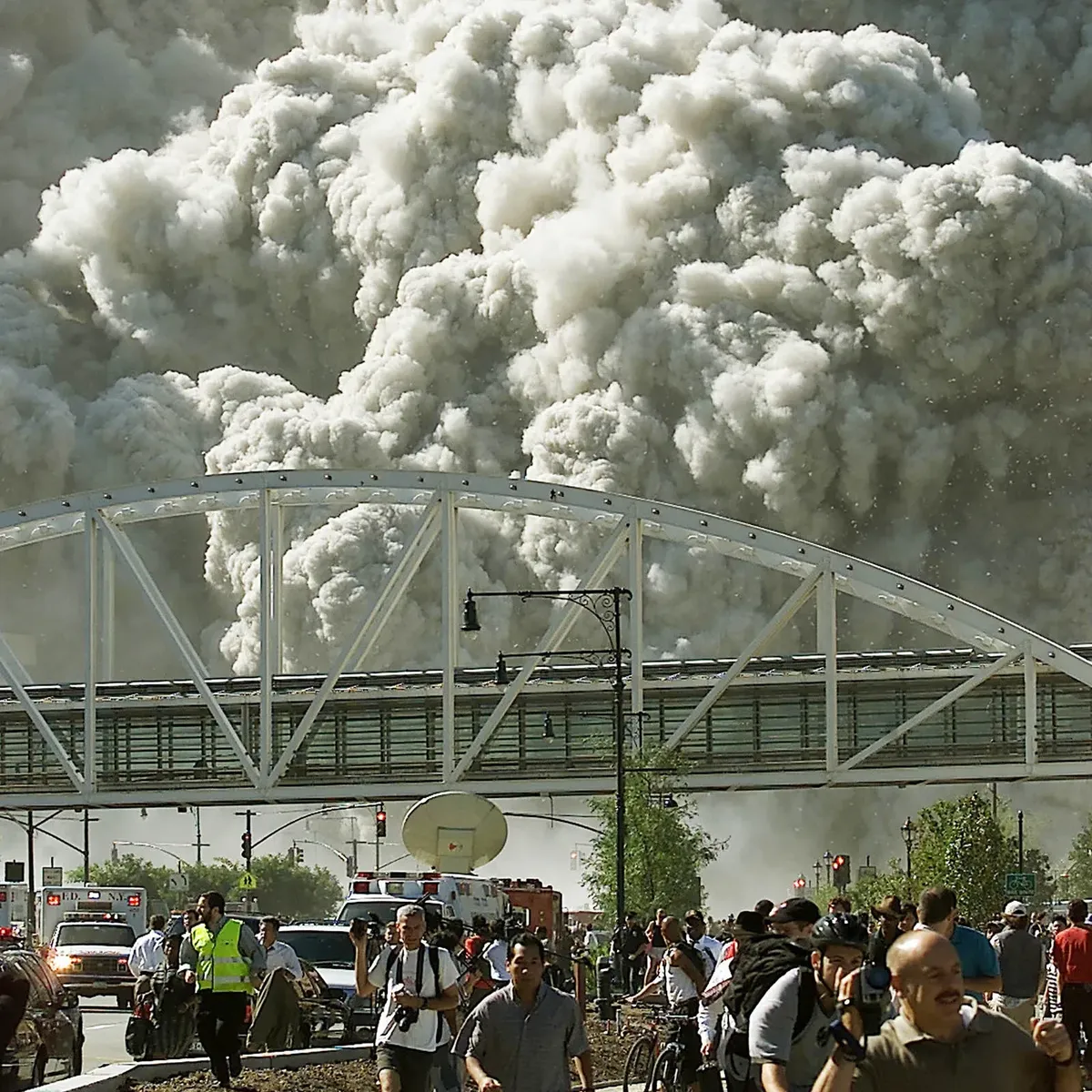
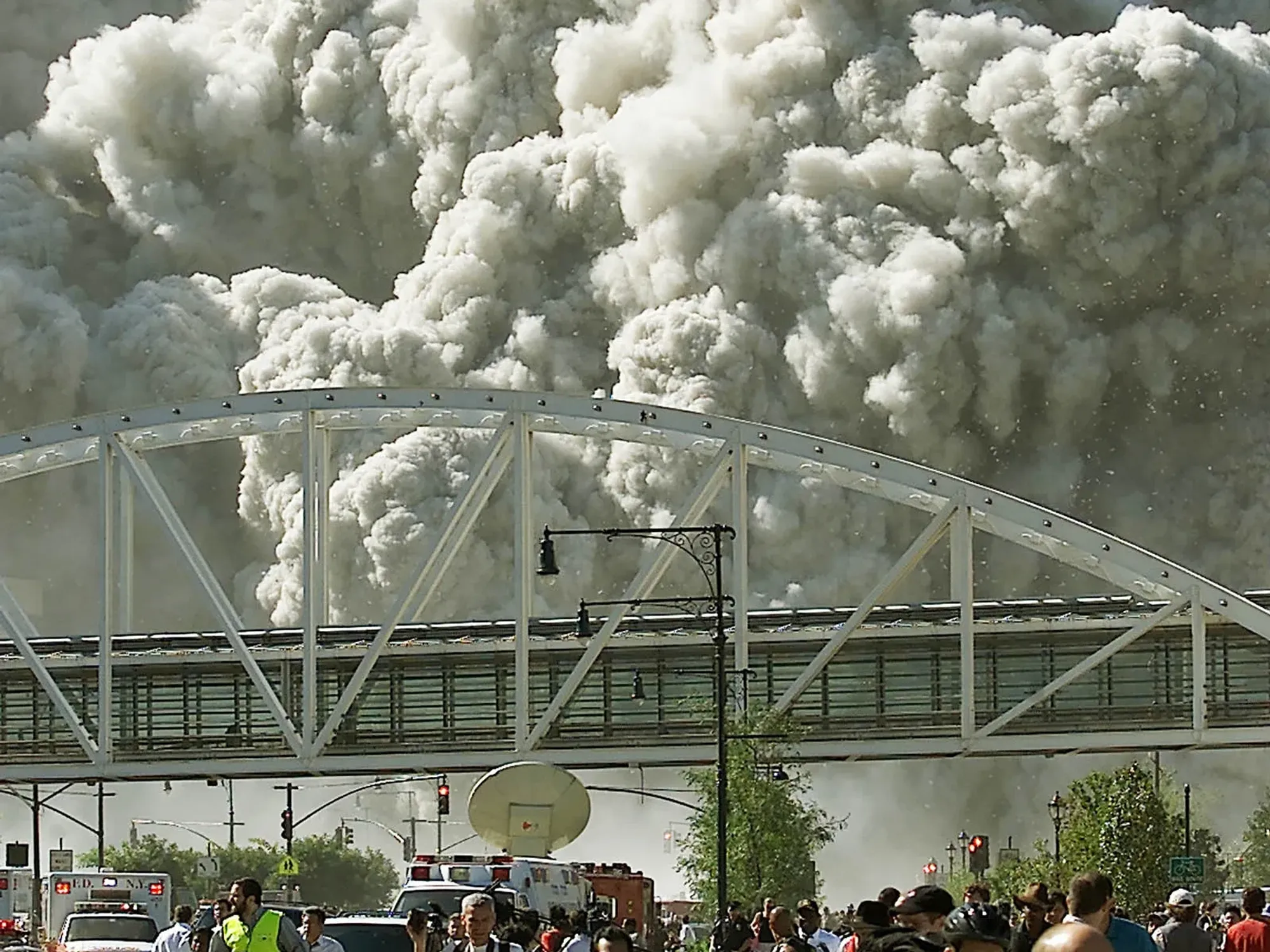


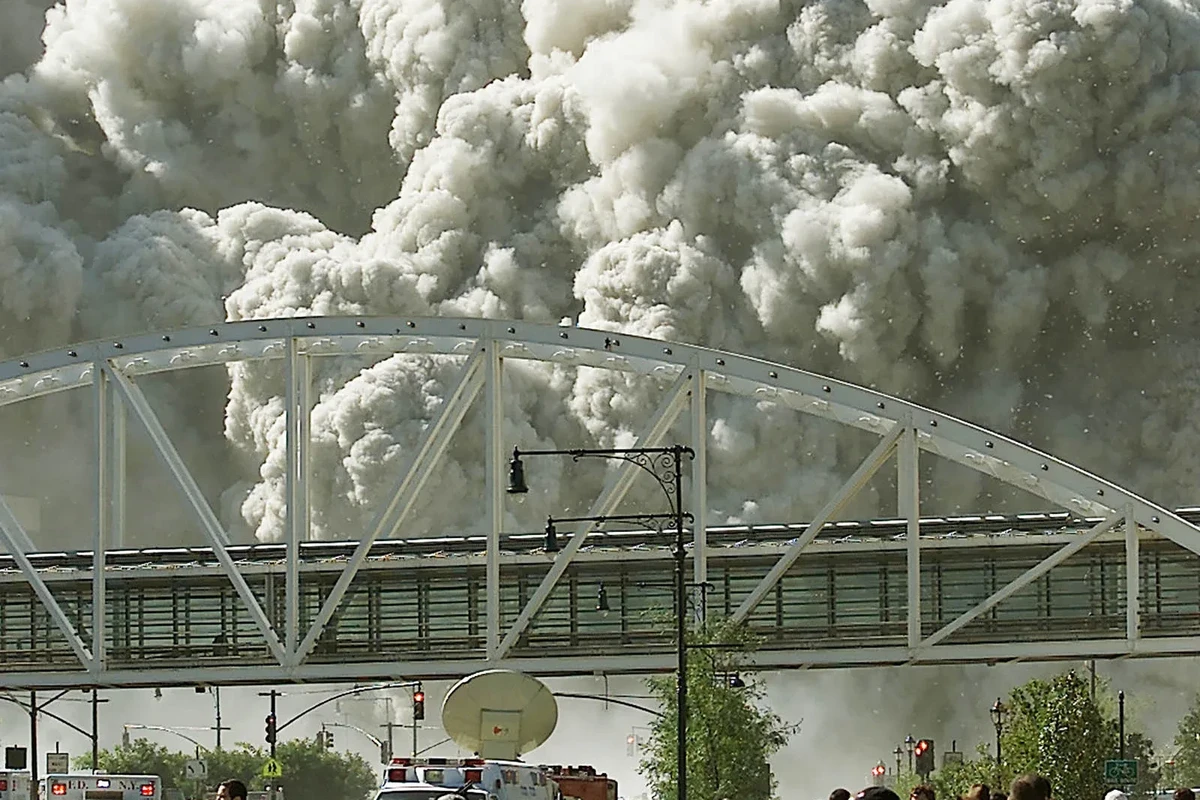
Timothy Townsend was just blocks away from his office at the World Financial Center when the first plane crashed. He grabbed his notebook and ran outside
The following article appeared in the Oct. 25, 2001, issue of Rolling Stone.
The first thing I saw in the parking lot across Liberty Street from the South Tower was luggage. Burned luggage. A couple of cars were on fire. Half a block east, a man who’d been working out in a South Tower fitness club was walking barefoot over shards of glass, wearing only a white towel around his waist; he still had shaving cream on the left side of his face. Bits of glass were falling to the ground like hail. I ventured a block south, away from the towers, and that’s when I started seeing body parts. At first, just scattered lumps of mangled flesh dotting the road and its sidewalks, then a leg near the gutter. Someone mentioned a severed head over by a fire hydrant. Hunks of metal — some silver and the size of a fist, others green and as big as toasters — were strewn for blocks south of the buildings. Shoes were everywhere.
“Oh, Jesus,” I heard someone say. “They’re jumping.” Every few moments a body would fall from the North Tower, from about ninety floors up. The jumpers all seemed to come from the floors that were engulfed in flames. Sometimes they jumped in — one just after the other. They were up so high, it took ten to twelve seconds for each of them to hit the ground. I counted.
What must have been going through their minds, to choose certain death? Was it a decision between one death and another? Or maybe it wasn’t a decision at all, their bodies involuntarily recoiling from the heat, the way you pull your hand off a hot stove.
Moments later, a low metallic whine, quickly followed by a high-pitched whoosh, came out of the south. I looked up to see the white belly of an airplane much closer than it should have been. The South Tower of the Trade Center seemed to suck the plane into itself. For an instant it looked like there would be no trauma to the building — it was as if the plane just slipped through a mail slot in the side of the tower, or simply vanished. But then a fireball ballooned out of the top of the building just five blocks from where we stood.
People were running south down the West Side Highway toward Battery Park — the southern tip, the end, of Manhattan — and west toward the Hudson River. I ran with the crowd that veered toward the river, looking back over my shoulder at the new gash in the Trade Center. Once relatively safe among the tree-lined avenues of Battery Park City, people hugged each other and some cried.
But about five minutes later, a sharp cracking sound momentarily replaced the shrill squeal of sirens, and the top half of the South Tower imploded, bringing the entire thing down. It was the most frightened I’ve ever been. Screaming and sprinting south toward Battery Park, we all flew from the dark cloud that was slowly funneling toward us. At that moment, I believed two things about this cloud. One, that it was made not just of ash and soot, but of metal, glass and concrete; and two, that soon this shrapnel would be whizzing by — and perhaps through — my head. A woman next to me turned to run. Her black bag came off her shoulder and a CD holder went flying, sending bright silver discs clattering across the ground. An older man to my right tripped and took a face-first dive across the pavement, glasses flying off his face.
In the seconds, minutes and hours following the World Trade Center attacks, hundreds — maybe thousands — of ordinary people would find their best selves and become heroes. And then there were the rest of us, running hard, wanting only to live and to talk to someone we loved, even if it meant leaving an old guy lying in the street, glasses gone, a cloud of death and destruction creeping up on him.
I’d always wondered what I’d do in a life-or-death situation. Until that moment, I’d believed I’d do the right thing, would always help the helpless, most likely without regard for my own well-being. All across lower Manhattan at that moment, people were making similar decisions, so many of them so much more critical than mine. September 11th, 2001, at 9:45 a.m. was not my finest moment. As I turned back to help, I saw two younger guys scoop the fallen man up, and we all continued running south.
After about three blocks, I hid for a moment behind a large Dumpster on the west side of the street. But when I looked back toward the towers, I could see that my Dumpster was no match for the cloud, and I took off again. I ran the last few blocks into Battery Park, where the cloud finally did catch up with the thousands of us fleeing it. I could see only a few feet in front of me, and so I followed the silhouettes I could make out. Because Battery Park is the tip of the island, it wasn’t much of a surprise that the crowd would wind up dead-ending at the water. When it happened, the people in the front panicked. So they turned around, screamed, and ran back toward us in a stampede. We had nowhere to go — there were thousands of people behind us and hundreds coming back the other way.
As the crowd doubled back on itself, I jumped over a wrought-iron fence and landed in a flower bed. I stayed down for a second, thinking I’d wait out the panic low to the ground. But then I felt other people jumping the fence and landing near me. Thinking I was about to be trampled, I got up and ran behind a nearby tree. In a minute or two the panic subdued, and I hopped back over the fence and onto a park path. But now the air was heavier with debris and there was no clear path out of the park. I took off my tie and wrapped it around my face. People were coughing and stumbling. Some were crying, others screaming. It was difficult to breathe or even keep my eyes open.
Soon, there was another wave of calm and quiet, and the ash that fell from the sky and settled on the grass and trees gave the park the peaceful feel of a light evening snowfall. Eventually, I found a path that led me out to the east side of the Battery area, and I followed a crowd to the FDR. Thousands participated in the exodus up the highway and into Brooklyn. It was now just past ten, and we looked like refugees. In a way, we were. My tie wasn’t doing much good against the ash, so I took off my shirt and tied it around my head. We walked in the falling gray dust for fifteen minutes, still hacking, and rubbing our eyes. Then the cloud broke, and, covered in soot, we were in the sunlight again. There wasn’t a lot of talking. Some walked in groups, desperately trying to stay together. Others walked alone, crying out the names of friends, co-workers or loved ones from whom they’d been separated.
At 10:25, as I was getting ready to cross the bridge, another cracking sound came out of the west. We looked behind us and to the left to see the remaining tower collapse. Soon, that ash reached the Manhattan foot of the Brooklyn Bridge, and the bridge was closed. Three hours later, I was finally back in my apartment in Brooklyn. It was nearly one o’clock. There was a thin layer of ash all over my kitchen from the blast. I made my phone calls and cried with my fiancée. Then I called some friends who’d left messages, checking on me. I called my friend Sully in Boston, and we went through the list of names of our friends who worked in the financial district. I was one of the last to be accounted for. When we’d gotten through most of the names — Sims, Kane, T-Bone, Molloy — Sully said, “It’s not all good news. Beazo called his wife from high up in the second building to say he was OK, but she hasn’t heard from him since it fell.” Beazo — Tom Brennan to those he didn’t go to high school or college with – still hasn’t been heard from.
As it turns out, when I was watching that tower fall, I was watching my friend die. His wife was at home, in their brand-new house in Westchester County, amid their still boxed-up life. She’d already turned off the TV when Beazo’s building collapsed. Their seventeen-month-old daughter is too young to have seen the images of her father’s death, but someday — maybe on a distant anniversary of September 11th when each network commemorates the tragedy — I’m sure she’ll be able to see it, along with her little brother or sister who is due in two months.
I hung up with Sully and turned on the television to see what I had seen. Places where I once ate lunch or shopped for a sweater or bought stamps were now buried under piles of concrete and metal, as were thousands of people – some of whom I probably rode the subway with every day. One of whom was my friend.
Since then, I’ve been freakishly fine, given what I’d seen. Maybe it’s because I realize how lucky I was — my experience was like Christmas morning compared to what other people went through. Maybe it’s because I lack the imagination, or the will, to realize the scope of what I’d seen. But sadness works in bizarre ways. The second night after the attack, I sat in front of the news, alone with my eighth or ninth beer, and I listened to a report about NFL officials considering a postponement of the second week of games. I thought about what a nice gesture that would be, and I cried and cried.
The Great Outdoors Comedy Festival has postponed its debut, just days before John Mulaney was scheduled to headline the Mississauga, Ontario event.
The festival was set to take over Erindale Park from September 11 to 13, with Mulaney, Hasan Minhaj, Ronny Chieng, Jeff Arcuri and many others on the bill. Instead, organizers announced yesterday that the entire weekend would be postponed, without providing a specific reason.
“After careful consideration,” the festival said, it decided postponing the event was the best way to deliver the “best possible festival.” Organizers say they are now exploring new dates and will contact ticket holders directly.
The announcement comes after a series of lineup changes in the weeks leading up to the festival. Nick Kroll and Mike Birbiglia were among the comedians originally scheduled to appear alongside Mulaney, while the festival’s published lineup was later revised.
See on Instagram
Mulaney, who has in the past had to cancel many shows in the GTHA, made clear Wednesday that the decision did not come from him. “It was not my decision,” he told Ontario fans, confirming that the festival producers had decided not to proceed with the weekend. He added that he intends to perform in the region soon.
The festival has not yet announced a reason for the postponing, replacement dates or a refund policy. For now, the Great Outdoors Comedy Festival is offering few answers beyond “stay tuned.”
“When things fall apart, men isolate and withdraw from the world more,” says Ronson.
“This story crashed unannounced into my life,” Jon Ronson tells me. It’s a lazy summer afternoon in the hamlet where he lives in upstate New York, and the journalist and author of The Men Who Stare at Goats, So You’ve Been Publicly Shamed, and The Psychopath Test is explaining the genesis of his latest book. He describes a night, almost exactly three years ago, when he slept through a series of texts that came in from his adult son. The messages told a disconcerting story: His son’s friend, a woman, had connected with a man on Tinder, who invited her to come over to his castle in a rural part of Connecticut and bring some friends. According to his son’s description, Ronson says, the structure was a “vast, newly-built castle, ostentatious even by Gothic castle standards. Like, Count Dracula would think this is a bit much.” There were turrets, and a drawbridge, but in the grand ballroom, there was no sign of a party. “There’s a couple of other young people looking awkward and wondering what the hell is going on, but nobody knows what’s happening. Everyone’s confused.”
When the middle-aged castle owner emerged, he introduced himself as Chris Mark. The assembled twentysomethings asked him what was going on, and he told them they were there to take part in his new reality show, 101 Princesses. “He said, ‘I’m the king. I’m looking for my queen, and I have 101 princesses to choose from.” He sent the women down to the basement, where they could find princess costumes to wear. “They went with it, I guess out of unease, awkwardness,” Ronson says. “A videographer appears. They start filming. It becomes pretty clear pretty quickly that this isn’t a real reality show. One reason being that the videographer kept cutting up [a slab of] meat for the castle owner. Just for him. No meat was offered to anyone else.”
Ronson, who was also host of the hit porn-industry investigative audio project The Butterfly Effect, has made a career of letting his curiosity get the better of him. So, the next day, he went to the castle “to find out what the hell was going on,” he says. “And that’s how the book begins.”
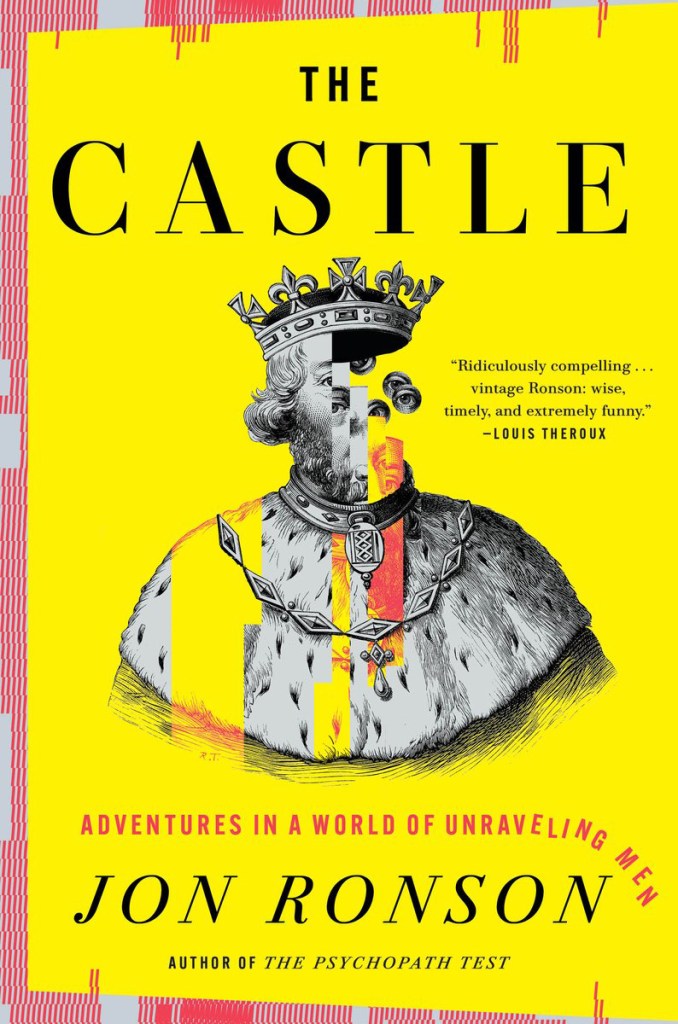
The Castle: Adventures in a World of Unraveling Men (out now from Riverhead Books), reads like an adventure story. Though much of it is framed around his interviews and interactions with Mark — the wealthy descendent of a Gilded Age baron — it opens up to a larger pursuit to understand the state of men, and how the breakdown of societal support, coupled with the rise of a technological state, has brought so many to the brink.
In the book, Ronson travels to the Midwest to visit a town built by Mark’s great grandfather in the 19th century, a recreation of a British village set under power plants and steel factories, where he talks to the man keeping its history alive. He charts the career path of an early YouTube star, Greg Chism, who went from being one of the first lawn-care influencers to chasing the algorithm by posting videos of his two young daughters. What starts as wholesome family content takes a left turn when he begins dressing up his daughters as babies, then donning a baby costume himself, before he’s ultimately all but run off the platform. Ronson includes chapters about Graham Linehan, the creator of huge British sitcoms like Father Ted and The IT Crowd, who became a prominent anti-transgender activist, and Armie Hammer, whose acting career crumbled after his cannibalism kink was revealed. Ultimately, Ronson develops descriptions of the different kinds of men who thrive online — the Vulnerable Man, the Doofus Man, the Manosphere Man, the Separatist Man, the Disinhibited Man — and what these modern archetypes communicate about the world we live in. And throughout it all, he comes back to his own unease about his place in the world. If a man doesn’t have purpose, what’s left?
Chris Mark is a fascinating character — he built this castle for his daughter, but then turned it into a sort of alternate-reality Playboy Mansion. At what point did you realize that his story was going to lead to your next book?The first thing I heard about the castle owner was that he was a big fan of Hugh Hefner. I thought, this is really funny. He’s trying to be Hugh Hefner at the worst moment in human history. I linked him with my feelings of unease, as well, about not having enough purpose. It felt like there were weird echoes there. I thought, this is a man out of time. He wants a world that’s no longer going to work for somebody like him, and maybe I should write a book about all these other things that men are no longer able to do that they used to be able to do.
One of the things you write about in the book is how people are reflexively dismissive of the problems of straight white men. What made you want to tackle this when you knew that there was going to be pushback?I think [of this] a little bit like my public-shaming book. People may not like the idea of the book, but then when they read it, they realize that their idea was wrong. Many times over my career, I’ve had this. Nobody wanted to read The Men Who Stare at Goats. The only book I’ve ever written which sold itself was The Psychopath Test — if you put “psychopath” in the title, you don’t have to do that much work. But what I do, I think, over and over again in my career, is look at how big changes that happen on high trickle down and impact the inner lives of people down here. But mostly, it was a book that crashed into my life, this big fucking castle that my son was lured to under false pretenses, and I just wanted to know what the hell was going on.
But let me add one more thing, and I think this applies equally to women as to men. One thing that I became really interested in is this: Structures and institutions collapse, and people feel cut adrift from society, and it does seem to be something that happens more to men than women. There’s more of a weakness in men, that when things fall apart, men isolate and withdraw from the world more. But I got really interested in that — like, what does a lack of purpose and structure do to people’s inner lives? And what’s filling the gap? And one thing that I found that’s filling the gap is content creation on YouTube.
Do you think, as these societal structures break down, the fact that men can’t live up to the preconceived notion of masculinity that they were fed as kids — being a provider, a protector — that’s part of what’s making them feel lonely?There’s a moment in the book when Greg Chism is the world’s greatest lawn-care influencer, but then his life spirals in the most bizarre ways. He starts to listen too much to the algorithms, and everything goes wrong. And it ends with him basically withdrawing from the world. But I ask him what his life’s like now, and he says, “Well, I wake up, I take my kids to school. I come home. I fall asleep. I wake up and I bring the kids back home from school.” I mean, what a terrible, depressing life. For me, it’s the erosion of structure which is causing so much horror in people’s lives.
So you think people are dealing with this by becoming content creators?It’s funny, I went to the cage fight at the White House [in July]. Everybody [in the press pool] was allowed to inspect the cage a couple of days earlier, so we all had to be at the White House at like half past five in the morning. Like 100 people were there, and we were all standing on the steps of the Eisenhower Building, and somebody from the UFC came up and yowled, “OK, everybody, content creators and videographers, step to the left, print journalists step to the right. And there was this vast exodus to the left. Like 98 percent of the people there were content creators, and the print line was like me [and a few other journalists]. And we were just laughing, like, “Oh, my God, we’re such redundant dinosaurs.” So that’s the kind of thing I’m talking about, like a huge shift from the old institutions that I grew up in, to the sort of post-institution era.
How do you think AI chatbot technology plays into accelerating this?It makes it so much worse. AI trawls the internet, sees how purposeless people feel, how lost, and comes in with a false idea of purpose. Like, “You’re the greatest mathematician on the planet,” or, “You’re creating the greatest reality show ever.” It’s so pernicious. It’s so evil. It’s like they’re swooping in to keep us engaged through sycophancy.
Going back to Greg Chism, the lawn-care influencer, one of the things that I found so stark in that story was how he kept changing his content to please the YouTube algorithm so he could get views. What did you find in reporting this book about people who are trying to contort themselves to the pleasure of the computer?His story has got to be one of the most extraordinary things that ever unfolded on YouTube. Like how he goes from lawn care through to all the stuff that happened after that, which is just nuts. Do you remember that novel, The Dice Man, by Luke Rhinehart? It’s about a character who decides to cede his life to the roll of a dice. Every decision he makes, he makes for the roll of a dice, and that’s what people are doing now on YouTube. If they give themselves over too much to the algorithm and the incentive structures, you end up doing more and more extreme things.
I think it’s partly because YouTube gained the reputation of being this wide-open country, like a post-institution utopia where men and women could thrive through grit and perseverance as an influencer, which is a very compelling idea. I grew up in a world of gatekeepers, and it was awful to have to beg people to give me a chance. It’s very compelling to have a world without that, that feels like it could be a true meritocracy where good people rise to the top. And good people do rise to the top. It’s not like it’s all an illusion. Greg Chism’s story and lots of other stories show that if you cede your life to the algorithm — and not just the algorithm, also what the viewers are encouraging you to do — it just leads to hell, and Greg’s story leads to hell in the most baroque and unexpected ways. But I think you could say the same thing about smaller stories, like anti-woke influencers, is a good example of another way that this manifests in sort of pernicious ways.
Another person you write about is your former friend, Graham Linehan, who went from being pretty universally beloved in Britain to becoming one of the country’s loudest anti-trans voices. He attacked you extensively online after you called him out for being a bully, too. Tell me about your decision to include such a personal story in this book.Well, it was very hard. I’ve been trying to write about Graham since 2020, and I’ve picked it up and put it down many times because I could just feel my stress levels rising. Because, you know, Graham’s story is, he became a gender-critical activist, and just made it his absolute identity. And he has his bêtes noires, and I’m one of them, and he’s posted about me thousands of times by now.
The Graham chapter was much longer, but it stressed me out so much. I cut it in half, but it’s like that scene in Poltergeist when you open the door in the bedroom and there’s all this furniture spinning violently around, and I think I’m a piece of furniture spinning violently around inside Graham’s head. I told him I thought he was acting like a bully back in 2019, and all these years later, he’s still going on about it. But I think there’s three or four reasons why I thought I should write about it. Firstly, the only reason to not write about it is fear, and I just don’t think, as journalists, we can be guided by fear.
Secondly, I’ve often thought about Graham. So Graham, for people who don’t know, was a huge figure in British cultural life, maybe a good equivalent would be like Judd Apatow. He was this showrunner of some of the most beloved comedies in British history, and then he fell into this new world in this extraordinary way. I hope this doesn’t sound glib, but I’ve always thought there was like an epic quality to Graham’s story. It was like if Harold Pinter or Tom Stoppard was writing a play about Graham, it would be an incredible play.
But the main reason [I wrote about him] is that I really wanted to do something about disinhibited men. What I discovered was that, when men feel cut out, cut adrift from society, some fold in on themselves. Some adapt. Some lash out. Graham is somebody, and you see it in a lot of different places, who basically decided to just be completely disinhibited, to basically rip off his face, and just allow his head to run wild. It’s as if he’s just decided nothing matters anymore. I thought that felt so extraordinary, but also so resonant to the world we’re living in now of disinhibition.
Tell me about Marktown, the town in Northwest Indiana that was built by Chris Mark’s great grandfather, and modeled after a British village. What did you find when you went there?I really wanted to do something after the castle mystery, you know, exploded into my life, and I decided I wanted to broaden it out into other men, feeling that life was passing them by, and then I thought, well, I’d love to do something about deindustrialization, but how? And also, men who are withdrawing from the world and becoming recluses, but how? And then I discovered, just incredibly fortuitously, that the castle owner’s great-grandfather was a Gilded Age steel tycoon. That’s how he got his money to build his castle, and he had built a utopian theme town in East Chicago, Indiana, for his steelworkers to live in. And over the years, this utopian town, which at the beginning looked great, has completely crumbled into a world of recluses and hoarders. Marktown’s designed to be this lovely English village, like a Miss Marple-type village where some kind of Agatha Christie adventure would happen, but it’s completely surrounded by heavy industry. So it’s like Miss Markle being like scrunched up and thrown into the middle of Wall-E. And when you look at an aerial photograph of Marktown, you just can’t believe it. It’s like nothing on Earth. So yes, so very fortuitously, I got to tell that story of deindustrialization in a way that’s completely relevant to the castle story.
Toward the end of the book, you write a little bit about an interview you did with Armie Hammer after his “cannibalism” scandal broke.So the story is, I got a call. He was filming in New Orleans, and I knew some of the people involved in the film [called Wounds], and they invited me to New Orleans to visit the set. We had dinner with Armie Hammer and his wife and the various movie people, and Armie talked a lot about meat, how much he liked meat, and he was utterly delightful and charming, and it was a great night.
So then a couple of years later, it all happens, the whole cannibal stuff, and then a couple of months after that he contacts me, and I fly to interview him. He says I’m the first person ever to interview him [since the scandal], and he tells me the whole story. But I sit on it. I don’t know what to do with it because there’s some things where he’s definitely right, but then there’s other things where he hasn’t behaved well. Like he would sweep women off their feet and take them to Ojai, and then give them the time of their life, and then come back and drop them off, and completely forget about them. And I thought, I need time. Like I just, you know, this is a story that needs a lot of time. And [eventually] he gave the story to someone else. I felt slightly like one of the women that you take to Ojai. But you know what? I can’t blame him. I was taking way too long. So I have no ill feelings, but this interview was sitting on my computer for the next couple of years, and so I included a little bit of it because there were moments in our conversation which I think shed light on some of the motivations of the castle owner, and privilege, and people not being told that they can’t do things. I cut it down to its absolute minimum, to shed light on other stories in the book.
You’ve got a stage show of the book you’re taking on tour in the States and the U.K. Can you tell us about that?It’s called Enter the Castle. I always do pretty elaborate stage shows. I still do a show called Psychopath Now, based on my Psychopath Test book, where I have mystery guests, and I’ve done shows where I have a band onstage, performing with me as I’m doing the speaking. This time around, I’m using a lot of audio and video clips, and bringing the book to life as a series, almost like a live documentary that I’m narrating onstage. So I always make it ambitious.
Lindsay Clancy attends her murder trial on July 29.
Lindsay Clancy’s triple murder trial ended in a mistrial Friday after jurors said they were hopelessly deadlocked and a higher court rejected a last-ditch defense bid to intervene in the deliberations.
“I’m going to declare that the jury is deadlocked, and I’m going to declare a mistrial,” Plymouth County Judge William Sullivan said from the bench Friday afternoon, according to a livestream of the trial by Channel 5 Boston. He then thanked jurors for their service during the heart-rending trial of the Massachusetts mother charged with killing her three young children during what defense lawyer Kevin Reddington described as a severe episode of postpartum psychosis.
The ruling capped a chaotic day in which Sullivan said in the morning that he intended to declare a mistrial, Reddington called the decision a “travesty,” and the judge gave him “one hour” to seek an emergency stay from a higher court.
The scramble followed a Friday morning note from the jury foreperson saying jurors could not reach a unanimous verdict. A day earlier, the jury had reported an 11-1 split, with a lone holdout preventing a verdict.
“It is with a heavy heart that we report we are unable to come to a unanimous decision and will not be able to,” the jury’s Friday note said.
Reddington disclosed in court that the holdout was a man and seized on the phrase “heavy heart,” arguing that it suggested jurors had reservations about a mistrial. Citing the foreperson’s Thursday note, he said the holdout had “made statements acknowledging doubt” but “will not apply reasonable doubt to the evidence to return a not guilty verdict.”
Reddington had previously asked the judge either to remove the holdout and replace him with an alternate or to order the jury to continue deliberating. The judge denied both requests, saying that removing a juror during deliberations was an extremely fraught and “sensitive” step, and he did not believe there was sufficient cause to take it. The parties are due back in court Sept. 29 to discuss what happens next. In the meantime, the charges against Clancy remain in effect.
Plymouth County District Attorney Timothy Cruz told reporters outside the courthouse that his office had not yet decided whether to retry Clancy. She remains held without bail at Tewksbury Hospital, a state-run psychiatric and medical facility.
During the closely watched trial that became a viral phenomenon, prosecutors argued that Clancy was deeply troubled but understood that what she was doing was wrong when she strangled her children with exercise bands. They asked the jurors to convict her of three counts of first-degree murder.
The defense argued that Clancy should be found not criminally responsible due to improperly treated mental illness, a verdict that likely would have resulted in her indefinite commitment to a forensic psychiatric facility.
During the divisive seven-week trial, prosecutors claimed the killings were “meticulously” and rationally planned by a controlling mother who was depressed and exhausted but not psychotic when she decided to kill herself and take her children with her. They asked jurors to hold Clancy criminally responsible for killing Cora, 5, Dawson, 3, and Callan, 8 months, in the basement of the family’s home in a suburb of Boston on Jan. 24, 2023.
“This is not a public debate about women’s mental health and how the medical system treats women,” Plymouth County Assistant District Attorney Shanan Buckingham said in her opening statement on July 27. But the trial became exactly that.
Clancy’s defense centered on testimony that she was suffering a complete psychotic break and hallucinating a commanding male voice outside her body, telling her to kill the children so she could then kill herself. Following the strangulations, Clancy used a kitchen knife to slash her own throat and wrists before she “threw herself” out of the second-story window of her bedroom, shattering her cervical spine, Reddington said. (A former labor and delivery nurse at Massachusetts General Hospital, Clancy, 35, was paralyzed in the fall and sat through the trial in a wheelchair.)
Jurors heard that after Callan’s birth, Clancy struggled with debilitating depression, sleep deprivation, intense anxiety, psychotic symptoms of dissociation, and intrusive thoughts about harming herself and the kids. She was “spiraling down,” Reddington said, at times crying hysterically or appearing like a “zombie,” as she repeatedly begged for help. The homicides happened just two and a half weeks after she was discharged from a psychiatric hospital.
Clancy was prescribed more than a dozen psychiatric medications over roughly four months, jurors heard. Trial testimony revealed a fragmented course of care from a rotating cast of prescribers who didn’t seem to have the full picture of Clancy’s mental state and medical records. Online, many trial observers seized on those gaps, claiming Clancy was failed by a system that expected an unstable patient to carry her critical information from one provider to the next.
In his closing argument, Reddington accused prosecutors of being “manipulative” by calling a witness who floated the theory that Dr. Paul Zeizel, a defense psychologist, planted in Clancy’s head the idea that she heard a voice ordering her to kill the children. He pointed to testimony from Sheila Cavanaugh, a chaplain at Brigham and Women’s Hospital, who met with Clancy immediately after the January 2023 killings.
During the trial, Cavanaugh testified that Clancy described hearing a “persistent” voice that “told her that if she did not follow the command, neither she nor her children would be safe.” Reddington argued Cavanaugh was present when Clancy was extubated and around for eight days before Dr. Zeizel even knew “Lindsay exited.”
“She told Sheila first that she heard voices, command hallucinations,” he argued before the case was handed to jurors for deliberations on Thursday, Aug. 27.
Shortly after the trial started, it quickly became a social media cause célèbre, with countless moms taking to Instagram, Facebook, and TikTok to say they saw echoes of their own postpartum struggles in Clancy’s private writings and Google searches. While postpartum psychosis is rare, affecting an estimated one to two people per 1,000 births, postpartum depression is much more common.
As the trial unfolded, supporters said they identified with Clancy’s notes about feeling overwhelmed and exhausted, and the crushing guilt she experienced over her choices related to breastfeeding, sleep-training, and how she divided her attention among her three kids. A medical expert for the defense testified that struggling mothers, such as Clancy, might minimize their psychiatric symptoms out of fear they could be reported to child protective services and lose custody of their children. The expert said Clancy also may have worried that disclosing her most severe symptoms could jeopardize her nursing license. (Prosecutors argued that Clancy’s decision to share her intrusive thoughts with her husband and mother, but not with her medical providers, was evidence of rational thinking because she understood that disclosing them to clinicians could have consequences.)
As public support for Clancy grew by the day, online sleuths went to work challenging the prosecution’s narrative, closely scrutinizing witnesses and criticizing authorities for not investigating certain details more aggressively. Some went further, circulating theories that questioned whether Lindsay Clancy had even killed the children at all. They argued that Clancy’s injuries, including her extremely low body temperature and damage to her thyroid gland and voice box cartilage documented at the hospital, were inconsistent with prosecutors’ account of what happened and raised the possibility of foul play.
Reddington, a veteran defense attorney, attracted a devoted following among trial watchers who praised how he held his client’s hand during difficult testimony and comforted her when she broke down in sobs. He was lauded online when he excoriated prosecutors for bringing a case that he said would “kill the soul” of a mentally ill mother who “loved those children up to the time of their death.”
“She knows that she killed these children,” Reddington told the jury. “She’s living her own hell. She knows what happened with those kids, and she wanted to die.”
Clancy’s former husband, Patrick Clancy, testified that he watched his wife’s condition steadily deteriorate from mid-October through December 2022. “She just kept getting worse and worse,” he testified.
As Clancy’s struggles deepened, her parents visited regularly from Connecticut to help out with the kids and support their daughter, he told jurors. “We didn’t have a diagnosis,” Patrick Clancy said. “We just didn’t really know what was wrong.”
He testified that Clancy told him she worried about harm coming to the children, but she denied having a plan to do anything herself, he said. Her behavior at other times appeared ordinary, he testified.
“It was very confusing because a minute later she was making lunch or playing with them or getting them ready for bed or whatever it was,” he told the jury. “I never saw Lindsay harm the kids.”
Describing the night of the killings, Patrick said he left the house to pick up some medication and takeout food for the family. When he returned, the house appeared eerily quiet. He went upstairs, found the door to the primary bedroom locked, managed to open it, and saw “blood everywhere,” with the window open, he said. When he ran outside, Clancy was on the ground with deep cuts to her wrists and a cut across her neck, he testified.
Clancy, who was in and out of consciousness, allegedly told him the children were in the basement of their Duxbury home, he said. Once paramedics arrived, he ran to the basement while still on the phone with a 911 operator. He found the children unresponsive, with exercise bands around their necks.
The two older children were pronounced dead at the hospital. The couple’s 8-month-old died several days later. As he testified about the horrific scene and losing all three children in one night, Patrick Clancy’s chin was quivering. Jurors and people in the courtroom heard his 911 call, but the judge did not allow it on the public livestream.
In his testimony, Patrick said his wife called him not long after the incident from the women’s hospital where she was being treated. “She didn’t talk about our kids. She talked about what she went through,” he told the jury. “She said she heard a man’s voice telling her that if she didn’t do it now, she would lose her chance.”
Investigators said that before killing her kids, Clancy researched how long the trip to the restaurant and a pharmacy would take so she would know how much time she had alone with the children.
After the killings, Patrick said in a statement that he had forgiven his wife and urged others to do the same. “I wasn’t married to a monster,” he later told The New Yorker. “I was married to someone who got sick.”
Both Lindsay and Patrick Clancy have filed separate lawsuits against her medical providers, alleging they failed to properly diagnose, treat, and monitor Clancy’s postpartum psychiatric condition.
“Lindsay Clancy did everything a mother in her situation could do,” her lawsuit says. “She recognized something was wrong with her. She sought medical treatment. She went to emergency rooms. She called crisis hotlines. She admitted herself to hospitals. She took the medication prescribed to her. She communicated her worsening symptoms to her providers. She told them the medications were making her worse.”
Hunter Biden, son of U.S. President Joe Biden, during a Medal of Freedom ceremony at the White House on Jan. 4, 2025.
I didn’t know what to expect when I met Hunter Biden. Would he have the Secret Service with him? Would he be cold? Would he be an asshole?
Biden, who is in recovery, was coming on my podcast, Dopey: On the Dark Comedy of Drug Addiction. He is exactly the kind of person I like to have on the show. When I started it in 2016 with my friend Chris O’Connor, our plan was to create a podcast all around the worst things we had ever done in active addiction. Chris wound up relapsing and tragically dying from a fentanyl overdose in 2018. I kept the show going, still focused on the insanity of addiction and ways that we can overcome it.
A few weeks ago, I flew to Los Angeles for the interview with Hunter Biden, and we met in a studio in Santa Monica, near where he lives. Biden casually arrived through the sunny back door. He was alone, came in smiling, and gave me a big, warm hug — not a weird, manipulative hug, which can be prevalent in the recovery community. It turned out we had mutual friends, and he knew about my podcast and how we were basically a for-addict-by-addict operation. He was happy to be there, and he fit right in.
I wanted Biden to come on the show because I know he was a drug addict like the other Dopes in the Dopey Nation. His exploits as a crack addict were legendary, his fall was well known and epic. The only difference between his story and our listeners’ stories was that their fathers hadn’t been president, and they haven’t been on the cover of the New York Post more than, as he puts it, “more than anyone else in history.” There is scrutiny, and there is Hunter Biden-level scrutiny. People struggling with addiction often feel the weight of the world on them. In Biden’s case, it kind of was on him. Pictures of him, naked and high, were plastered on TV screens around the world. His father’s political enemies used his problems with crack to try and erode trust in the Biden administration. His addiction or sobriety became connected to the state of our nation.
How did he get sober? What is it like to have the bar on his recovery set so high? The answers to these questions are very important to our community of addicts and alcoholics, both in and out of recovery.
During the interview, Biden and I covered a lot of ground. There was the basic Recovery 101 stuff, the immense trauma he suffered from losing his mother and sister in a horrific car accident when he was three years old. How his addiction began, and how the death in 2015 of his brother Beau, just 46, pushed him over the edge into crack addiction. And maybe most importantly we spoke of how meeting his now-wife Melissa set him on his current path of over seven years in recovery. We also covered some of his craziest moments using drugs; my favorite being the story of when he moved his crack dealer, whom he called Bicycles, into his apartment, and what it was like when his father, who was then the Vice President of the United States, arrived by presidential motorcade and met Bicycles face to face. It turned out to be one of my favorite talks in Dopey history.
The whole interview can be found on my podcast, but here are some highlights of our conversation.
What is the trickiest part of sharing your recovery story with the public in general?We get to talk about the beauty of our recovery and all the things that we’ve gained, like the amends that we get to make and what a wonderful existence that I am free to talk about anything I want. And I wanna make it clear that the hardest part of recovery and addiction is the effect on the people around us, the traumas that we put them through.
Like I always say, the biggest thing with my daughters was that I just was not available to them. I wasn’t present in their lives during that period of time.
Well, it’s a hell of a lot more fucking complicated than that. And a lot more traumatic than just that. And it’s easy for me to say, and we have a great relationship and we’ve amended everything. But when the shit really hit the fan with my addiction, they were in their formative years, between 16 and 20 and 21.
They really needed me when my brother died — my brother was their rock. My brother was their second dad and in every beautiful way that you can imagine. They loved their Uncle Beau. And when he died, I disappeared.
Cause you were destroyed.I was destroyed. But my reasoning or the rationale or my experience doesn’t matter to the trauma that it creates in a child. I have all my reasons for why I lost my shit. But you know what? Doesn’t matter. What really was the thing is that when they needed me most, I wasn’t there. And you can live a life trying to make amends for that. But I think it’s really important for me to always remember… they’re still living with the trauma of it.
Biden and I spoke about a woman he calls Bicycles, who was a crack-cocaine dealer who moved into his apartment in Washington, D.C. She was a fascinating character in his memoir, and I was dying to hear the story.
Tell the Dopey Nation all about Bicycles, please.Well, Bicycles has been on the street basically her whole life, since she was like 13, 14 years old. She would tell these stories about how, for periods of time, the way that she survived is that she would sneak into motels when they were changing rooms, just to get sleep, and she would hide under the bed and sleep there. She would go into police stations and she would hide underneath the bench, and sleep underneath the bench, when she couldn’t find a place to stay. And she had this incredible story of resilience and survival, and she was incredibly smart. I mean like quick-witted, a fast-thinking survivor.
She was about 15 years older than me, and she rode everywhere on her bike. I knew that she was a crack addict, and so I walked over to Lincoln Park — and I was like, “Hey, I want some crack.”
And she said, “You sure?”
Did she know who you were?No, I don’t think so. She says, “Are you sure?” And I said, “Yeah.”
And she sold it to me. Then she showed me how to smoke it and gave me all the necessary things to smoke it. And I did. And I had what they refer to as a bell-ringer experience, and it was revelatory. It was the answer to everything. I even suppressed the visceral memory of it right now because it was that profound and powerful. And then that began a two-year odyssey of chasing that singular moment.
Does your dad ever meet Bicycles?He’d call and he’d call. And then when he wouldn’t get the calls, he literally would drive over with a motorcade, as small as he could possibly make it.
I’d hear all these cars, and I’d see like six SUVs pull up and my dad get out and and walk with one or two of the guys — because they have to be next to him — and I’d hear a knock on my door and I’d open it. There I would be with all of the obviousness of someone that was in distress. And he’d say, “Please, what are we gonna do tomorrow? What’s the plan?”
And I’d say, “I got a plan, and this is what it is. And I promise you, Dad, I’m all right. I just am feeling really sad. Sad about the divorce, sad about the kids, sad about Beau. Just let me deal.”
We make all of these excuses for all the things that we do.
Tell us about how your dad tried to help get you sober.Here’s the thing: you can’t force anybody. I mean you can; you can grab them and kidnap them like they do with these poor kids, and send them out into the wilderness, and I guarantee you there’s a 98 percent recidivism rate with those people.
Talk about creating more trauma.Yeah, and less trust. And so he was wise enough to know that. And he was wise enough to know this: All you can do is love. And unconditional love is not love without consequences. And unconditional love is not love without accountability. Unconditional love means that no matter what you do, I will still love you. No matter what the consequences of what you’re doing, I will still love you, and that was the door that he always, not just left open, but would always be calling from.
What is your painting process? How do you pick your subjects?I know why I paint owls because there’s a really beautiful story about an owl that I have.
Tell me a little bit of that story, please.Well, I don’t know if it was a hallucination. I think part of it was definitely a hallucination, but it doesn’t matter because it was a real outcome. And the outcome was that I had been up for literally over 10 days and smoking crack. I had agreed to go to this treatment [center] in Arizona.
I kept saying I’d come and I wouldn’t and I wouldn’t, and finally I got my shit together enough to pack everything, put it in a rental car, and drive to Prescott [Arizona]. At one point, there are eight lanes with that giant gully in the middle, and I hit it. I fell asleep. And this is, like, a funny story for me. What if I killed 10 people?
Well you didn’t, thank God.Thank God.
I called the rental car company and they got me a new car. They bring it and they ask, “What happened?”
I said, “Somebody ran me off the road.”
They said, “How are you going in the wrong direction?” I said, “Man, I don’t know,” like this was God’s way.
That’s crazy.I get back in the car, and in order to be able to go to Prescott, you have to go through the mountains. And it’s literally windy roads, and it’s four o’clock in the morning. I mean no amount of crack that I have left to smoke or anything is keeping me awake and if you doze off on that road, you’re done. I mean completely done; it’s like a sheer cliff kind of road. And I swear to God, this giant barn owl flies over — well, I assume over the roof — right in front of the windshield and into the beams of the light of the car in front of me, enough to where it kind of jolts me awake.
I’m looking at this giant owl in front of me, and it makes the turn along the road. So, I make the turn. And then it keeps coming back, and it’s literally guiding me through these windy roads.
Now it had to be a hallucination, right?I don’t know.
I think it was just a psychedelic spirit.You know what I know, though? Whatever that was, it was real to me at that moment, and it saved my life. And I got to Prescott.
Koko and Hedge tracking Flock cameras.
Campus security is on to us. For the past 30 minutes, I’ve been doing laps around a satellite campus of a small Virginia university in the back of a conspicuously rigged-out Toyota Tacoma, a fat disc-shaped antenna magnet-clamped onto its roof and connected to a thick tube of cables that run into a black box by my side. In the front seat are two professional security researchers – call them hackers, if you want – who go by their online pseudonyms Koko and Hedge. Koko and Hedge’s work is all above board, but they still ask me to keep their legal names off the internet. In return, they agree to take me hunting for the cybersecurity world’s greatest enemy: the AI-powered mass-surveillance cameras that have popped up all over America.
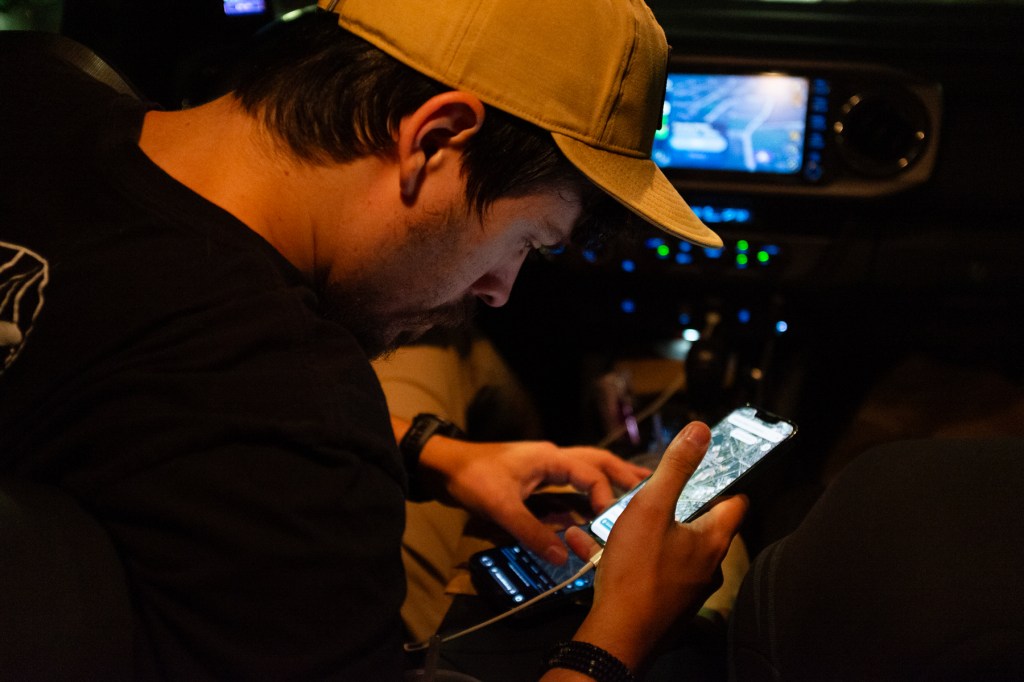
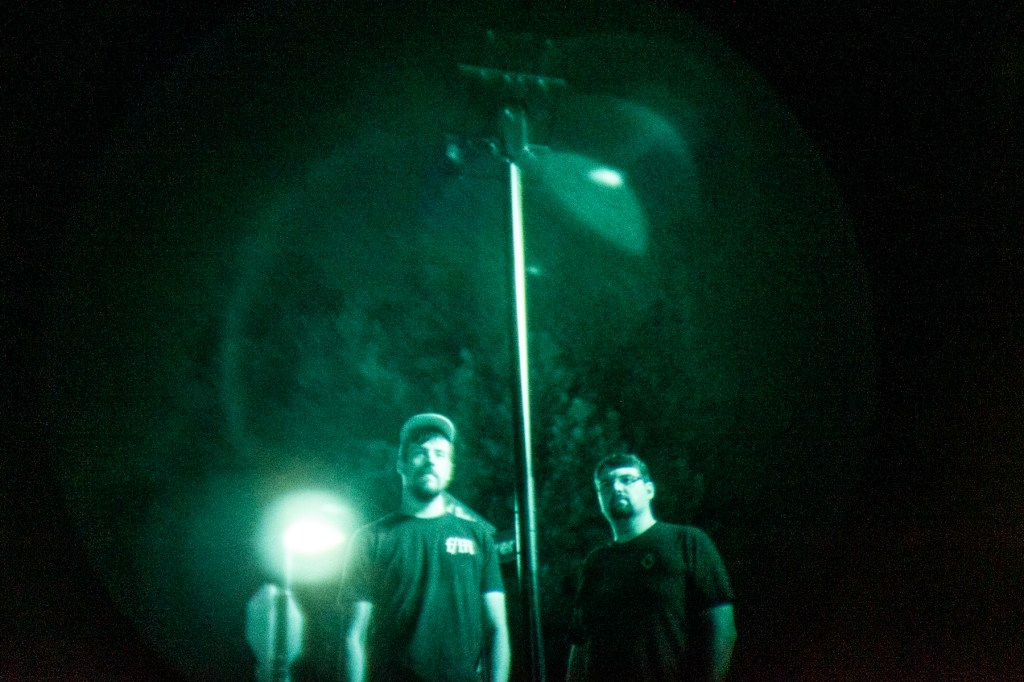
We spot our prey, but still need to get the shot — and we’ve already been passed by one city police squad car and another campus cop. Hedge is riding shotgun and navigating, neck bent over two iPhones, the glow lighting his face from below. Koko is watching for cops and keeping an eye on the numbers flashing on a small, homemade device fastened to his windshield. “OK, around this corner,” Hedge says. “We’re going to pass it on the right.” In the back seat, I twist around, trying to line up my phone camera with a night vision scope Koko brought along.
Koko crawls through the intersection. I get the target – a Flock Safety surveillance camera perched above the sidewalk on a long black pole – in frame just as its infrared flash goes off. It’s invisible to the naked eye, but on the night vision scope it’s a blinding pulse of white light. I catch it all on video — but it also catches us: the truck I’m in, the license plate, and almost certainly me, glued to the back window, phone in hand.
Over the past few months, Flock Safety has gone from a little-known, quietly-expanding security camera company into public enemy number one for a vast political coalition. Flock’s critics, which include left-wing anarchists, suburban soccer moms, libertarian computer dorks, and hardline far-right secessionists, have all claimed that the company’s nationwide network of interconnected surveillance cameras violate Americans’ right to privacy in new and frightening ways. That grassroots anger has, in turn, made Flock a defining issue in the 2026 election cycle.
“Little cameras, watching your every move, to collect information about you without you even noticing,” Michigan Senate candidate Abdul El-Sayed said in a new campaign ad on the website X. “That’s all been part of a regime that’s been pushed by, well, this guy: who happens to be the guy I’m running against – Mike Rogers.”
Opposition to Flock has also crossed party lines. In July, Tennessee Republican Rep. Tim Burchett introduced the Protection Against Mass Surveillance Act, a single-page, simple bill that would bar the federal government from “purchasing or accessing” any “mass surveillance” technology, specifically mentioning Flock cameras and devices that use biometric or facial recognition features to profile people.
“We’ve gotta put some guardrails in,” Rep. Burchett tells me over the phone. “You want to follow my ass, get a dadgum warrant.”
Flock, which has been around since 2017, primarily makes cameras known as Automated License Plate Readers, or ALPRs, which it then leases to cities, towns, and homeowners’ organizations, promising their clients an always-on, easily-searchable database of surveillance footage for stopping crime. There are many companies who make ALPRs, many of which offer similar services, but in the past few years, Flock has come to dominate both the market for this technology and the spotlight that it now commands. In some form or another, license-plate capture technology has been around for at least a decade — but privacy experts and security researchers have warned that the Orwellian capabilities and slap-dash vulnerabilities of Flock’s cameras represent a new, drastic security threat for everyday citizens like you and me.
Flock claims its cameras focus only on vehicles — but critics say they’re collecting so much more: giving the government tools to analyze identifying features on vehicles and pedestrians alike, creating profiles that can log everything from a bumper sticker on a car to the color of clothing a jogger wears. That data is held by a private company, which sells it to whoever is willing to pay. And once they have it, anything goes. Across America, rogue cops have used Flock data to stalk ex-wives and girlfriends, held families at gunpoint after faulty readings, and kept one woman in jail for 13 days before admitting that the cameras had led them astray. Mistakes happen in police work, of course, but security researchers also say Flock is also barely bothering to secure their cameras: they’re easy to hack and exploit by anyone with the right gear. All this adds up to a systemic invasion of privacy that is causing sane and rational experts to use words in interviews like “panopticon” and “big brother.” The future is here, and our laws have yet to catch up. Flock did not respond to a detailed list of questions sent by Rolling Stone.
“In the old days, it was just impossible to do these things,” says Andrew Crocker, a senior staff attorney at the Electronic Frontier Foundation who leads the privacy organization’s surveillance cases. “You couldn’t follow someone around 24 hours a day. That was just physically impossible. This technology makes that possible. It changes the relationship of surveillance to people in a really fundamental way.”
Crocker says Flock and other interconnected ALPRs give the government an enormously powerful tool. There are at least 131,000 ALPR cameras in the U.S., over 80 percent of which are owned by Flock. If you have access to Flock’s system, you can plug in a license plate number or even a description of a vehicle and see footage from many of those cameras, effectively telling you almost everywhere their car has been, and sometimes even who was inside it. You can tell what time they arrived somewhere and what time they left. Flock makes all of this information available to its customers at the push of a button, with no warrant or effort required, even if the target isn’t suspected of any crime at all.
“It’s easy for everyone to understand how invasive that could be,” Crocker says. “People get, intuitively, that no one is immune from this sort of surveillance.”
And people, broadly, are pissed: hating Flock is one of the hottest trends on social media. Content creators from across the political spectrum are making guides on the best tools to cut down Flock cameras, blasting them off poles with shotguns, and dissecting every misstep the company makes.
America’s Great Flock Hunt began almost exactly one year ago, when Benn Jordan, a musician and technology YouTuber released a video titled “Breaking the Creepy AI in Police Cameras.” In Jordan’s first video about Flock, he spent much of its runtime figuring out unique ways to fool the cameras’ license plate readers using his own AI programs. But his plain English introduction to what Flock Safety was actually doing is what connected with his audience. Today the video has 3.6 million views.
“It just opened up a rabbit hole that kept going and going,” Jordan tells me. “And it’s still going – now it’s reached critical mass.”
A few months later, he was back with a far more provocative take. Working with a security researcher going by the name GainSec, Jordan showed how Flock’s specific protocols and tech were immensely vulnerable to cyber attacks — some of which would let them tap right into the cameras’ live feeds — in a video called “We Hacked Flock Safety Cameras in 30 Seconds.” Jordan and GainSec found unsecured video feeds they could patch right into and watch, vulnerabilities that let them into back doors in Flock’s database and the camera’s code, and even unsecured databases of Flock’s users, down to the names and addresses of police officers using the system.
Online, the security and hacking world lit up. Here was a company, the consensus went, that was doing almost everything wrong — at the people’s expense.
I started seeing other Flock videos around this time. They came across my feed, at first, through the fringes: 3D-printed gunsmiths, hard-line anti-fascists, weird black-pilled internet denizens, and even some crunchy far-right secessionists in the Pacific Northwest were suddenly all posting about these little black cameras on aluminum poles. Many of them were posting a map on a site called DeFlock.org, which showed the United States as an enormous constellation of lights — thousands upon thousands, with every dot on the map representing an ALPR camera. They were everywhere. To date, DeFlock has mapped more than 131,000 ALPR cameras in the United States, around 80 percent of which are owned and run by Flock Safety. The map, along with a searchable database called HaveIBeenFlocked.com, are the product of a massive public undertaking by a community of hackers who adapted an old A/V-club hobby into a service for the public good. They call themselves “wardrivers,” and for the past year or more, they’ve been fighting to track down every single Flock device active in the United States.
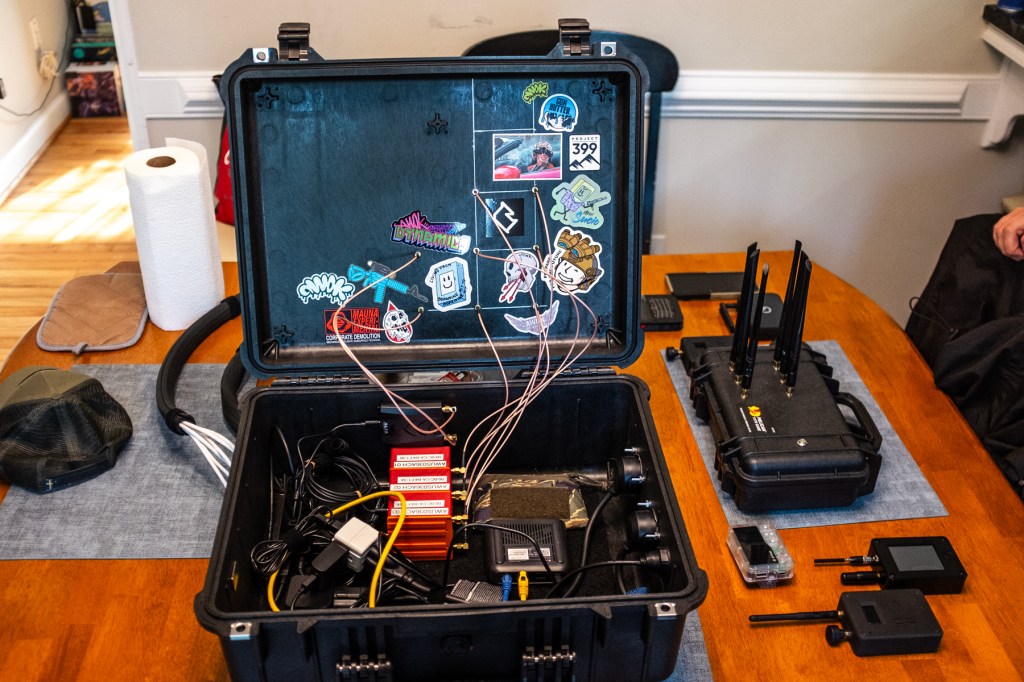
IN MID-AUGUST, I HOPPED IN A rental car and drove from New York to a suburb of DC in Northern Virginia, to meet Koko, a security consultant, entrepreneur, and dedicated wardriver who agreed to take me Flock hunting for a few days. Koko shows me into his house, where his two friendly cats climb all over a dining room table covered in hard-shell Pelican cases — think a boxy briefcase made of industrial plastic — crammed with electrical gear. One of Koko’s friends, another security researcher named Hedge, is along for the ride as well, tinkering with his own gear when we walk in.
Wardriving, they explain, is a relatively simple concept: you pack your car with all the signal-receiving gear you can get and drive around seeing what you catch. Basically every device with a battery or power cable these days is emitting some kind of signal, mostly WiFi or Bluetooth. An extremely simple “wardriving” session, then, would be just traveling along a route and logging the raw number of WiFi and Bluetooth signals you pick up: phones, cameras, computers, cars, et cetera. For some people, that’s the whole hobby — there are online leaderboards of wardrivers competing to put up the most numbers, games that they can play by “capturing” digital territory on real-world maps. Both Koko and Hedge have designed their own specific devices that are tuned to detect Flock cameras as well as other ALPRs and surveillance devices. Doing that is more complex: it requires reading the MAC address — a sort of digital serial number — for a device their gear detects and cross-referencing it with a known list of MAC addresses used by Flock cameras’ manufacturers. (This is in imperfect science. There is one brand of Bluetooth-enabled CPAP machine and certain electric toothbrushes known to have similar MAC addresses to Flock cameras, so sometimes you get false positives if you drive too close to the house of a heavy snorer.)
When you get this deep into the hobby, things get a bit more serious. The gear Koko and Hedge are packing – pocket-sized, 3D-printed boxes with tech inside that they call the Marauder and the Biscuit, respectively — can go beyond passive monitoring. They can spoof WiFi networks, clog up bandwidth, mimic AirTag signals, and all kinds of other mischief. At one point, to demonstrate, Hedge taps in a short command to the Biscuit – which is a 3D-printed mini-computer about the size of a hockey puck that pairs with your smartphone. There’s a brief pause, and then my phone goes haywire, inundated with Bluetooth signal spam — new Airpods connections, contact requests, an avalanche of popups that make my phone basically unusable until Hedge shuts it off.
“We mess with each other all the time,” Hedge laughs. “Usually when someone’s on the toilet, and we know they’ll be on their phone.”
Koko loves the pranks too, but is serious about what this tech can do. On the way back from DEFCON, a hacking conference he attended in early August, several attendees were pulled off a plane by armed air marshals after they set up a malicious WiFi network while on board their flight home.
“This stuff should be seen no differently than owning a firearm,” Koko says. “It all depends on the person wielding it.”
I take his word for it, seeing as he also has a Glock 19 holstered in the front of his waistband.
“So, anyway,” he says. “Want to go do some wardriving?”
Koko quickly dashes my dreams of watching black-clad hacker gangs scrambling sensors and hacking at Flock poles with skill-saws. That’s definitely going on, somewhere, but most wardrivers, like Koko, keep all their activities strictly above board (at one point, for instance, Koko refused to park in a handicapped spot even though the parking lot we were in was entirely deserted at 11 p.m.). We load up Koko’s truck, a four-door 2023 Toyota Tacoma: Koko gets in the drivers’ seat, clipping the Marauder to the windshield. A bigger version of the same tech sits in the back seat, hooked up to a clunky round antenna on the roof. Koko’s truck only has one bumper sticker, an image of a guillotine that says “MAKE CONSEQUENCES GREAT AGAIN.”
Our first stop is the “most controversial,” Koko says: the Lowes parking lot. There are three Flock cameras there and several other non-Flock police cameras. Activists suspect that Flock’s data has been used to plan immigration raids, which frequently target hardware store parking lots where migrant day-laborers often wait for work. We drive around the lot slowly, parking next to one of the cameras to take some photos and video. It’s late in the day, and our gear isn’t picking up the camera’s signature, even though we can see it right there. This is interesting to Koko — he has a theory that some of Flock’s solar-powered cameras shut down their WiFi and Bluetooth signaling after dark to save power, uploading data only through the cell networks, which are much harder to detect.
Stuff like this is all part of the puzzle. It’s what makes it fun for Koko and Hedge, who are in their early 30s. They both make their living primarily through selling the Marauder and Biscuit devices, which are currently selling out as fast as they can make them due to the new influx of privacy-conscious wardrivers. But the mysteries of Flock are also what piss them off: they know better than anyone the kind of data everyday people are giving up to the now-omnipresent cameras in their midst.
“Before, you had more control over the data you put out,” Hedge says. People enjoyed a reasonable amount of privacy in public; they could use cash for purchases and paper tickets for transit. The CCTV footage that did exist was, at best, lazily reviewed by a manager somewhere if and only if there was an incident. Now, he says, the cameras are always on, always taking data. “It’s hard to avoid going to the grocery store.”
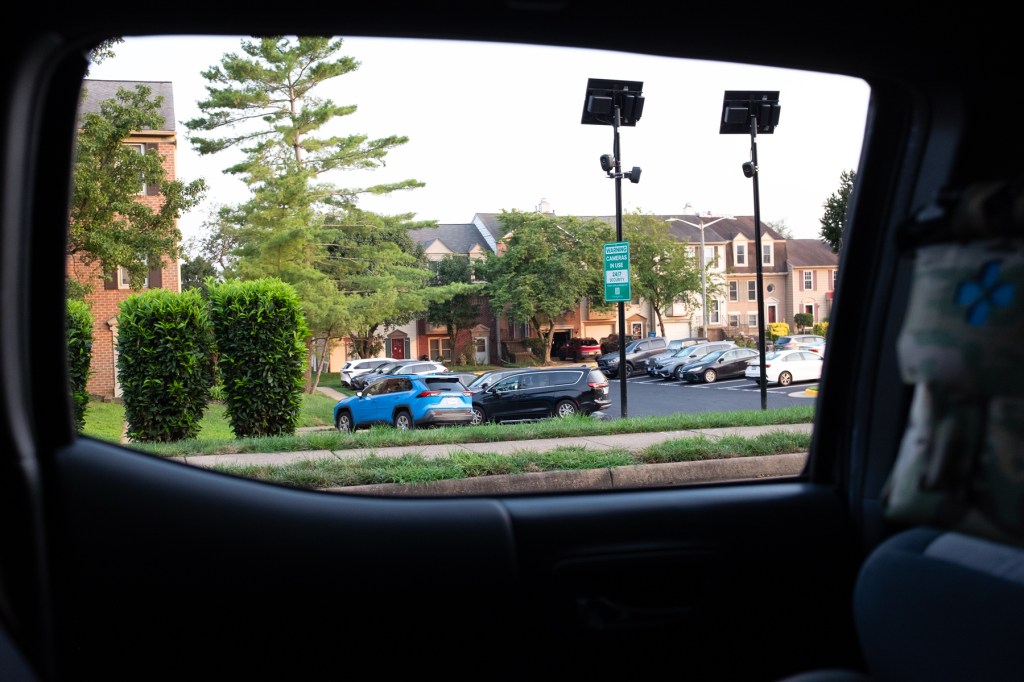
Koko and Hedge take me through a couple parking lots and a small condo development that has three new Flock cameras posted right at its entrance. Then we swing back by the house to grab some more gear. As night falls, Koko busts out a military ballistic helmet with a night vision scope attached — crucial for picking up Flock cameras’ infrared flash. We then head to a satellite campus of George Mason University, which the DeFlock map shows us is infested with Flock cameras. Koko wants to test another theory: Flock claims that their cameras are built to collect data from cars, not people, but he is pretty sure they’ll go off even if a person walks past. We do laps around the campus, recording the cameras going off as the truck drives by. Eventually, we find one pointed right at the sidewalk, and hop out. We wait for there to be no cars in sight, and then Koko and Hedge walk past. They make it about five yards past the camera, next to a row of electric scooters, before the IR flash goes off. We repeat the process with one person, then two. The camera snapped us all. Eventually, a campus security cruiser rolls past. We take that as our cue to leave.
IT’S ODD, STANDING IN FRONT of these cameras. I’ve been on TV plenty of times; as a journalist, I’m vaguely used to being treated as a quasi-public figure, albeit an extremely non-famous one. But it’s another thing entirely to stand in front of a lens that you know is recording you on behalf of a private company — not just to make sure you don’t swipe a candy bar at the self-checkout, but to keep a detailed record, if it can, of who you are and how you move about the world. Because we’ve already seen how much power that data conveys. Just last week, Wired reported that Flock had developed a new AI tool for tracking not just vehicles but their specific drivers, matching them with known “associates.” Flock did not dispute any of the capabilities Wired described. In July, 404 Media reported that police departments around the country were running Flock searches for physical descriptions of people, such as “person on skateboard,” or “woman wearing grey shirt, blond hair, black shorts.” Police have used Flock data to search a man’s car on suspicion of possessing marijuana after tracking him traveling between Michigan, where weed is legal, and Wisconsin, where it is not. Local, state, and federal law enforcement are all reportedly tracking social media users who have posted anti-Flock content. Flock’s CEO, Garret Langley, once called DeFlock, the camera-mapping website, a “terroristic organization whose primary motivation is chaos.”
“The fact that they don’t have to get a warrant for [running a search of Flock’s data] is really shocking to me,” Crocker, the EFF lawyer, says. “The law has a hard time keeping up.”
Flock, for its part, claims that its product is solving crimes and saving lives. That’s hard to refute. The technology is clearly powerful — in the right hands, in the right situation, there’s no doubt that an ever-vigilant surveillance net would stop horrific things from happening. Like a gun, it depends on who wields it. The argument against Flock, right now, is that a loophole in the American legal system has allowed a group of tech guys to invent a really, really big gun, which they have then loaned to the government with few restrictions and oversight. That’s not how this country is supposed to work, Koko thinks. He joined the Navy straight out of high school because he wanted to serve his country. He’s proud of that. The Navy taught him cryptography and signals intelligence and crammed years of computer science education into a few focused training units, skills he used on behalf of his country and still wants to use to help the people who live in it.
“I feel like the presence of these cameras kind of undermines the idea that people are entitled to that freedom and their privacy,” Koko says.
The day after the university hunt, we’re talking all this over back in Koko’s office. I notice a post on my phone: Flock Safety, announcing a new slate of privacy and accountability measures. Everyone crowds around Koko’s PC to pore over the statement, trying to puzzle out what the new “default retention period” for camera data means. Koko and Hedge aren’t impressed.
“I mean, this is too little too late,” Koko says.
We pile back in the truck. There’s another subdivision nearby with several cameras Koko and Hedge haven’t been able to pick up. They’re on the DeFlock map, and you can see them with your eyes, but they’re not showing up on the Marauder or Biscuit — perhaps some evidence that Flock is changing some of their tech, or has systems that the two researchers aren’t familiar with.
“I like the idea of understanding something that we’re not fully meant to understand,” Koko says.
On the way back, we drive through a quiet intersection with one camera, facing south, already on the map. As we pull up at the stop sign, I spot something else. “Wait,” I say. “Isn’t that another one?” There’s a second camera, pointing north, affixed to the side of a telephone pole. “Is that on DeFlock?” Hedge asks. We pull out our phones to check. It’s not. Hedge taps away, dropping a pin in the map, putting the new camera in the system, rotating the icon so it shows the exact angle the lens is facing. He zooms out, and the new camera becomes another dot, one of two at that intersection, of a dozen in that town, of hundreds in that part of the state. If you go outside right now and drive around, chances are, you might find one, too. It’s a small comfort, I think, to at least know where these cameras are, to be able to see them for yourself. After all, they’ve already seen you.