100 Unhinged Things Trump Did That You May Have Forgotten
Photo record
6 images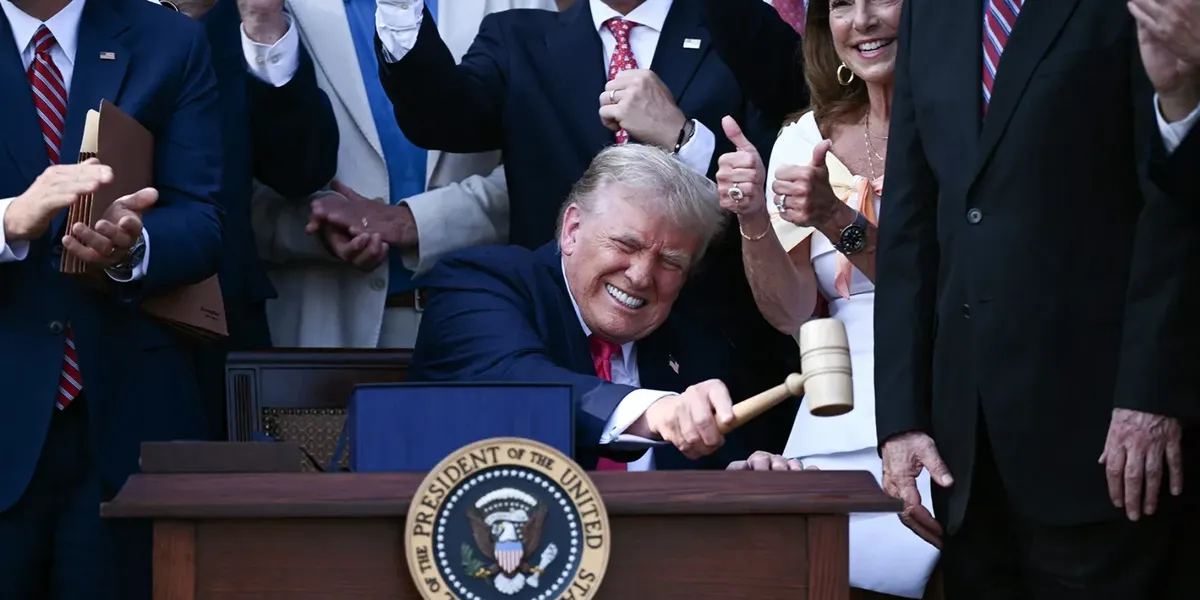

An open letter to independents about what Trump promised, what he delivered, and what you need to remember before you vote
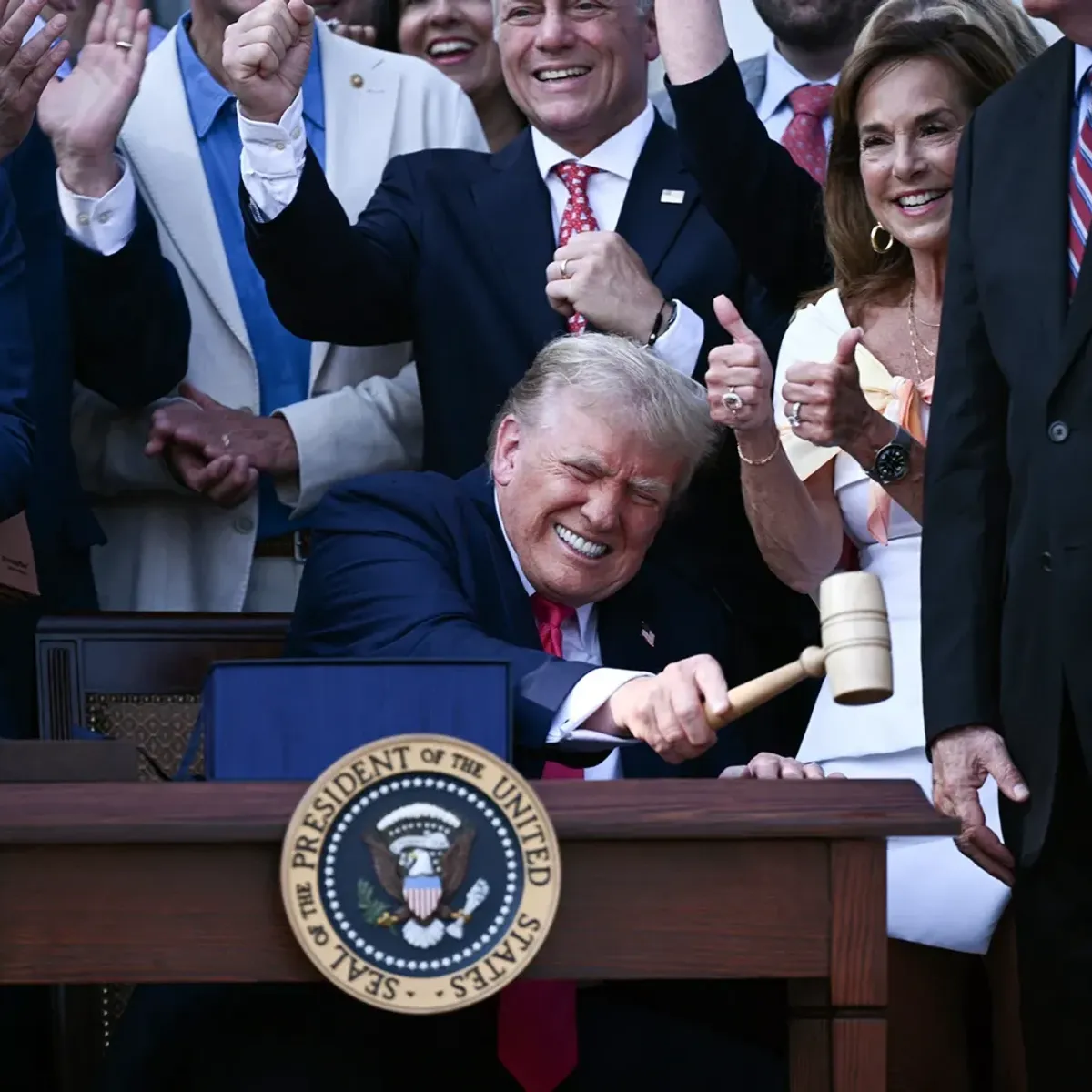
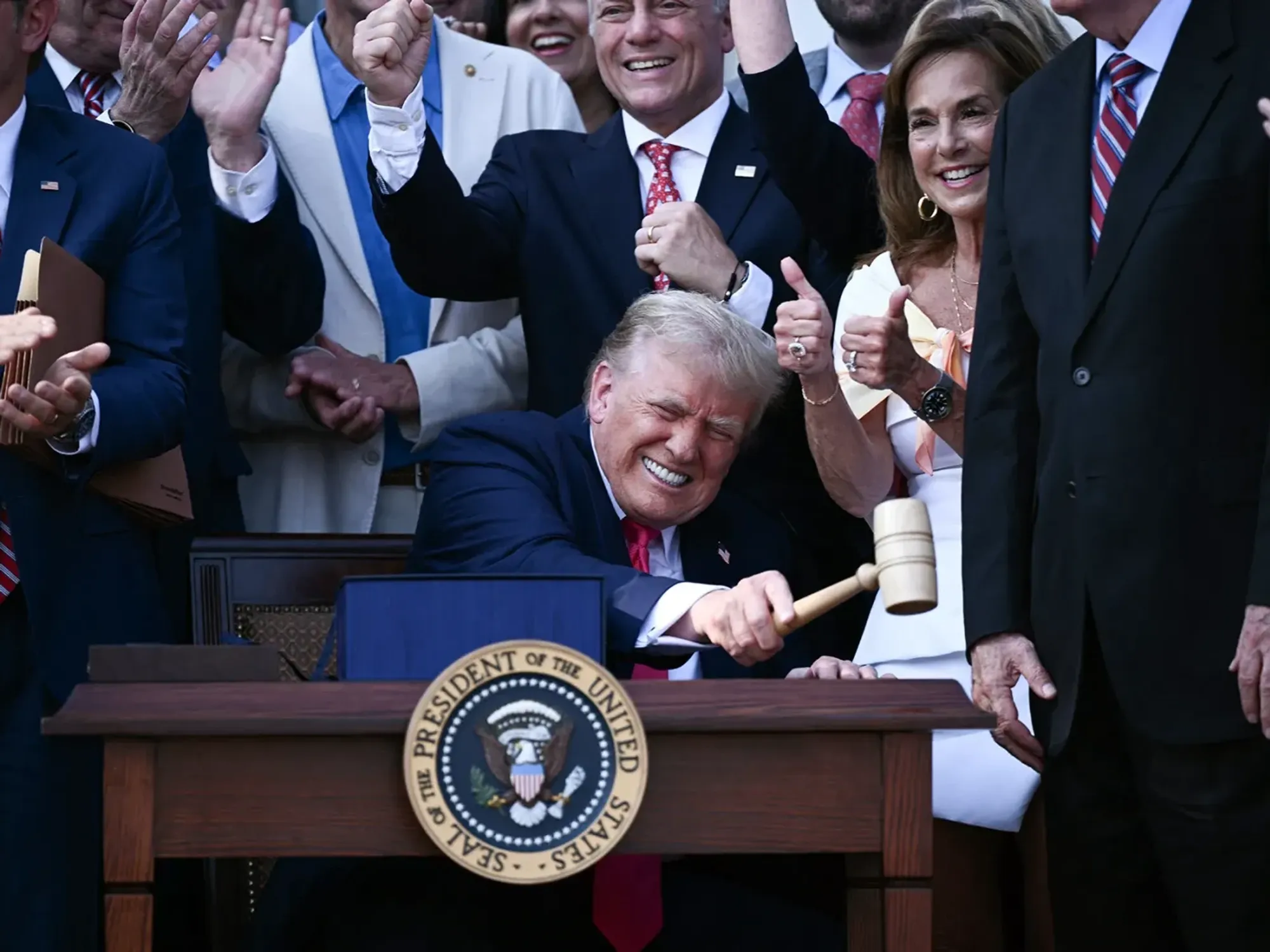
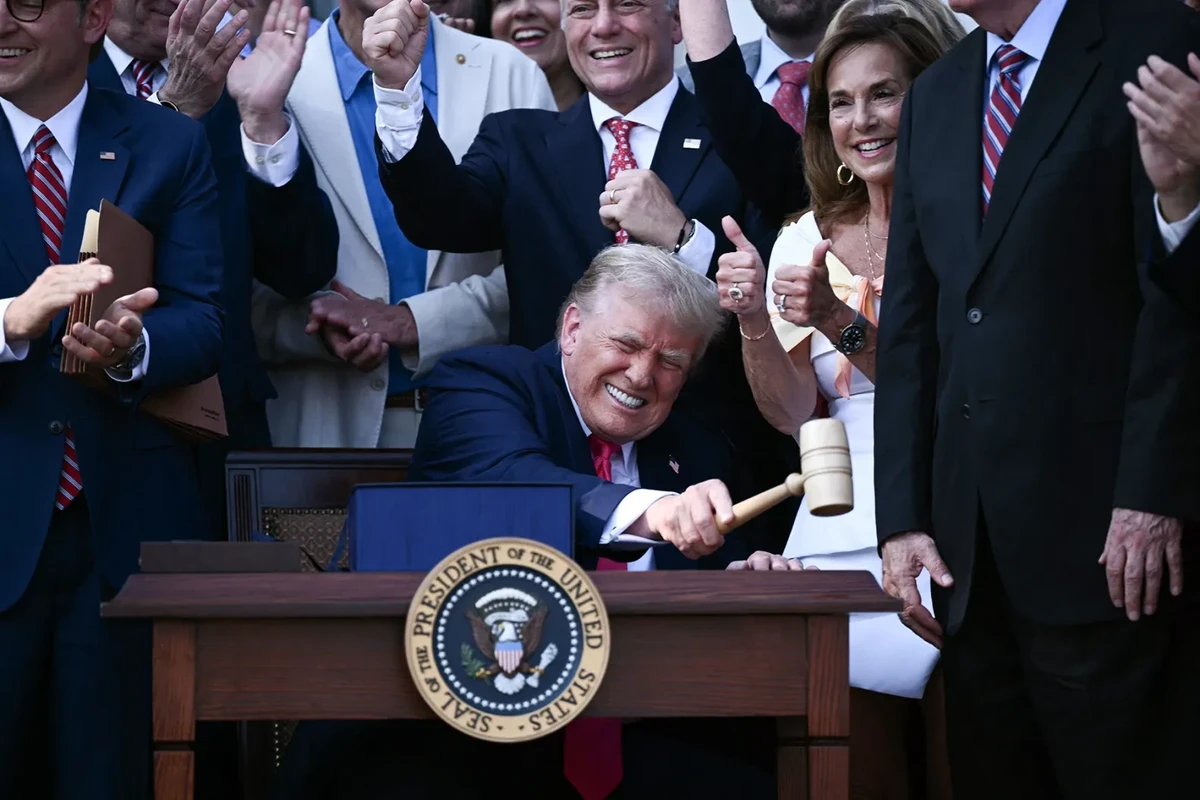
Donald Trump bangs a gavel after signing the "Big Beautiful Bill Act," on July 4, 2025.
“Flood the zone with shit.”
That’s how Steve Bannon once described Donald Trump‘s attention-overload strategy. It’s designed to overwhelm your senses, so the latest outrage erases your ability to remember the avalanche of outrages past. The “shit” part matters as well — because the goal is to make politics seem so dirty and indecent that no sane person would ever get involved in the political arena. This cedes the civic ground to hyper-partisan sociopaths.
That’s exactly why combating the memory hole is essential as voters head to the polls. The 2026 midterm elections are the only structural opportunity to put guardrails on this runaway train of a president who seems hell bent on destroying our democratic norms, dividing the American people, and alienating our allies while emboldening our enemies. The result is a tsunami of sleaze: unprecedented corruption, rising costs, and governmental chaos.
But the voters who most need to remember are the ones most likely to forget.
Independents are the largest block of American voters, and they decide who wins elections. They’re fed up with both parties and tend to be fiscally responsible, socially tolerant-to-libertarian, and strong on national security. This election, their number-one issue is affordability. They voted for Trump in 2024 but now his approval rating among independents is a pathetic, record-low 22 percent.
Here’s the catch: independents are also the voters least likely to pay attention to politics on a regular basis. That’s why they are so susceptible to the trap set by the Trump team: sliding from healthy skepticism into the corrosive cynicism that says all parties and politicians are equally corrupt. While no party has a monopoly on virtue or vice, Donald Trump’s reign is in a heated feces class by itself.
Below is a reminder of Trump’s second term low-lights. You’ve probably forgotten most of these amid the doomscroll of our daily lives. But the damage doesn’t disappear because our attention drifts. Share it with your independent friends and neighbors who may have quietly voted for Trump in 2024. It’s a timely reminder that Trump’s billionaire cabinet and his democracy-deforming presidency is an insult to their wallet, their health, their government, their safety, and their values.
Trump promised that “when I win, I will immediately bring prices down, starting on Day One.” He promised gas below $2 a gallon. But, of course, prices did not come down. Instead, Trump now calls the affordability crisis a “hoax.”
Gas now averages $4.28 a gallon, up 38 percent since his inauguration, and diesel is $6.28, up 69 percent. The main cause is the $47 billion war with Iran he launched without offering the American people a reason or an exit strategy, let alone getting congressional approval. So much for no new wars.
Trump’s tariff obsession is costing American households more than $1,000 a year. And Trump has inexplicably aimed some of his harshest tariffs at America’s closest democratic allies and trading partners, including the European Union and Canada.
Health care costs are also spiking because of Trump’s actions. After the longest government shutdown in American history, enhanced Affordable Care Act tax credits were allowed to expire in the Trump-Republican budget. As a result, in 2027, premium payments are expected to more than double, from $888 to $1,904 a year, and as many as 5 million people may drop coverage. The Congressional Budget Office projects that Trump’s budget will add roughly 10 million Americans to the uninsured over a decade.
Food aid for kids wasn’t spared in the GOP budget either. ProPublica found that more than 770,000 children in 12 states lost SNAP benefits.
But surely all these cuts will help get America’s debt and deficit under control, right? Wrong.
Trump’s “One Big Beautiful Bill” adds an estimated $3.4 trillion to deficits. For all the chaos unleashed by the DOGE cuts that threw career civil servants and programs into the “wood chipper,” less than $1.5 billion in savings have been verified and government spending actually increased. This year’s $2 trillion deficit is the highest ever outside a war or recession. The U.S. national debt just hit a record $40 trillion. Moody’s downgraded America’s credit rating from its top AAA grade. As Trump assaults the independence of the Federal Reserve, America is careening toward a fiscal cliff.
All this has happened while the Trump administration has taken ownership stakes in some 30 private companies, from 10 percent of Intel to 15 percent of rare-earth miner MP Materials, a “golden share” in U.S. Steel, and a stake in a magnet maker backed by Don Jr.’s venture capital firm. Conservatives used to call that socialism or crony capitalism. Now it’s business as usual in the GOP.
In 2024, many independent voters were swayed by independent candidate Robert F. Kennedy Jr.’s endorsement of Trump as part of the “Make America Healthy Again” movement.
But once in office, the Trump administration that promised to take on pesticides actually sided with the company that makes Roundup at the Supreme Court against cancer lawsuits and won. Yep, that happened.
On Day One, Trump withdrew the U.S. from the World Health Organization and the Paris Climate Accords, while banning any mention of climate change from U.S. government websites — because ignoring a problem always makes it better.
That’s not all: the Trump’s administration rolled back limits on “forever chemicals” in drinking water and on mercury and arsenic from power plants. It also eliminated the Environmental Protection Agency’s research office. You can’t make America healthy while making our water and air dirtier.
During his confirmation hearings, Kennedy promised the Senate that he was not an anti-vaxxer, despite boatloads of evidence to the contrary. But he turned around and fired the CDC’s vaccine advisory panel and replaced it with hand-picked successors. Then he fired the new CDC director after just 29 days. She testified that she was ousted for refusing to preapprove the new panel’s vaccine recommendations without reviewing the evidence.
Kennedy’s founding MAHA report seemed to have been written with AI, and cited studies that do not exist. He then canceled nearly $500 million in mRNA vaccine research. Meanwhile, measles has come roaring back under his watch. Once considered an eradicated disease, the U.S. has recorded more than 4,400 confirmed cases so far this year, nearly double last year’s total — with 96 percent of this year’s cases among people who were unvaccinated.
In his last inaugural address, Trump pledged to restore competence to the federal government.
That’s the punchline. The Trump administration has consistently chosen loyalty over expertise. In addition to an anti-vaxxer with no medical experience running the health department, we’ve got a self-styled Secretary of War who was a Fox News weekend host with no experience running a large organization who is now in charge of the world’s largest military. FBI Director Kash Patel is a conspiracy theorist who one senator credibly called the “least qualified and most partisan FBI director in our nation’s history.”
Personnel is policy and the pattern runs all the way down the ranks. At Homeland Security, the job of safeguarding elections went to Heather Honey, an activist whose faulty voter-data claims Trump cited in trying to overturn the 2020 results. The DHS terrorism-prevention hub went to Thomas Fugate, a 22-year-old Heritage Foundation intern a year out of college with no national security experience. FEMA put disaster response in the hands of Gregg Phillips, an election denier who claimed he had been teleported to a Waffle House 50 miles away. He was removed from the post only after months of embarrassing headlines. The White House hired “Stop the Steal” lawyer Kurt Olsen to reinvestigate the 2020 election, then ordered the nation’s spy agencies to share intelligence with him. Trump nominated Paul Ingrassia to run the office that protects federal whistleblowers until texts surfaced in which he admitted to “a Nazi streak.” When Republican senators sank the nomination, Trump simply moved him to the General Services Administration, where he is now acting general counsel overseeing more than 100 government lawyers. These are not “the very best people.”
The problem isn’t just incompetence, it’s corruption. On her first day in office, former Attorney General Pam Bondi disbanded the task force pursuing Russian oligarchs and told prosecutors to deprioritize foreign bribery cases. Five days later, Trump froze enforcement of the Foreign Corrupt Practices Act. By spring, the department slashed its Public Integrity Section, the unit created after Watergate to prosecute corrupt officials, and scrapped its crypto enforcement team.
This has unleashed a wave of corruption and presidential self-enrichment without precedent in U.S. history. His net worth has increased by billions this term, compounded by frenetic stock trading. The Trump family made at least $2.3 billion from crypto ventures while investors lost a combined $2.3 billion, in an industry his administration regulates. He pardoned the founder of Binance after a UAE fund used the family’s stablecoin to buy a $2 billion stake in that company.
Trump even tried to shake down $230 million in taxpayer dollars from his own Justice Department. The White House asked the Pentagon for a record $620 million loan to a company Donald Trump Jr.’s venture firm had invested in three months earlier. Despite that windfall, a Putin-allied oligarch helped pay for Trump Jr.’s wedding celebrations. The administration accepted a luxury 747 from Qatar, with ownership slated to pass to Trump’s library. All this makes the case of Trump’s border czar, who was recorded in an FBI sting accepting $50,000 in cash in a takeout bag, seem like a sin of small ambition.
As I’ve written before in Rolling Stone, presidential pardons are being sold. A nursing-home owner whose collapsed chain left grieving families with tens of millions in unpaid judgments spent more than $1 million on lobbyists and then received a full pardon. This month, The New York Times reported that a billionaire banker’s family hired Trump’s former lawyer Alina Habba under a contract worth more than $50 million. Trump pardoned him weeks after she started. The dizzying full list includes pardons of corrupt partisan cronies and several violent drug dealers.
The one promise Trump kept was “I will be your retribution.” The January 6 pardons were just the start. A Pulitzer Prize-winning Reuters analysis documented at least 470 targets of retribution in Trump’s first 10 months alone.
In his inaugural address, Trump said his success would be measured by the wars America ends and, most importantly, the ones it never gets into. But the president who petulantly demands a Nobel Peace Prize has ordered military strikes on at least seven countries in his second term, including Venezuela, Yemen, and Iran. He even threatened to seize Greenland from our ally Denmark at a NATO conference.
At the same time, Pete Hegseth is purging the U.S. military leadership with a political agenda, boasting to troops that he had fired 10 percent of the military’s generals and admirals, including the chairman of the Joint Chiefs and the top uniformed officers of the Army, Navy and Air Force. Five weeks into the war with Iran, he fired the Army’s chief of staff. Defenestrating decades of military expertise during a war does not make America safer.
While Trump bragged that he could end Russia’s war on Ukraine in a day, he has not only failed to deliver peace but seems intent on rewarding the aggressor. The United States shamefully voted with Russia and North Korea against a UN resolution condemning the Russian invasion. Then Trump and JD Vance berated Ukrainian President Volodymyr Zelensky in the Oval Office, and days later the administration paused all military aid. Putin got a blood red-carpet welcome in Alaska, while Trump keeps on insisting that it is “time for Ukraine to get a new president.”
While Russia has been struggling on the battlefront, this month Trump threw Putin a lifeline by listing sanctions on the sale of diesel which The Economist described as “scandalous” and “shameful for America,” explaining: “Putin terrorises his own people, kills Ukrainian civilians, and is helping Iran fight America. Mr Trump’s repeated acts of indulgence towards him, supposedly in pursuit of peace, undermine deterrence, hastening further crimes.” Six Republican senators, including Mitch McConnell, joined six Democrats in calling it “a gift to our adversary and a betrayal of our allies.” Trump responded by waiving every Russian provision of a new sanctions law named for the late Sen. Lindsey Graham, finding a way to betray an ally beyond the grave.
Trump’s team often sold his softness on Russia with a promise to be tough on China in return. But the long-promised toughness never arrived. He also announced that he would ignore the bipartisan law banning the CCP-controlled TikTok that the Supreme Court had unanimously upheld. Trump cut sanctions put in place to punish China for the flow of fentanyl into the U.S. and suspended Radio Free Asia, which for decades brought uncensored news to Chinese audiences. China has benefitted economically from Trump’s tariff wars with U.S. allies, and despite arguing that the AI race requires no guardrails on development as a way to block China’s advances, Trump let Nvidia and AMD sell advanced AI chips to China in exchange for a 15 percent cut of the revenue. The administration blocked Taiwan’s president from a New York stopover after Beijing objected and Trump called a pending $14 billion arms package for Taiwan “a very good negotiating chip.” And amid increasing cyber-attacks, especially from China, Trump has inexplicably cut America’s cyber-defenses when we need to be ramping them up.
At home, “law and order” has too often meant order without law. Trump sent National Guard troops into American cities, and the courts repeatedly blocked him. The government deported a Maryland man to a Salvadoran prison in violation of a court order, called it an “administrative error,” and then resisted a Supreme Court order to facilitate his return. In Minneapolis this January, federal agents shot and killed two U.S. citizens in 17 days: Renee Good, a mother of three, and Alex Pretti, an intensive-care nurse at the Minneapolis VA. When federal prosecutors in Minnesota began investigating the killings, Washington told them to stop and the Trump Justice Department cut off access to the evidence.
But perhaps the most dangerous violation of basic safety occurred on day one of this term, when Trump legitimized political violence by pardoning roughly 1,500 of his followers charged in the January 6 attack on the Capitol, including some convicted of assaulting police officers.
Character is the single most important quality in a president. But Trump’s contempt for the truth, evidenced in his singular impulse to lie all the time, has translated into a sustained assault on the basic values of our democracy.
Every patriot ought to flinch when confronted with the photos of a wrecking ball being taken to the East Wing of the White House. Trump did the demolition without the independent reviews, congressional approval and public comment required for even minor changes to historic buildings in Washington. He does not believe that rules apply to him.
But that was just the start: His administration gutted the U.S. Institute of Peace, fired its board and seized its building, bolting Trump’s name onto the facade while the legal fight was still underway. Trump purged the Kennedy Center board and his lackeys voted to rename it the “Trump-Kennedy Center,” attaching his name to a living memorial to a slain president. Blocked by the courts, now he is threatening to tear the Kennedy Center down.
The narcissistic impulse extends to Trump putting his face on our money as well. One-dollar coins bearing his likeness are now in circulation, and the Treasury has prepared a $250 bill with his portrait. Nearly every country that isn’t a monarchy declines to put its sitting leader on its money. The U.S. is in the ugly company of a rogue’s gallery of regimes including Marcos, Assad, Idi Amin, Saddam Hussein, Gaddafi, and Mobutu.
Speaking of ugly company, let’s talk about Trump’s longtime friend, Jeffrey Epstein. Trump promised to release the Epstein files as a candidate. But as president, he spent months fighting it. His team even summoned a Republican congresswoman to the White House Situation Room to pressure her to drop her support for releasing the files. The Trump Justice Department then withheld or redacted some 200,000 pages, which a federal judge found likely violated the law. Once Trump had the power to deliver the truth to the victims of a convicted child sex trafficker he used to pal around with, he tried to bury it.
That tracks with his promise to “bring back free speech to America.” Out of the gate, the White House barred the Associated Press from the Oval Office for refusing to say “Gulf of America.” It kept the ban in place after a federal judge called it unconstitutional retaliation. He has since tried to ban CNN, Politico, and MS NOW from the White House, while repeatedly suggesting negative coverage of him and his administration should be illegal.
At the Pentagon, Pete Hegseth demanded that reporters pledge not to publish even unclassified information without approval, and nearly the entire press corps, Fox News included, walked out rather than sign. In just one chapter of Trump’s war on media, hours after Trump’s hyper-partisan FCC chairman warned ABC that “we can do this the easy way or the hard way,” Jimmy Kimmel was briefly pulled off the air. Even Ted Cruz called it “dangerous as hell.” Trump sued The New York Times for $15 billion, and a Bush-appointed judge threw it out. He issued executive orders punishing law firms that had represented his opponents, and three federal judges struck them down as unconstitutional. The United States has now fallen to a record-low 64th in the World Press Freedom Index.
But perhaps the weirdest window into Trump’s twisted psyche comes in the form of the 80-year old’s unhinged late night social media revenge benders, where he posted 2,249 times in the first four months of this year. One night, he posted more than 160 times, including a post branding Sen. Mark Kelly, a Navy combat veteran and astronaut, a “traitor” who deserved death. His account also shared a video depicting Barack and Michelle Obama as apes. Amid a feud with Pope Leo, he posted AI images of himself as a Christ-like figure. Finally, after millions of Americans joined peaceful “No Kings” protests, he posted an AI video of himself in a crown, flying a jet labeled “King Trump” and dumping feces on the marchers.
If an aged family member behaved this way, you’d schedule an intervention. If a CEO did, the board would remove them. The presidency deserves to be held to at least the standard of conduct we expect in daily life, and patriots of every party should insist on it.
This is nowhere near a complete list of Trump’s assaults on American democracy. This election has provided a constant stream of insults to the integrity of the office, from Trump’s call for red states to do a mid-decade redistricting so Republicans could hold onto Congress, to his endorsement of buffoonishly corrupt Texas AG Ken Paxton over conservative incumbent Jon Cornyn, to using $22 million taxpayer dollars for campaign ads, to his absurdly propagandistic videos at rallies about how “God Made Trump,” to ogling “asses” on the campaign trail to his latest gambit of offering a bribe of $5,000 for each vote — are all just signs of how deep the rot has gotten a decade into the Trump era. This year’s midterms are the only chance we have to restore some basic guardrails on this unhinged president and redeem our country’s once-respected leadership in the free world. The question for independent voters is whether you will now hold Trump to the same standard you’d apply to any other president, regardless of party. You don’t have to join a team. You just have to remember the damage Trump has done over the past two years back in office and vote. Don’t let the memory hole win.
Donald Trump looks to an image of Michigan Democratic Senate candidate Abdul El-Sayed during a campaign rally on Sunday, Oct. 25, 2026, in Port Huron, Mich.
In 2010, a splinter group of far-right Republicans known as the Tea Party summoned a red wave of Republican voters in Barack Obama’s first midterm elections, capitalizing on the remnants of the global financial crisis and troop surges in Afghanistan to help the GOP win 63 seats in Congress. The Tea Party wanted to be known as fiscal conservatives, but their darkest power was abject, open fury that the United States had dared to elect a Black man as president.
But 2010 was not, somehow, the most racist election in recent memory. It’s the 2026 midterms, thanks to the invective spewed by the man in the White House and the worst dregs of his movement around the country. With a war in Iran, skyrocketing gas prices, rampant inflation, and a burgeoning housing crisis, the GOP has no claim to fiscal conservatism this election cycle. Instead, all they have is race.
“There’s five hundred million Arabs in the world,” Health and Human Services Secretary Robert F. Kennedy Jr. said recently. “And yet they don’t produce science. They don’t win the Nobel Prize. They don’t win the Fields Prize. They don’t win the Wolf Prize. They don’t produce literature.”
RFK was making a barely veiled reference to the primary target of Republican racism this cycle: Michigan Senate candidate Abdul El-Sayed. El-Sayed is a muslim, and is sufficiently left wing so as to invite the ire of basically every faction of American politics, including centrist Democrats, centrist Republicans, and the far right, who have taken up the cause of cutting him down with particular zeal. Trump has joined in:
“If Abdul and the Democrats win, they will open the floodgates and invite hordes of jihadis to our shores, creating a nightmare of violence and terror until you cannot even have a Christmas,” Trump said at a rally in Port Huron on Sunday.
Trump has repeatedly issued some of the worst attacks against El-Sayed, repeating the claim that he is a member of the Muslim Brotherhood and calling him a “jihadist.” He has also gleefully mocked El-Sayed’s name at multiple campaign stops, and said over the weekend that he would “be the only senator that has to go through a metal detector before he is allowed to go in the Senate,” the implication, of course, being that he is a potential terrorist.
Vice President JD Vance, not one to be out-done, accused El-Sayed of “anti-white” racism, a familiar line of attack by members of the far right looking to mobilize economically disadvantaged white voters.
“Abdul El-Sayed, who maybe more than any Democrat running in the nation has engaged in the kind of explicitly anti-white racial hatred that has become common in the Democratic Party,” Vance said at a rally in Michigan on Tuesday. “I’d say that person should not be elected.”
The attacks on El-Sayed are shocking and crude, but they didn’t spring out of a vacuum. Racist dogwhistles — and more explicit attacks — have been common fodder for the GOP for decades, from Ronald Reagan’s popularization of the term “welfare queen” — a veiled attack on impoverished Black Americans — to Trump’s support of the Barack Obama birth certificate conspiracies. Some of Trump’s earliest political breakthroughs came on the back of demonizing Latin American immigrants and painting undocumented migrants as a boogeyman threatening the livelihoods of “real” Americans.
All these threads have come together in the second Trump administration, with the persecution of Haitian immigrants who were stripped of their Temporary Protected Status by the Department of Homeland Security, a campaign of terror across the heartland committed by Immigration and Customs Enforcement agents, repeated denigration of African countries in public speeches, and constant racist dogwhistles in official government communications. The Trump administration has raided the home of a sitting congresswoman, Somali-American Representative Ilhan Omar, reportedly as part of an investigation aiming to strip her of her citizenship. Trump has repeatedly suggested Omar should be deported, while making fun of her head coverings.
Trump’s racism has spread throughout the GOP, emboldening the most fringe candidates to take positions so blatantly bigoted that some squeamish members of their party are cringing. In Texas, Railroad Commissioner candidate Bo French recently doubled down on a racist post he made remarking on the number of Indian-American students at a recent University of Texas football game. Republican megadonor Elon Musk, a white South African born and raised under apartheid, has spent entire months this year posting incessantly about race, repeatedly returning to racist tropes to attack Democratic candidates as he pours money into attack ads in several states.
This kind of animus is the sign of a desperate party — one whose own consultants are already admitting might be “fucked.” The idea they’re selling to American voters is simple: Hate your neighbor, based not on what they say or do, but because of who they are. The problem is, most of their enemies are just as American as their marks, and no amount of rhetoric can cover up the fact that they’re here to stay.
President Donald Trump watches NIcki Minaj speak at a rally in Port Huron, Michigan.
With the midterm elections just over a week away, and with polls indicating the increasing likelihood of steep Republican losses in Congress, President Donald Trump took to the campaign trail to deliver a new message sure to assuage concerns about a war abroad and a brutal economy at home: Get a load of Nicki Minaj’s butt.
Minaj appeared alongside Trump at a rally in Port Huron, Michigan, on Sunday, ostensibly to gin up support for Republican Senate and gubernatorial candidates Mike Rogers and John James, respectively. But at one point during his speech, Trump hit upon a topic that’s been on his mind a lot lately: the human posterior. Because apparently much like Al Pacino in Heat, when the president of the Untied States starts to think of asses, something just comes out of him.
Funnily enough, Trump wandered into his comments about Minaj by way of recounting the recent rave review he bestowed upon the ass of Ohio Senate candidate Jon Husted. At the Michigan rally, Trump insisted he made the comment “in fun,” joking, “I’ve never done that with a man before. It’s true. Off the record, women: Yes. Men, no, OK?”
Then, to be sure the crowd really knew where he stood, Trump said, “By the way, I looked at one hell of a beautiful ass before: Nicki Minaj! That’s hard to miss!”
As for Minaj, she was one of the final speakers at the Port Huron rally. She offered a few words in support of Rogers and James, and even led two absolutely exhilarating chants of, “When I say ‘Mike,’ you say ‘Rogers,’” and, “When I say ‘John,’ you say, ‘James.’” But, of course, most of her praise was for the man not on the ballot in Michigan. Minaj, who’s become MAGA’s favorite celebrity to tote since Kid Rock, told Trump “it is an honor to stand with you” and “if you run again, I will support you again.”
Along with her appearance at the Port Huron rally, Minaj also go to be the lucky recipient of a tour of Air Force One courtesy of Steven Cheung, the White House director of communications. Looking to spin out a few more headlines out of this celebrity appearance, Cheung even joked on social media that Minaj could be the next White House press secretary, which obviously isn’t happening, but you also wouldn’t be surprised either.
Alberta Premier Danielle Smith
Alberta voters rejected a move toward independence from Canada on October 19, but the province’s referendum also tested support for a broader political agenda built around immigration restrictions, provincial autonomy and frustration with Ottawa.
With roughly 76% of counted votes favouring remaining in Canada, the result is a huge blow to separatists seeking to advance the independence process. It was Alberta’s first referendum on separation, making them the only province to have done so aside from Québec, which held sovereignty referendums in 1980 and 1995. Both those votes resulted in the province remaining in Canada, although the 1995 result was decided by an incredibly narrow margin.
Supporters for Alberta's separation argue that the province’s oil and gas wealth contributes disproportionately to the Canadian economy, while federal energy and environmental policies constrain its development. Some also contend that federal bureaucracy limits Alberta’s ability to manage its own affairs.
Premier Danielle Smith, who called the referendum in May, has argued that Alberta should remain in Canada while gaining greater control over provincial affairs. The vote also included nine other non-binding questions on immigration, public services and constitutional reform.
Early results showed support for eight of those nine proposals, although several constitutional questions were closely contested.
The strongest support was for requiring proof of Canadian citizenship to vote in provincial elections. According to unofficial results reported by The Canadian Wire, the proposal received 63.2% support. Measures to increase provincial control over immigration and restrict eligibility for publicly funded services according to immigration status also led, with 55.7% and 56.5% support, respectively.
Two other immigration-related proposals, requiring temporary residents to live in Alberta for 12 months before qualifying for certain social supports and allowing fees for their families’ use of health care and education, received 58.4% and 57.1% support.
The constitutional proposals, meanwhile, produced narrower results. A measure to give provincial governments control over appointments to superior and appeal courts led with 51.2% support, while abolishing the Senate received 53.2%. A proposal to give provincial laws priority over conflicting federal laws in areas of provincial or shared jurisdiction had 50.6% support.
The only additional question trailing on the Yes side concerned allowing provinces to opt out of certain federal programs, including those involving health care and education, without losing associated federal funding. It received 48.6% support against 51.4% opposition in the early count.
Premier Smith is expected to make a speech tonight, October 20, around 6:30 PM, local time. This morning, Canadian Prime minister Mark Carney took to social media to celebrate Albertans voting to remain Canadian. ''Over the past 18 months, our governments have worked together to deliver on what matters most to Albertans,'' he declared. ''Now, we have an opportunity to build on that progress.Albertans have chosen Canada, and we’re moving forward together with renewed purpose and high ambition — to build a stronger future for all.''
Volodymyr Zelensky and Donald Trump on the sidelines of the 81st United Nations General Assembly in New York, on Sept. 22, 2026.
Most Americans continue to support Ukraine in its war against Russia. But under President Donald Trump, their government is now on Russia’s side.
The relationship between Washington and Kyiv has been in crisis since Trump returned to power last year. The White House increasingly blames Ukrainian President Volodymyr Zelensky, rather than Russian President Vladimir Putin, for the war’s continuation.
“Zelensky is not a good guy for us to deal with,” the president said in a TV interview on Friday. “I’m not a big fan of Zelensky. They’ve destroyed that country.”
Even as Trump blamed Zelensky, Russia was launching hundreds of missiles and drones targeting Kyiv.
The crisis has deepened over the past two weeks as Trump has taken a flurry of steps to undermine Ukraine and assist Moscow, beginning with a proposal to let Russia sell diesel fuel to the U.S. and culminating in Friday’s decision to effectively waive portions of the so-called “Graham Bill.”
The bill, named after recently deceased Russia hawk Sen. Lindsey Graham, is a recently enacted law that would have tightened economic pressure on Russia.
“The decision to undo all of this, to block all of it, seems wrong to me. And it definitely helps only the Russians,” Zelensky told reporters in Kyiv on Saturday. “It only fuels their satisfaction and their desire to keep killing people. This certainly does not stop the war.”
Ahead of the announcement, the administration worked throughout the week with tech billionaire Elon Musk to throttle access to the military version of Starlink. The space-based internet system has become a critical lifeline for Ukrainian defenders — although both the White House and Musk have denied responsibility for deciding to limit usage.
Multiple officials describe hours of heated phone calls between Americans and their Ukrainian counterparts, after the White House ordered its people to ramp up pressure on Kyiv and deliver an ultimatum that the U.S. would cut off intelligence unless Ukraine stopped attacking Russian oil refineries.
Trump has been courting Moscow with energy deals and eased sanctions to try to deliver lower fuel prices — which have spiked due to disruptions from the U.S.-Israeli war with Iran — ahead of midterm elections. He is trying to recast the fallout not only from the Iran quagmire, but also his failure to end Russia’s war in Ukraine, as someone else’s fault.
Once again, Trump has made Zelensky the scapegoat, blaming him for high diesel prices.
“Zelenskyy is using Diesel Refineries in Russia as a target, knowing that these attacks are seriously hurting the world diesel markets, including those in the United States,” Trump wrote on social media on Sunday, adding “he doesn’t want to end this war, and probably never did.
The world has gone through the looking glass since the first time I met Zelensky in Mariupol, less than two months after his election in 2019. The man once derided for his willingness to make peace is now condemned for refusing to surrender. In Washington, the victim has become the aggressor, the adversary has become the friend.
Zelensky was visiting the bustling industrial port to attend the Fifth Annual Liberation Day Parade, an event held by the Azov Regiment. The far-right volunteer unit had played a central role in retaking the city from pro-Russian separatists in 2014. Five years later, Azov had become a bugbear, a central pillar in the Kremlin’s propaganda about “neo-Nazi” Ukraine and a staple of Western media coverage — despite the combined far-right never pulling more than three percent of the vote in any Ukrainian election.
Zelensky campaigned on ending the simmering war in Donbas by speaking directly to Moscow — and that led many to fear he would give up land to secure peace. There was so much anger about it that there were already rumors of a coup plot by right-wing nationalists only 60 days into his term.
It seemed the “comedian-turned-politician” — as he was invariably dismissed in international media — was in over his head. But I had seen Servant of the People, the popular TV series in which he played a schoolteacher who becomes president due to a viral video rant about endemic corruption. This is no mere satire, I thought. It is a political manifesto packaged as mass entertainment.
And so it proved. Zelensky and his cohorts built a political base via sitcom. His party was named after the show, and the last episode aired three days before the start of the election that would bring him the presidency.
Zelensky was hardly the first to parlay a television personality into a political career. After all, back in the United States, Trump had built his candidacy largely on the popularity of his fictitious portrayal of a successful business tycoon in a reality TV show.
So on June 15, 2019, there was Zelensky in Mariupol, celebrating Azov’s triumph while keeping the regiment itself at arm’s length. Zelensky was trying to show he wasn’t afraid of the far-right — and he wouldn’t let it claim a monopoly on patriotism.
I watched Zelensky work the crowd at a concert. “Mariupol is a Ukrainian city forever,” he told the audience, to wild cheers. Few Americans at the time really cared about Ukraine’s new president. They weren’t watching what was happening between Moscow and Kyiv.
Within three summers Russia invaded, and that vibrant city by the sea was left in ruins, surrounded by mass graves.
Zelensky became the face of dogged resistance, rallying his nation in its desperate hour. He’s now in the seventh year of a five-year term, with elections prohibited while the country is under martial law.
The far-right threat proved stronger in America, where a cadre of reactionary extremists have taken power. They, too, want to oust Zelensky. The transgression they charge him with isn’t his willingness to sell out his country; it’s his unwillingness to give it up. It’s Putin who wants peace, Trump and his cohorts say. Zelensky is the war-mongering dictator.
Through the looking glass, indeed.
There was a time after that first disastrous Oval Office showdown, where Trump’s venal arrogance was on full display, when people thought the relationship between Washington and Kyiv could be salvaged. But Trump has yet to make any substantial moves to pressure Russia.
Trump’s overriding of the Graham bill shows exactly how unrestrained he feels in mollycoddling Putin — the bill passed with 86 votes in favor in the Senate, a display of bipartisan resolve that was for nought.
Republicans in Congress keep explaining away Trump’s words and actions. But the excuses never change the result. Trump’s actions might be defensible if they actually set the belligerents on a path to peace. But there’s no reason to think they will.
That’s because Trump and his MAGA mouthpieces are delusional. To anyone who knows Ukraine — to anyone who is honest about Russia — listening to the American president pontificate about the war is like attending the Mad Tea Party in Wonderland.
Trump, Hatter-in-Chief, presides over chaos with ever-changing rules, one minute spouting nonsense about the war having started because he lost a “rigged election,” and the next barking riddles about Crimea having “four sides of ocean.”
All the usual suspects echo the same ignorant talking points and hone in on the same culprit. Musk says “Zelensky has gone too far.” Former Trump adviser Michael Flynn, who nearly went to prison for lying about his meetings with Russians during Trump’s first campaign, says once Zelensky is gone, “this war will end and people of that region of the world can start rebuilding their lives.”
Trump and his allies behave as if this war is just a matter of personalities and deals. But the war in Ukraine is not a real-estate transaction. It’s not even about geopolitics — NATO expansion or spheres of influence — as so many seem to believe.
This war isn’t about empires, it’s about national identity.
That’s where Trump — and Putin — go wrong. Zelensky is a figurehead. Even if you get rid of him, Ukraine will keep fighting. Even if Kyiv were to fall, and Russia magically occupied the entire country, Ukrainians would resist.
Russian imperialists have been trying to destroy the idea of Ukraine for generations. Joseph Stalin, one of the bloodiest dictators in human history, starved millions of Ukrainians to death; he purged, executed, and deported tens of thousands in part to eradicate their national identity. He couldn’t do it. The tsars before him couldn’t do it, either.
This isn’t some mysterious, unique human experience. The English could never stamp out Irish nationhood in hundreds of years of occupation; Imperial Japan couldn’t stamp out the Koreans; neither the Israelis nor the Palestinians will eradicate the other nation, despite all their efforts.
Resistance to Russia is central to the very idea of Ukrainian statehood. So long as Russia is intent on destroying Ukraine as a nation, the war will go on. Peace doesn’t require Zelensky’s acceptance of Russia’s territorial demands. It requires Putin’s acceptance of Ukraine as a nation. Americans deserve a government that has figured this out and acts accordingly.
Alice found her way out of Wonderland by waking up. It’s high time America and its political leaders do the same.
Donald Trump dances as he leaves the stage after speaking during a campaign rally at the Freeman Coliseum on Oct. 7, 2026 in San Antonio, Texas.
The general theory of economics is a simple one: some numbers you want to go up, other numbers you want to go down. A businessman like Donald Trump knows this — but unfortunately, during his second term, many of the wrong kinds of numbers have been going up, up, up.
Case in point: a new Consumer Price Index report issued today by the Department of Labor showed that prices and inflation are up in September, and are significantly higher than they were last year. In September alone, prices rose 0.6 percent, the highest monthly increase in several months, showing that the damage caused by Trump’s economic policies is only increasing. Those prices are, overall, 3.7 percent higher than they were last year.
Even single-digit percentage changes have big impacts on Americans’ lives, especially when some of the most vital stuff we buy has been hit the hardest. Gas prices alone rose 9.1 percent in September, accounting for almost half of the overall price increase. Fuel oil, what most people use to heat their houses, also shot up 15.3 percent. That’s the biggest increase since March, shortly after the beginning of the Iran war, which is still very much unresolved.
“Oil right now is much cheaper than it was under sleepy Joe Biden,” Trump said recently. This is technically true for at least one point in time — the price of a barrel of crude briefly spiked to almost $140 in 2022 when Russia invaded Ukraine — but fails to note that even after that world-historic event, prices for consumers largely stabilized. Gas, for instance, leveled out around $3.20 per gallon by the end of 2022, and stayed there till Trump took office. The national average today is $4.33.
It doesn’t seem like the Trump administration has any plan to deal with this, either. “TRUST IN TRUMP,” the White House posted back in June. “Just sit back and relax, it will all work out well in the end — It always does!” Since then, Trump has escalated in Iran and rambled incoherently on the stump while hosting rallies for midterms candidates. He’s asked for strike packages to hit Iran again before the election, if needed. Got a problem with that? “Trust the process,” the White House posted yesterday.
American voters aren’t this stupid, even if Trump thinks they are. With his approval rating in the dirt and even his own party turning against him, it’s clear that people recognize that Trump’s choices — namely, invading Iran and setting up ludicrous tariffs — are what created the economic situation we’re currently dealing with. And the final indignity is that wages simply aren’t catching up. The New York Times notes that hourly wages fell by 0.5 percent in August and are down 0.7 percent in the past year, putting them right around the level they were when Trump first took office. Your pay has not gone up, but the prices have.
The only financial fix to any of this is for the Federal Reserve to raise interest rates again, which analysts think will be discussed at the end of October — just in time for the midterms. The idea to raise those rates is to stop people buying stuff, hopefully stopping some inflation. This doesn’t mean life gets easier, of course, it just means taking on a loan gets more expensive. The numbers we like go down, the numbers we don’t like go up. So goes the economic world in Trump’s second term, with no end to the trend in sight.